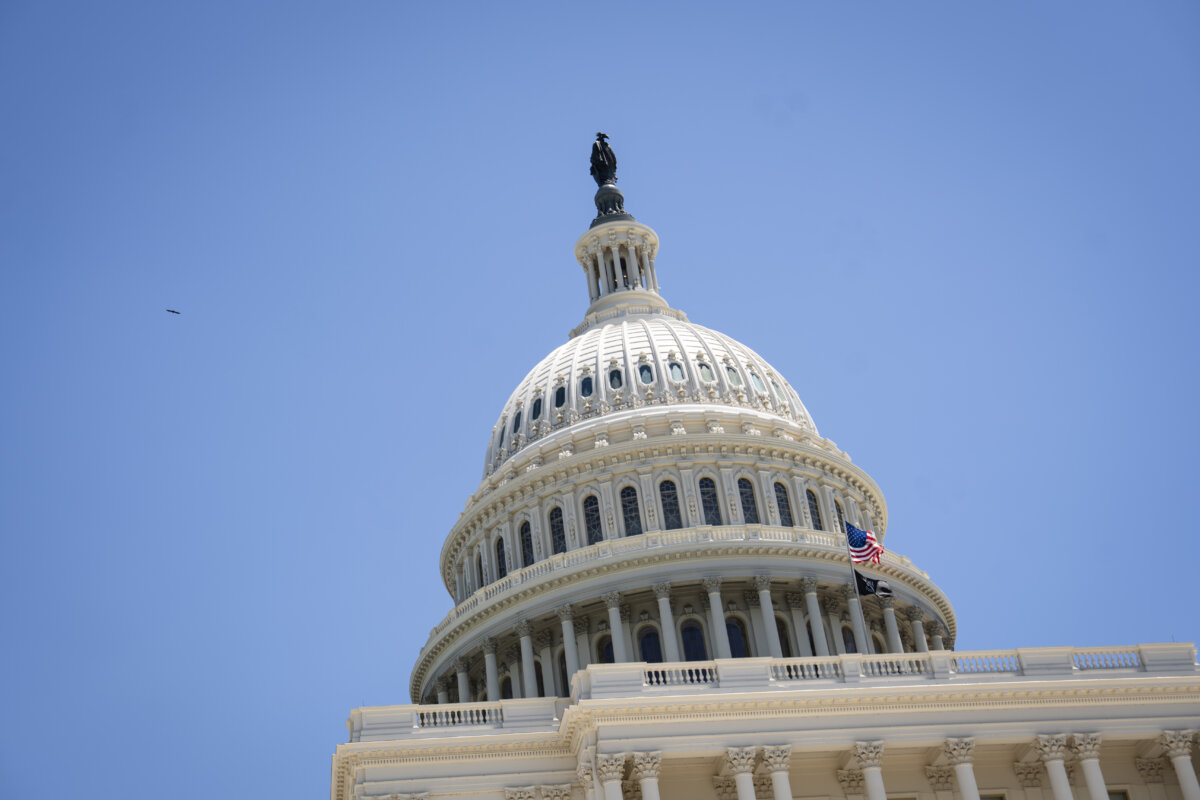

The U.S. House will take up legislation this week to provide around $70 billion in funding to Immigration and Customs Enforcement (ICE) and other immigration enforcement, coming as splits among moderate Republicans about a so-called “weaponization fund” leave a question mark over the final outcome of the vote.
The funding measure—which funds immigration enforcement until the end of Trump’s term in 2029—passed the Senate after an extended voting process.
In an early morning vote on June 5, the Senate approved the measure 52–47. All Republicans voted for the measure, and all Democrats except for Sen. Michael Bennet (D-Colo.), who did not vote, voted against it, setting it up for a vote in the House.
The funding legislation is being fast-tracked under the partisan reconciliation process in order to fully close the Department of Homeland Security (DHS) funding gap following the start of a partial government shutdown in mid-February amid continued Democratic opposition to funding for portions of the executive department.
The administration’s previously announced plans to create a proposed $1.8 billion compensation fund for individuals alleging harm caused by the federal government were a central issue in the debate and vote series leading to the Senate’s passage of the measure.
This “weaponization fund” prompted controversy on Capitol Hill and beyond, with several moderate Republicans demanding an outright legal prohibition on such a use of taxpayer funds.
After progress on the legislation stalled amid Senate Republicans’ opposition to the fund, Attorney General Todd Blanche announced that the administration would end the program on June 2, a move that helped break internal Republican divisions.
“We’re not moving forward with the fund, period,” Blanche said.
Originally, House Majority Leader Steve Scalise (R-La.) told reporters that the House had hoped to quickly move to a vote on a rule last week following the Senate’s passage of the measure.
However, no such vote was held, potentially foreshadowing difficulties the bill could face in the lower chamber.
House Speaker Mike Johnson (R-La.) can spare no more than two defections with his current majority—meaning every vote counts in party-line votes like this one. Lawmakers in purple New York, California, and Pennsylvania districts are particularly vulnerable.
But some moderate Republican House lawmakers also have concerns about the weaponization fund, opposition that could easily tank the measure in the lower chamber.
One of the leading opponents of the fund has been Rep. Brian Fitzpatrick (R-Pa.), a long-serving moderate member, who has led Republican opposition to the fund in the House.
Fitzpatrick, with Rep. Tom Suozzi (D-N.Y.), introduced legislation—the Bipartisan Transparency for American Taxpayers Act—that would legally block any federal funds from being used to pay claims out of the account, calling it a “dangerous backsliding in transparency.”
Rep. Don Bacon (R-Neb.), the retiring lawmaker from Nebraska’s “blue dot” district, has also been critical of the measure.
Senate Republicans’ updated legislative text also formally removes $1 billion in funding tied to Trump’s ballroom project and White House security updates.
The compensation fund had sparked strong bipartisan opposition; several Republican senators previously signaled that they would not support the legislation while the proposal remained under consideration.
Despite the administration’s decision to drop the compensation fund, some Republican senators continue to express concerns about the Justice Department’s proposed Anti-Weaponization Fund. Several Republican senators backed amendments to permanently eliminate the program, distrusting Blanche’s assurances that the administration no longer intends to pursue it.
During the Senate vote-a-rama on the legislation, GOP senators batted down several amendments seeking to ban the fund.
An amendment by Senate Minority Leader Chuck Schumer (D-N.Y.) to block the anti-weaponization fund failed in a 49–50 vote.
An amendment offered by Sen. Thom Tillis (R-N.C.) that would have reallocated the use of taxpayer funds for an anti-weaponization fund for fraud enforcement was also rejected, 15–84.
Tillis had said he was introducing the amendment to ensure that the fund cannot be revived in the future.
“I think even DOJ knows that this was a bad idea, and what we need to do is provide finality,” Tillis said. “They’ve said that they’ve quiesced the program, then why can’t we just take the step of statutorily eliminating the question, so that a future decision to reopen it is eliminated?”
—Joseph Lord, Jackson Richman, Nathan Worcester
BOOKMARKS
The Israel Defense Forces (IDF) has accused Iran of launching missiles at the country for the first time since the ceasefire between the United States and Iran, The Epoch Times’ Jacki Thrapp and TJ Muscaro reported. “Sirens were sounded in several areas across the country following the identification of missiles launched from Iran toward Israel,” the IDF wrote in a post on X.
A tiny insect is causing extreme issues for Florida’s citrus farmers—and they’re beginning to fight back, The Epoch Times’ Jacob Burg reported. In spite of challenges, the Sunshine State’s citrus farmers are holding on after a 95 percent industry decline in the past 30 years.
Jessica Cox has spent a lifetime proving that the ability to soar above the clouds has nothing to do with having arms, The Epoch Times’ Allan Stein reported. For Cox, born without arms, the word “can’t” has never been part of her mindset. Instead, her response has always been simply: “Watch me.”
The nation’s largest pharmaceutical company and biggest hospitals are headed for a showdown over federally mandated drug discounts, The Epoch Times’ Lawrence Wilson reported. June 8 is the deadline set by Eli Lilly for hospitals to provide claims data, excluding personal information, to demonstrate they are not double-dipping on federal discounts and rebates.
 Friends Read Free
Copy
Facebook
Tweet
Friends Read Free
Copy
Facebook
Tweet