



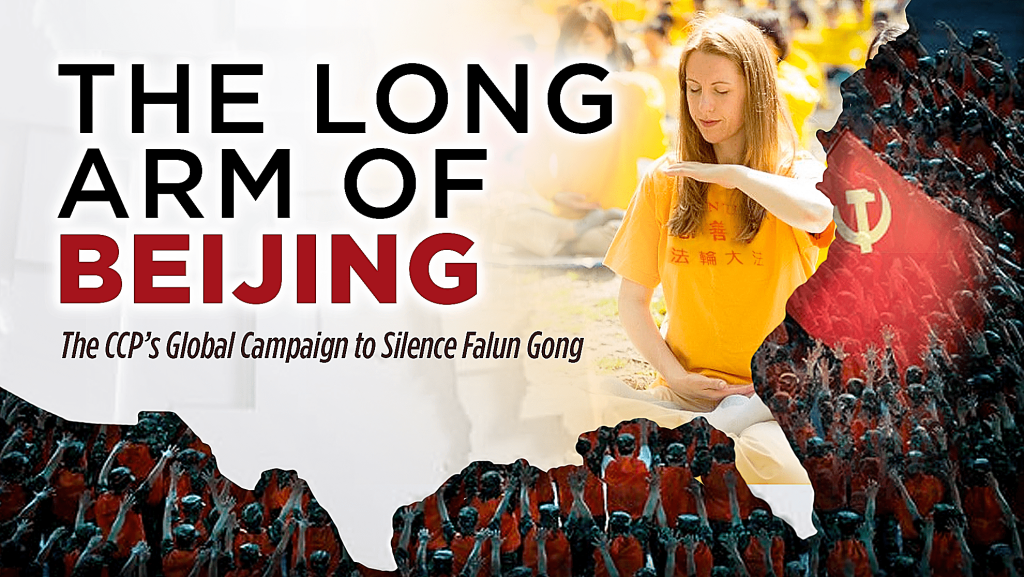
NR | 20m | Documentary | 2024
It is hard to beat the Chinese Communist Party (CCP) when it comes to shameless hypocrisy. The same oppressive organization that promoted Mao’s cult of personality (and currently does the same for Xi Jinping) has demonized Falun Gong practitioners as a “cult.” Similarly, the CCP demands that all international visitors follow its dictates, even when they conflict with the laws of their native jurisdictions.
Yet the CCP regime has flagrantly opened secret police stations in foreign nations, for the express purpose of harassing dissidents and human rights critics. Not surprisingly, Falun Gong practitioners are among their highest-priority targets. Filmmaker Mathias Magnason exposes the CCP’s increasingly brazen transnational campaign of intimidation and harassment in the short documentary “The Long Arm of Beijing: The CCP’s Global Campaign to Silence Falun Gong,” which is now available online.
Mr. Magnason provides solid historical and political context to help viewers fully understand the current situation. Initially, CCP propaganda hailed Falun Gong for encouraging a healthy lifestyle and positive social values. However, the Party quickly grew envious of the practice’s growing numbers, so it began a brutal and concerted suppression campaign that continues to this day, both inside and outside China’s internationally recognized borders.

Because of its control of the media and the internet, the Party was able to domestically censor news of mass arrests, while at the same time slandering practitioners in state news broadcasts. Over the years, reports of Falun Gong slave labor have been widespread, and independent researchers outside China have concluded that hundreds of thousands of prisoners were likely executed so their organs could be harvested for China’s booming transplant market.
Silencing Dissent
Criticizing such practices is essentially impossible in Xi’s China, but it is also growing increasingly difficult abroad. In one chilling scene, Emily Myers, a practitioner based in New York City, describes menacing phone calls she received late at night, which replayed unauthorized recordings of private conversations she held with other practitioners. Clearly, this violates several federal and state laws, but CCP agents who are engaged in transnational operations constantly disregard other sovereign nations’ rules and regulations.

Suspected CCP agents often take a more violent, direct approach. For instance, Australian-based dissident David Liang was shot multiple times by a suspected hit squad. Similarly, Dr. Peter Yuan Li was beaten unconscious on his own front lawn in Atlanta by a Mandarin-speaking gang.

Perhaps the scariest manifestation of CCP extraterritoriality has been the widespread discovery of secret Chinese police stations operating in foreign countries, including the United States. Mr. Magnason’s experts point out the obvious hypocrisy, arguing the CCP would hyperventilate with outrage if U.S. law enforcement agencies ever opened equivalent clandestine bases in mainland China.
In fact, every minute of “The Long Arm of Beijing” is a necessary primer on the CCP’s international campaign against any form of dissent. It is a good introduction to the regime’s tactics, but it ought to come with a viewing list of other feature-length documentaries that focus on many of the issues and incidents referenced by the short film.
Indeed, there is a growing body of work that conclusively establishes CCP culpability in large-scale systemic crimes against humanity. For instance, Raymond Zhang’s “State Organs” investigates the regime’s organ harvesting industry, Leon Lee’s “Letter From Masanjia” profiles a Falun Gong practitioner who survived a forced labor camp, and Jason Loftus’s “Eternal Spring” chronicles a desperate attempt to hack the state news broadcast feed to rebut the CCP’s defamatory propaganda (an amazing caper-like act of resistance also mentioned in Mr. Magnason’s film).

Frankly, there is an urgent need for a feature-length exposé of CCP extraterritoriality, because it is only getting broader and more invasive. For instance, the recent so-called Hong Kong National Security Act imposed by Beijing claims to apply to Hong Kong residents and nonresidents alike, no matter where they might live. Essentially, it codified extraterritoriality into law.
Arguably, 20 minutes is not enough time to fully describe the extent and danger of the CCP’s campaign of foreign intimidation and interference, but it is a good start. The survivors of the Party’s transnational scare tactics deserve a lot of credit for sharing their stories.
Urgently recommended as a concise wake-up call, “The Long Arm of Beijing” is now available for viewing online.
‘The Long Arm of Beijing’
Documentary
Director: Mathias Magnason
Running Time: 20 minutes
Release Date: April 15, 2024
Rated: 4 stars out of 5
Would you like to see other kinds of arts and culture articles? Please email us your story ideas or feedback at features@epochtimes.nyc
