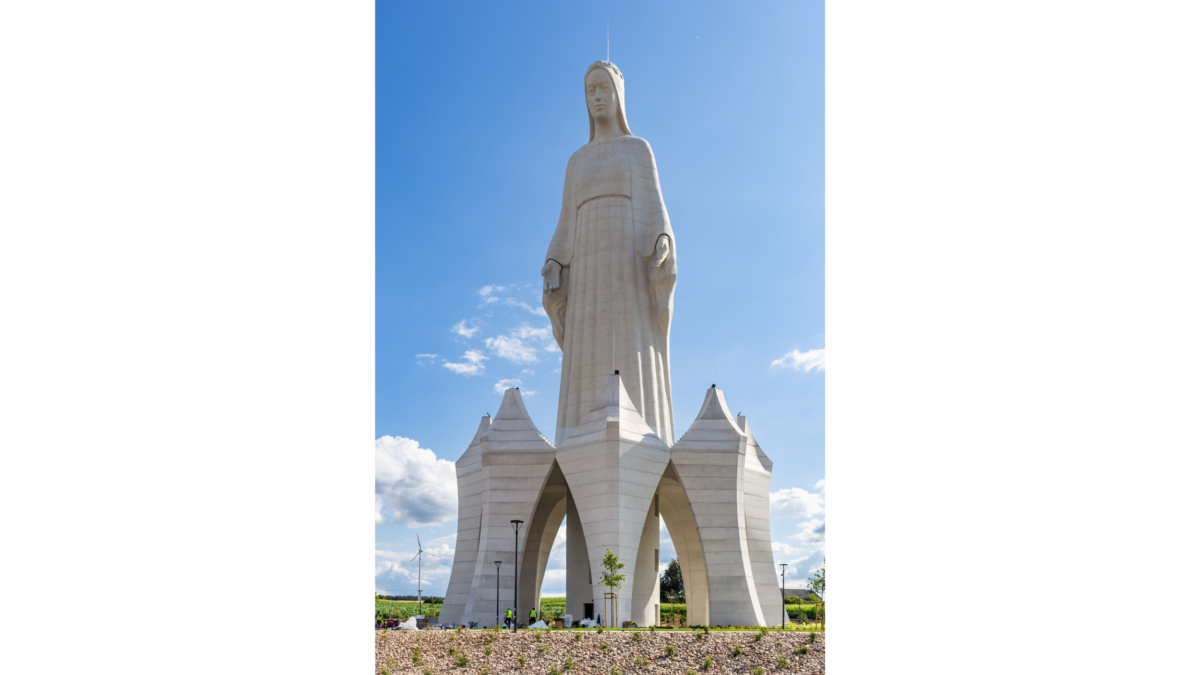
The largest statue of the Blessed Virgin Mary in all of Europe was recently erected in the remote village of Konotopie, Poland. It rises a massive 182 feet from the patchwork of fields around the village, like a spiritual lighthouse for weary travelers. A 49-foot crownlike base and viewing platform supports the statue, which is 133 feet tall, making this the tallest monument of Mary in Europe and the second-tallest in the world.
Though built of steel and concrete, the new statue, called Our Lady of Mercy, looks like a marble or a beautiful ivory tower, gleaming on the horizon.
“Here in Konotopie, we lift our eyes upward; we lift our eyes toward Mary, who directs us toward God,” said Bishop Krzysztof Wetkowski of the Diocese of Wloclawek during the ceremony for the blessing of the statue. The ceremony took place on Aug. 15, the day the Catholic Church celebrates the Assumption of Mary. “Yes, Our Lady of Mercy is meant to remind us of God. In this image, Mary welcomes us all, bending toward us and opening her arms, inviting us to raise our eyes upward, toward God and toward heaven.”
His words fell on listeners like the miniature red roses dropped from helicopters during the ceremony. Among those under the shower of roses was the legendary anti-communist leader Lech Walesa. He won the Nobel Peace Prize for his efforts against communism as head of the Solidarity trade union and, later, president of Poland. Walesa famously wore a Black Madonna pin—a symbol of Mary—when he led the Solidarity movement. His Catholic faith informed and sustained his resistance to communist authoritarianism. “This is the end of my path,” 82-year-old Walesa told the Associated Press (AP). “I started with the Virgin Mary and I end with the Virgin Mary.”
Built to Express Gratitude
The new statue surveys the area near a chapel dedicated to Our Lady of Sorrows, a popular pilgrimage destination, some 100 miles northwest of Warsaw. “The place where we stand is no ordinary place; it is a place sanctified by the prayers of pilgrims,” the bishop said, referring to the pilgrimage site. Officials hope that the presence of the shimmering white statue will lead to even more pilgrims visiting the area.
Not far from the site of the chapel and statue live Roman and Grazyna Karkosik, the couple who commissioned and funded the statue. Roman Karkosik is among the wealthiest individuals in Poland, with an estimated fortune of $511 million. He made his fortune through a variety of means, beginning with just a single pub and expanding into beverage manufacturing, then a wire and scrap metal business, as well as some savvy investments in metal and chemical companies. While the statue’s approximate cost is not publicly known, it’s estimated at around $26 million.
“The statue will be for all people,” Grażyna Karkosik said to the AP. “Each of us coming to see it will think more deeply about their own lives, not only about God.” According to the Karkosiks, the monument is a “gesture of gratitude” for Roman Karkosik’s recovery from a serious illness.
A History of Faith
The Catholic faith has long been a crucial part of Polish culture and Polish identity. Poland has also made important contributions to the Roman Catholic Church, being the birthplace of St. John Paul II, who was pope of the Catholic Church from 1978 to 2005. St. Faustina Kowalska, who was born in the same diocese where the statue is located, gave to the Church the Divine Mercy devotion. The statue’s name—“Our Lady of Mercy”—is a nod to this devotion.
In recent decades, the influence of Catholicism in Poland has waned. Younger Poles, particularly in urban areas, have begun to abandon the Church. Sociologists in Switzerland, the UK, and the United States have analyzed a pattern of secularization that many societies are experiencing. This process of secularization appears to be happening more quickly in Poland than in any other country. The researchers found that the difference in attitudes toward faith between Poles 40 or older and those 40 or under was more significant than elsewhere.
According to one of the study’s authors, Jörg Stolz of the University of Lausanne, “[Poland] now seems to be the fastest secularizing country in the world.” The secularization “translates into intergenerational differences in the approach to religion,” he explained to the Polish Press Agency.
In the 2021 census, 71 percent of Poles identified as Roman Catholic. Though that’s still a high percentage—Poland remains one of the most thoroughly Catholic countries in Western Europe—it’s still a significant drop from the 88 percent who self-identified as Catholic in 2011.
Will Our Lady of Mercy help stem the tide of secularization, standing like a bulwark against loss of faith? Only time will tell.
What arts and culture topics would you like us to cover? Please email ideas or feedback to features@epochtimes.nyc.