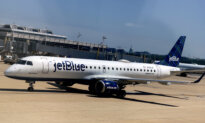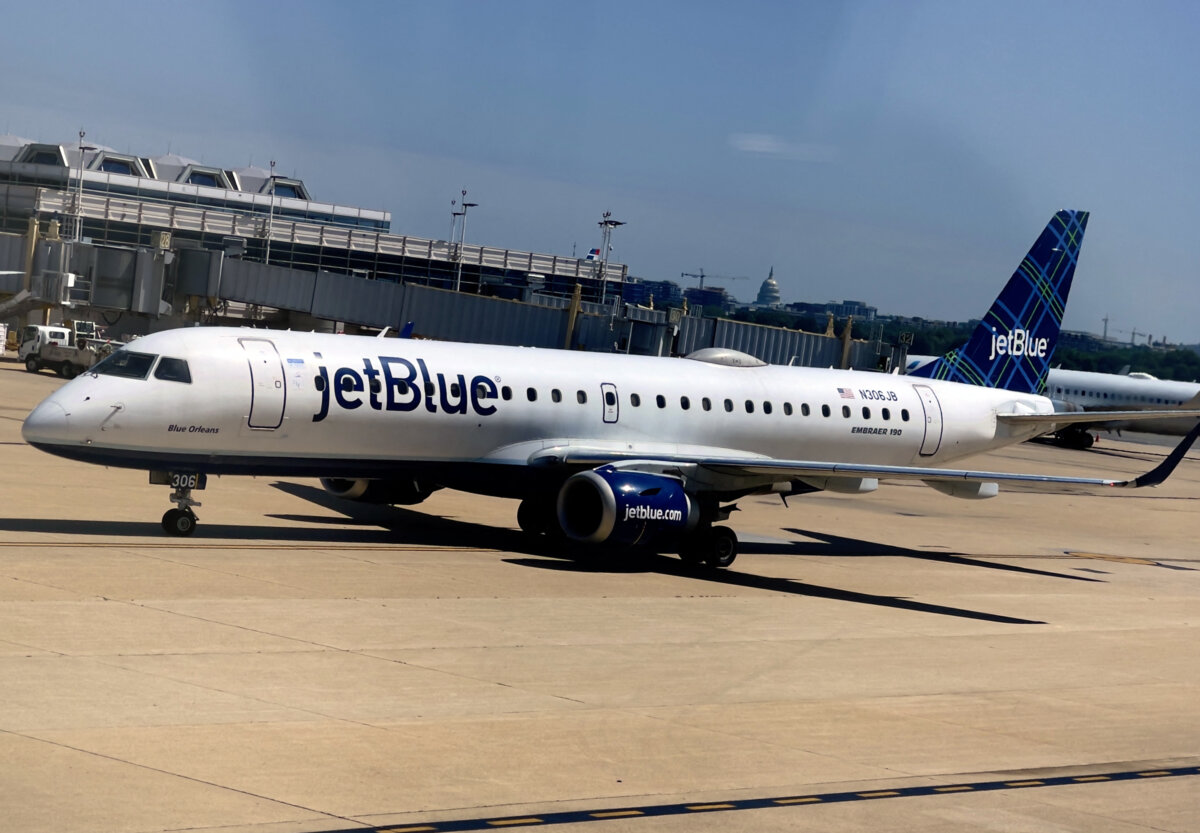

Passengers traveling on JetBlue will have to dig deeper into their pockets for baggage fees now, as the airline attributes an increase to rising operating costs.
According to the JetBlue website, baggage fees for the first checked bag on the company’s economy fare tiers—including Blue Basic, Blue, Blue Extra, and EvenMore—will rise to $39, or $49 during peak periods. The fee was previously $35, or $40 during peak periods. Passengers who choose to check a second bag will pay $59, or $69 during peak time.
For higher fare tiers—including Blue Plus and Mosaic 1—as well as JetBlue Plus and Premier cardholders, the first checked bag will remain free, while the second bag fee will be $59.
For Mint and Mosaic 2, 3, and 4 fare tiers, both the first and second checked bags will be free.
Those costs apply to all flights within the United States, Latin America, the Caribbean, and Canada.
“As we experience rising operating costs, we regularly evaluate how to manage those costs while keeping base fares competitive and continuing to invest in the experience our customers value,” a JetBlue spokesperson told The Epoch Times via email.
“Adjusting fees for optional services used by select customers, such as checked baggage, allows us to continue offering more competitive fares.”
The spokesperson noted that the airline will continue to deliver the same onboard experience for passengers including complimentary snacks and drinks, unlimited, high-speed Wi-Fi, and seatback entertainment screens.
“While we recognize that fee increases are never ideal, we take careful consideration to ensure these changes are implemented only when necessary,” the spokesperson added.
JetBlue requires that all checked bags meet their size and weight requirements. Any luggage exceeding 62 inches in overall dimensions or 50 pounds will incur an extra fee.
“We encourage all customers to add their checked bags to the online or JetBlue mobile app booking at least 24 hours prior to their flight to save $10 off their first and second bag,” the spokesperson said.
Since the outbreak of the U.S.–Israel conflict with Iran in late February, crude oil and product prices have surged.
According to the International Air Transport Association (IATA), a trade association representing more than 360 global airlines, the full impact of the U.S.–Israel conflict with Iran on airline fuel costs is still unknown.
“But some things are already clear. Fuel costs have risen sharply,” IATA Director General Willie Walsh said in a March 31 statement. “With tight capacity and thin margins, air fares are already rising.”
Walsh added that capacity deployment is also adjusting, particularly for air traffic to or from the Middle East in areas where the fuel supply is an issue.
“Capacity growth scheduled for March, for example, has eased to 3.3 percent from earlier predictions of more than 5 percent,” he said.
In February alone, international travel demand increased by nearly 6 percent compared to February 2025. North American air carriers saw a 5 percent year-over-year increase.
 Friends Read Free
Copy
Facebook
Tweet
Friends Read Free
Copy
Facebook
Tweet