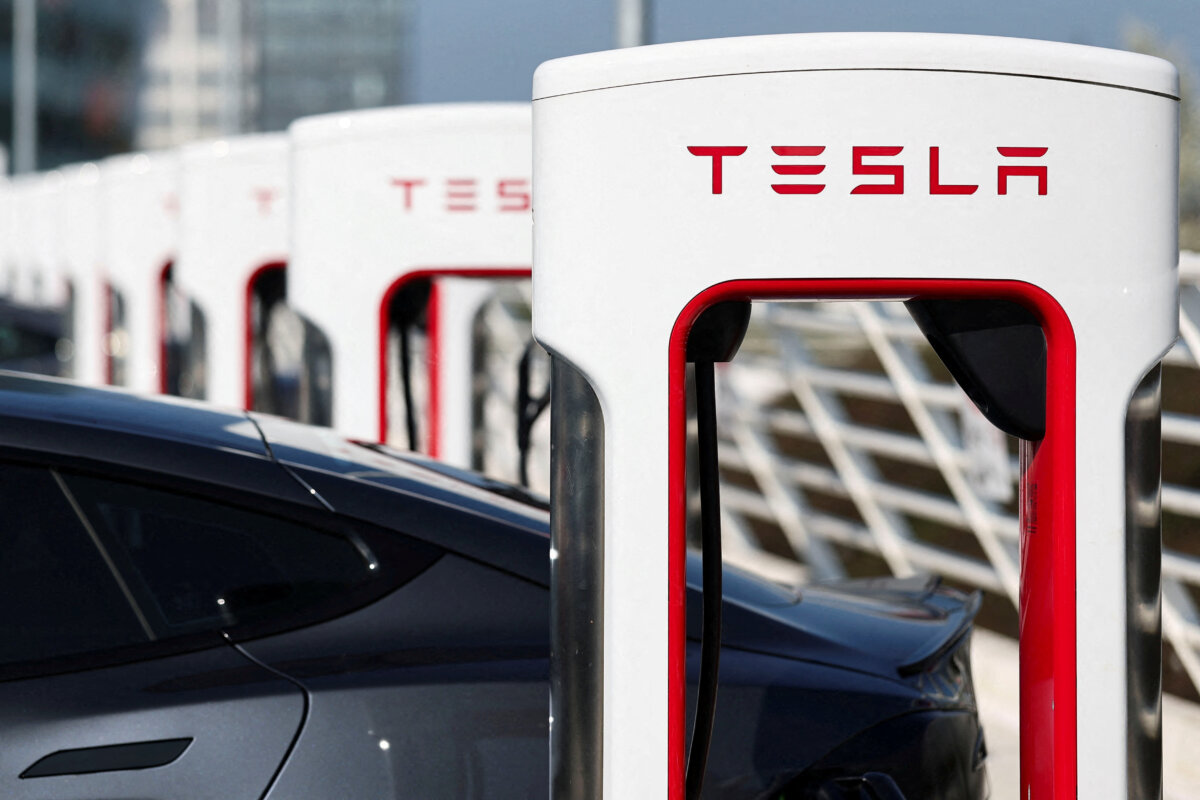

Tesla reported its first-quarter 2026 vehicle deliveries and production on Thursday, posting a decline from the previous quarter but modest growth from a year earlier.
The company said it delivered 358,023 vehicles worldwide in the first quarter, down 14 percent from the fourth quarter of 2025. Tesla produced 408,306 vehicles during that period, which was down 6 percent quarter over quarter.
For Tesla, which relies on a direct-to-consumer model instead of the traditional franchised, third-party dealerships, deliveries are generally considered the closest equivalent to sales and are the primary metric the company uses to report its performance.
It was the second straight quarter in which Tesla fell short of expectations. A company-compiled consensus published on March 26 showed analysts on average expected 365,645 deliveries in the first quarter.
Even so, deliveries were up 6 percent from a year earlier. In the first quarter of 2025, Tesla reported 336,681 deliveries, a 13 percent decline from the same period in 2024, as the company faced political protests and vandalism after CEO Elon Musk joined the second Trump administration to lead the Department of Government Efficiency, which was tasked with rooting out waste, fraud, and abuse in the government.
Tesla’s lower-priced Model 3 sedan and Model Y sport utility vehicle remained the core of its electric vehicle business. The two models accounted for 341,893 deliveries in the latest quarter.
The Model 3 and Model Y have long formed the backbone of Tesla’s volume, while deliveries of the company’s older Model S and Model X have been in decline for years. Musk said in a post on X on Wednesday that custom orders for the S and X had “come to an end,” although there are still some left in the inventory.
“We will have an official ceremony to mark the ending of an era,” he wrote. “I love those cars.”
In Tesla’s quarterly report, the Model S and Model X are grouped into an “other models” category that also includes the Cybertruck. Together, those vehicles accounted for just 16,130 deliveries.
Tesla had once hoped the steel, futuristic-looking Cybertruck would become a major growth driver, but it has yet to offset weakness in the rest of the lineup. Musk has recently shifted the company’s focus toward future products such as the autonomous Cybercab and Optimus humanoid robots, which he has cast as Tesla’s next major growth engines.
Musk has said Tesla aims to soon begin volume production of the Cybercab, a two-seat vehicle designed to operate autonomously without a steering wheel or pedals, as part of the company’s emerging robotaxi business. In January, it was confirmed that Tesla’s Fremont, California, factory lines used to assemble the Model S and Model X would be repurposed to build Optimus robots.
Tesla was not the only EV maker to face weaker performance last year. EVs have become less attractive to buyers since the Trump administration ended the $7,500 federal tax credit for the vehicles last October, years ahead of its original 2032 expiration date. Tariffs imposed to protect domestic manufacturing also pushed up the cost of EVs that rely on imported parts.
In recent months, some of the biggest automakers have delayed or discontinued their EV programs. General Motors announced in October 2025 that it was ending production of its BrightDrop electric vans. Ford stopped production of the F-150 Lightning pickup truck in December, citing lower-than-expected sales.
And most recently, in March, Volvo discontinued the EX30, just two years after the SUV’s U.S. debut, while Honda also said that it was canceling all three EVs it planned to manufacture in the United States: the 0 Series SUV, the 0 Series Saloon, and the electric version of its Acura RSX.
 Friends Read Free
Copy
Facebook
Tweet
Friends Read Free
Copy
Facebook
Tweet