
China’s industrial policies threaten up to $650 billion in manufacturing output from many of the world’s most advanced economies, a new report has warned.
The analysis says Beijing’s strategy risks hollowing out industrial capabilities in G7 countries by 2030.
Chinese policies are becoming more systematic and pervasive, according to the report published on Monday by the U.S. Chamber of Commerce and prepared by the Rhodium Group research firm.
Beijing is actively reinforcing control over value chains using regulations and economic coercion, it states.
The G7 group comprises Canada, France, Germany, Italy, Japan, the UK, and the United States. The $650 billion figure equals around 12 percent of their manufacturing exports if current trends continue.
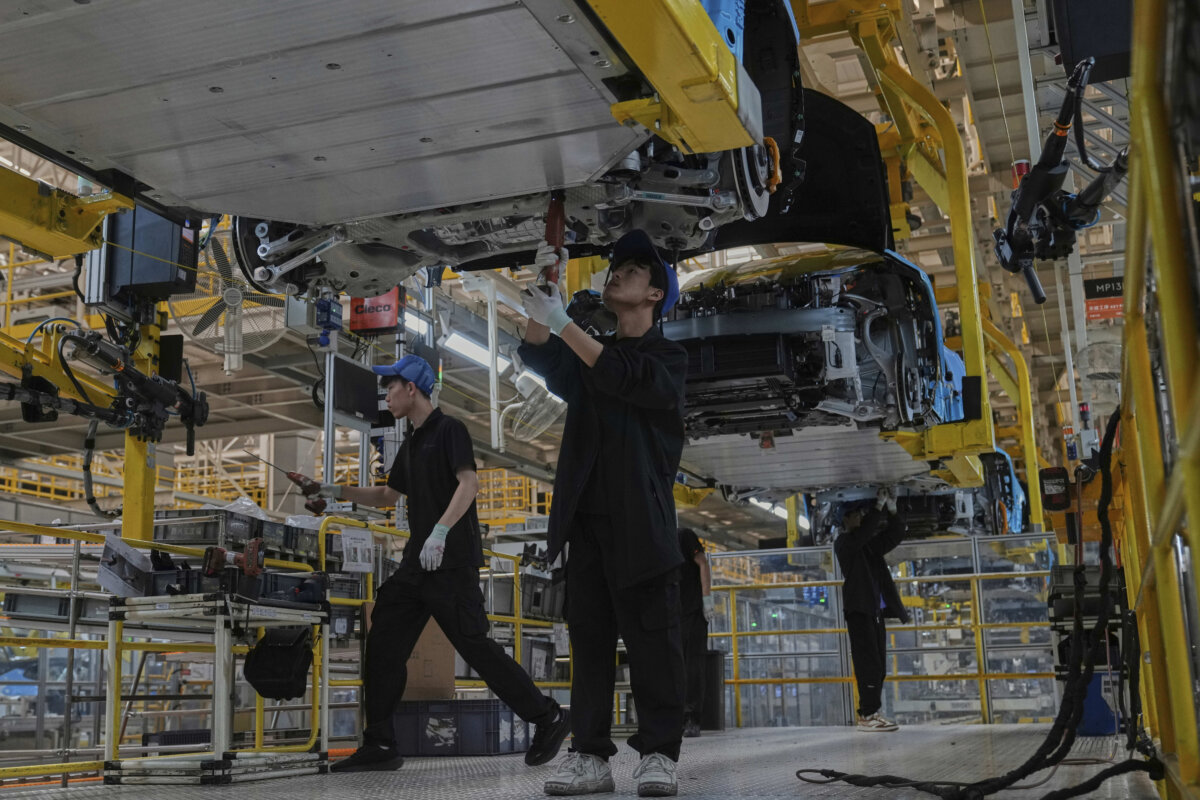
Automotive, machinery, and chemicals are among the sectors most at risk from Chinese competitors.
The report calls for better coordination among developed nations. Many governments have responded with trade measures, industrial policies, and supply chain de-risking efforts, but these remain fragmented.
“Without more coordinated action, China’s industrial policy is likely to continue reshaping global markets, entrenching dependencies, and eroding industrial competitiveness across both advanced and emerging economies,” the authors write.
Potential consequences include declining investment, weakened innovation, and loss of industrial capabilities in advanced economies.
The report, titled “China’s Next-Generation Industrial Policy,” describes China’s approach as an “industrial policy of everything.” It extends across upstream inputs, equipment, downstream applications, services, and frontier technologies.
This builds on China’s Made in China 2025 plan, launched in 2015, which has helped the country lead in solar panels, high-speed rail, and lithium batteries while advancing in pharmaceuticals and artificial intelligence.
A 2025 Rhodium Group assessment for the U.S. Chamber found Made in China 2025 achieved substantial progress in reducing import dependence and building competitiveness in areas such as new energy vehicles.
China’s manufacturing trade surplus has roughly doubled since 2019 to around $2 trillion. The number of products where China accounts for more than 50 percent of global exports nearly doubled from 192 to 315 between 2021 and 2024.
Earlier Warnings Proved Prophetic
A 2016 Mercator Institute for China Studies report stated, “If China succeeds with ‘Made in China 2025,’ foreign companies and industrial countries will find themselves confronted with a powerful competitor backed by massive state support across a wide range of advanced manufacturing industries.”
The EU Chamber of Commerce in China warned in 2017 of risks to fair competition, while the U.S. Chamber highlighted a shift in China toward state-directed outcomes.
The new report highlights that the costs of delayed responses are now visible in lost competitiveness and strategic vulnerabilities.
 Friends Read Free
Copy
Facebook
Tweet
Friends Read Free
Copy
Facebook
Tweet