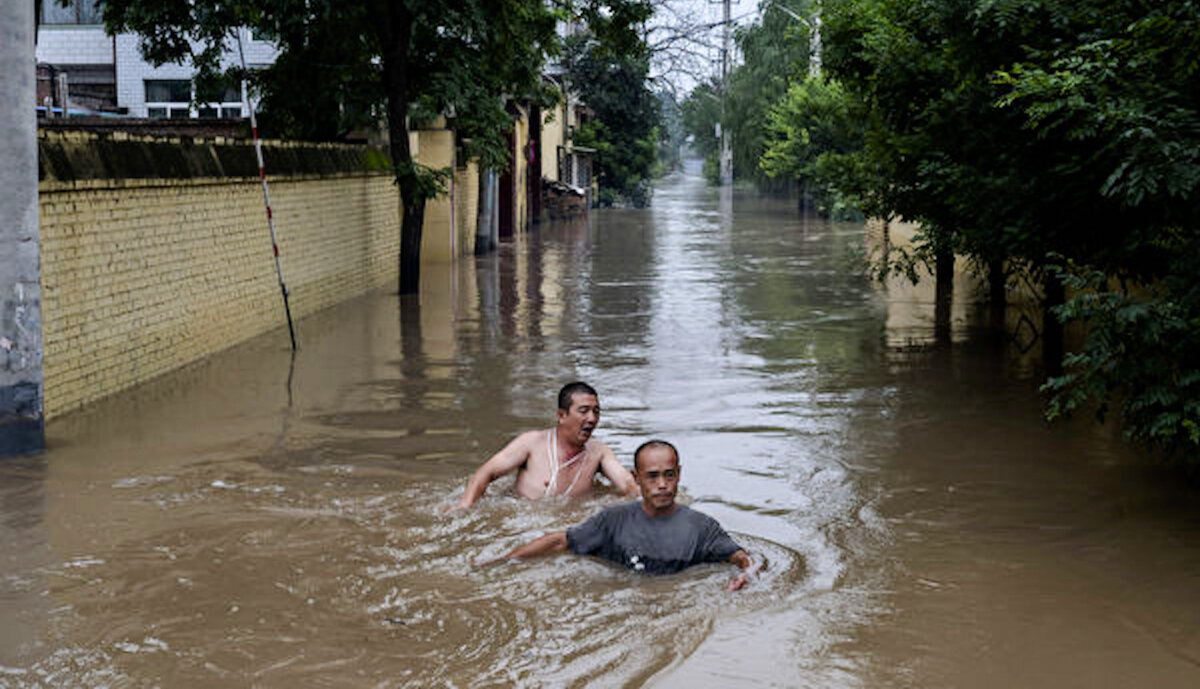

Torrential rains battered Beijing on July 26 and 27, causing severe flooding and landslides in the city’s northeastern Miyun District. Multiple villages suffered significant damage, with transportation, electricity, and communication services disrupted.
According to district authorities, as of 5 a.m. on July 27, a total of 3,065 people across 18 towns were evacuated.
Water levels began to rise at midnight. A tourist staying at a rural residence similar to an Airbnb in Miyun District told Chinese state media that around 2 a.m. on July 27, the water suddenly surged to chest level. She and six others were trapped inside and had to jump out of a window to escape. They spent the rest of the night at a nearby guesthouse located on higher ground and were eventually rescued by a forklift. When they returned to their original lodging later, they found the house filled with mud.
As of 5:30 p.m. on July 27, Beijing had issued red rainstorm warnings across four districts and orange warnings in six others. The entire city remains under a yellow rainstorm alert.
China’s meteorological warning system is structured into four color-coded levels: red, orange, yellow, and blue, with red indicating the most severe conditions.
In neighboring Hebei Province, Baoding’s Yi County recorded 448.7 millimeters of rain within 24 hours, most of it falling in just 12 hours. Xizhuang Station reported 540 millimeters of rainfall in eight hours, surpassing its average annual total, while Fuping County registered a record-breaking hourly rainfall of 145 millimeters.
The heavy rains have resulted in at least two fatalities and numerous missing persons in Hebei. As reported by Chinese state outlets, more than 46,000 people have been affected, with thousands displaced. Vast rural and urban areas remain submerged, while many villages are experiencing power outages and loss of communication. Key infrastructure, including roads and bridges, has been severely damaged.
As continual rainfall significantly increased the risk of secondary disasters such as floods and mudslides, the Ministry of Natural Resources and the China Meteorological Administration jointly issued a top-level meteorological risk warning for geological disasters in the area at 6 p.m. on July 27, according to Chinese state media.
Prior to the rainfall, Beijing and many parts of northern China experienced a prolonged and intense heatwave beginning in mid-July, lasting approximately 10 to 13 days. Temperatures repeatedly exceeded 35 degrees Celsius (95 degrees Fahrenheit), with some areas recording nighttime lows above 32 degrees Celsius (89.6 degrees Fahrenheit). The persistently high nighttime temperatures created unusually oppressive conditions, unprecedented for the region at this time of year.
Reuters contributed to this report.
 Friends Read Free
Copy
Facebook
Tweet
Friends Read Free
Copy
Facebook
Tweet