
Commentary
With the United States poised to label Venezuelan President Nicolás Maduro a drug lord in charge of a narco-terrorist cartel, the focus in the Caribbean has been drugs, drugs, and more drugs.
But deploying an entire carrier task force and a whole marine expeditionary force is about more than just drugs and blowing up small drug boats and semi-submersibles. It’s about U.S. President Donald Trump’s favorite subject: oil, as well as a dispute between recently oil-rich Guyana and Venezuela. And it’s about countering China’s ongoing successful efforts to expand its influence in Guyana, Venezuela, and South America in general.
The dispute between Venezuela and Guyana over the Essequibo region is more than a century old, yet for most of that time, it remained a quiet disagreement over maps and history. What transformed it into a crisis was the 2015 discovery of the Liza oil field in the offshore Stabroek Block—a block that lies well inside Guyana’s internationally recognized 200-nautical-mile Exclusive Economic Zone, a maritime zone repeatedly upheld by an 1899 arbitral award issued by an international tribunal. While there is a pending case before the International Court of Justice (ICJ) asking the court to confirm the 1899 decision as valid and binding, the court has yet to rule.
But with Guyana controlling the disputed territory for more than 120 years—and with it making up two-thirds of Guyana—it would be surprising to have the ICJ rule against Guyana. Doing so would destabilize—perhaps even destroy—Guyana and give control of some of the world’s richest oil fields to Venezuela, a country already extremely rich in oil.
Since ExxonMobil drilled the first successful Liza oil well in May 2015, more than 30 commercial oil fields have been proven, holding more than 11.6 billion barrels of recoverable light sweet crude. As of November 2025, Guyana is producing nearly 900,000 barrels per day and is on a path to produce 1.4 million by 2027 and potentially 1.7 million by 2030. U.S. oil companies ExxonMobil and Chevron have already invested more than $100 billion.
China has also invested in Guyana oil with a 25 percent stake in the Stabroek Block, which is operated by ExxonMobil. China National Offshore Oil Corp. and other investors have already committed more than $60 billion to developing the region.
In less than a decade, a country of 800,000 people has become the fastest-growing oil province on the planet.
Maduro, facing economic collapse and international isolation, has turned the Essequibo into a nationalist cause. A 2023 referendum “authorized” annexation, legislation in 2024–2025 created a Venezuelan administrative zone called Guayana Esequiba, and military units have moved toward the border. Maduro has repeatedly declared Guyana’s Stabroek licenses null and threatened to award new concessions to Russian and Chinese firms.
Guyana’s defense force numbers fewer than 4,000 soldiers and possesses no combat aircraft, while Venezuela’s force numbers more than 120,000. Georgetown has formally requested U.S. protection, and Trinidad and Tobago has publicly offered American forces basing rights for the explicit purpose of defending Guyana from a Venezuelan invasion.
Washington’s response has been unambiguous. In March 2025, U.S. Secretary of State Marco Rubio stood next to Guyanese President Irfaan Ali in Georgetown, Guyana, and delivered a clear warning: “It would be a very bad day for the Venezuelan regime if they were to attack Guyana or attack ExxonMobil or anything. It would be a very bad day, a very bad week for them, and it would not end well for them.”
Eight months later, the Trump administration has made good on that promise. No one in the Pentagon pretends that counter-narcotics is a low priority—Operation Southern Spear has already carried out roughly two dozen lethal strikes on drug-running vessels since September, and the administration has been vocal about treating certain cartels as terrorist organizations.
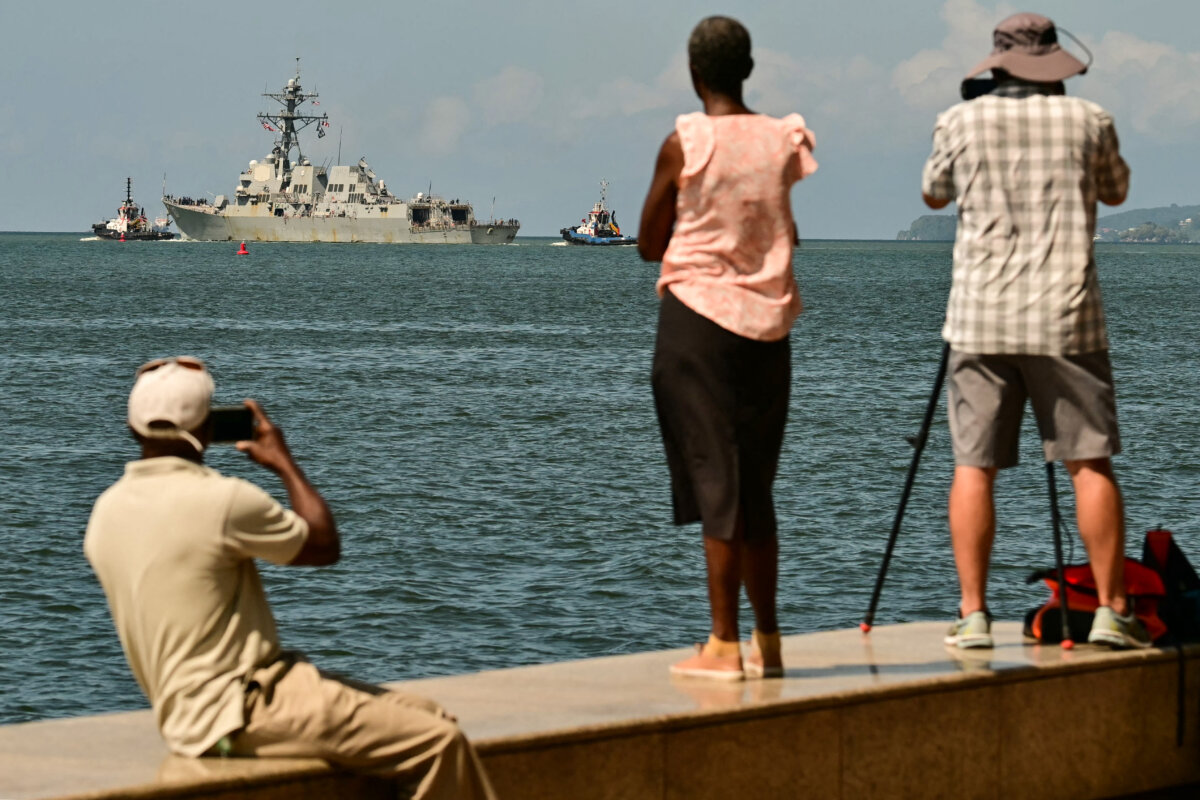
Yet the scale of the U.S. Navy presence off the coast of Venezuela far exceeds anything required for that mission. A handful of destroyers, littoral combat ships, and Coast Guard cutters have handled Joint Interagency Task Force South for decades. Sending a nuclear supercarrier, a full Marine expeditionary unit, F-35 squadrons, attack submarines, and Aegis cruisers is not how you chase speedboats.
On Nov. 16, the USS Gerald R. Ford and its strike group entered the region, joining forces already in place. The combined armada now includes a 100,000-ton supercarrier with 60 to 75 aircraft—F-35Cs, F/A-18E/F Super Hornets, EA-18G Growlers, and E-2D Hawkeyes—escorted by multiple Aegis destroyers and a Ticonderoga cruiser carrying hundreds of Tomahawk land-attack missiles.
The Iwo Jima Amphibious Ready Group—USS Iwo Jima, USS Fort Lauderdale, and USS San Antonio—carries the full 22nd Marine Expeditionary Unit of approximately 2,200 Marines equipped with MV-22 Ospreys, AH-1Z attack helicopters, CH-53Ks, landing craft, and a reinforced infantry battalion. A Los Angeles-class attack submarine, additional destroyers, the special-operations support ship MV Ocean Trader, and a reactivated F-35 squadron at Roosevelt Roads in Puerto Rico complete the order of battle.
This force can establish air and sea superiority over all of Venezuela in hours and, if necessary, put boots on the ground in Essequibo long before any Venezuelan column reaches the interior. It is far beyond what is needed to conduct drug interdiction operations, but it is exactly what is needed to deter a desperate regime from launching a military adventure to annex the oil-rich territory of its much smaller, weaker neighbor. And it also provides the ability to strike drug operations in Venezuela, further forcing Maduro to pivot away from any thoughts of seizing Guyanan lands.
The deployment also carries a message for Moscow, which maintains military advisers and air-defense systems in Venezuela. But the massive military deployment is even more about countering China’s growing influence in Guyana, Venezuela, and South and Central America in general. By stepping in to defend Guyana so decisively, the Trump administration has put Guyana in the United States’ debt. And the U.S. presence puts massive pressure on Maduro, weakening his position and encouraging the two-thirds of Venezuelans who voted to get rid of Maduro in 2024 to keep up the pressure on Maduro to step down.
Having Guyana in the United States’ debt and creating massive new pressure on pro-China Maduro puts the United States in a better position to counter China’s extensive efforts to gain influence right in America’s backyard. Ryan Berg, director of the Americas Program at the Center for Strategic and International Studies, observed in October 2025 that this could be the revival of the Monroe Doctrine.
“I think that the general precepts of the Monroe Doctrine are still very much guiding principle for the United States, but also for this administration. And what this administration is doing is bringing our attention back to the Americas in a way that many administrations in the past haven’t,” he said.
Vice President J.D. Vance referred to this revived Monroe Doctrine as the “Trump Doctrine.” But regardless of what it is called, it’s clear that the strikes on narco-terrorist boats, while providing dramatic optics, are only the tip of the iceberg, while the bulk of the iceberg is oil and China. What’s more, with nearly 300,000 tons of U.S. Navy vessels within striking distance of Venezuela, the United States is taking decisive steps to counter Russian and Chinese influence in its own hemisphere—and hopefully spending less time trying to counter Russian influence on Russia’s border.
Views expressed in this article are the opinions of the author and do not necessarily reflect the views of The Epoch Times.
 Friends Read Free
Copy
Facebook
Tweet
Friends Read Free
Copy
Facebook
Tweet