
Commentary
The intuitive model of diplomacy is a settlement, much like a commercial deal negotiated, for example, from $120 million down to $100 million. The contract is inked, the transaction closes, and neither party retains a residual claim on the difference.
Conventional statecraft leans heavily on this logic, assuming that if interests are sufficiently compatible, good-faith bargaining can establish a durable, rules-governed equilibrium.
Yet the exact same transaction can serve a completely different purpose: a deal as an instrument. Instrumental diplomacy is not inherently dishonest, nor is it unique to autocracies. Democratic governments constantly sign armistices, negotiate temporary ceasefires, and agree to interim trade frameworks because the alternatives are worse. That is also part of statecraft.
The problem arises when the two sides sign the same paper with incompatible operating models: One believes it has achieved a durable settlement, while the other has acquired a tactical instrument.
Suppose an actor pursues an existential, long-term objective. An adversary stands in the way, but the present balance of power is unfavorable. It signs a 10-year deal—not to resolve the underlying dispute, but to lift sanctions, access capital, buy time for its domestic economy, build its military force, or delay an opposing coalition. It may honor every clause to the letter. Why wouldn’t it? The arrangement provides immediate utility.
To the settlement-minded government, that decade represents genuine reconciliation, justifying thinner military defenses, deeper economic interdependence, and the drawdown of strategic reserves. So one side’s proof of peace is the other side’s proof of a successful staging ground.
U.S. President Donald Trump’s successes in foreign policy have consistently operated on the commercial premise: locate the other side’s baseline interests, apply maximum leverage, put something on the table both can live with, and make the deal. Yet in dealing with Iran, Russia, and China, for example, no deal has so far been sustained.
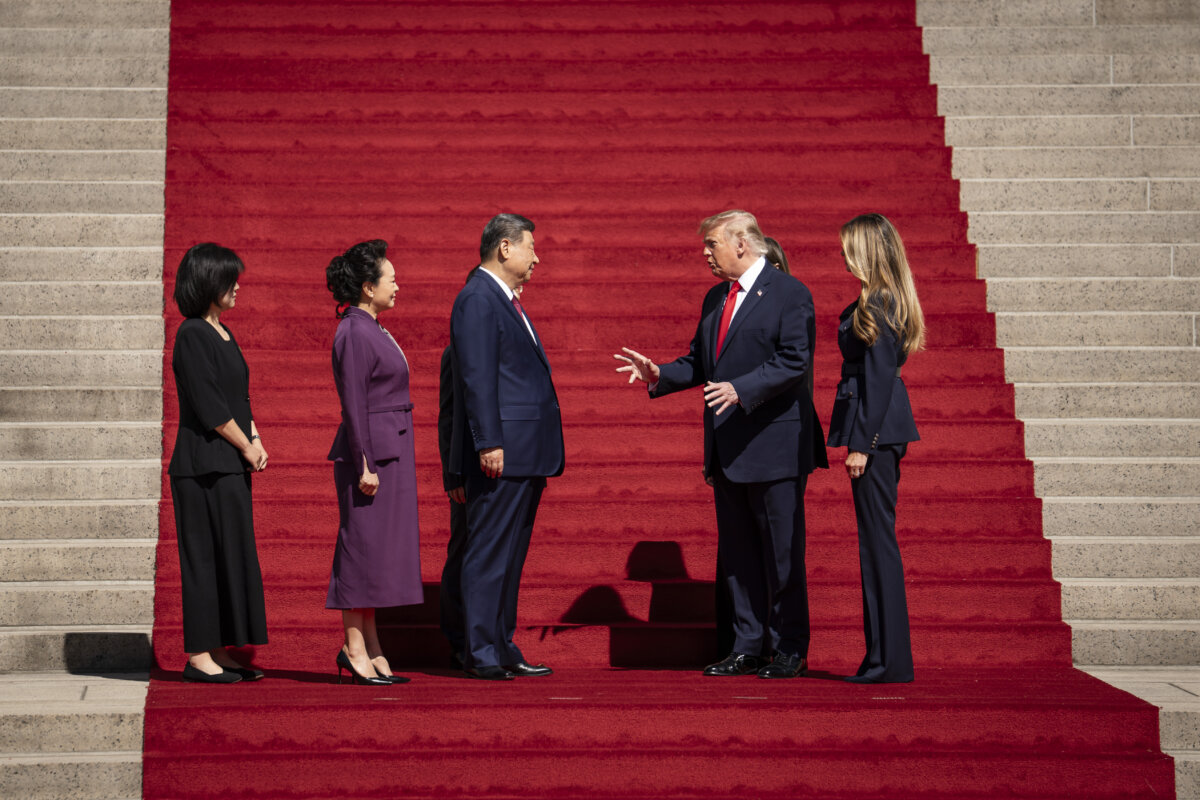
That was again on display as Trump and Chinese leader Xi Jinping concluded their bilateral summit in Washington. Joint announcements to create bilateral investment boards, dial back reciprocal tariffs, and establish guardrails on artificial intelligence were framed as proof that personal diplomacy and commercial leverage can tame great-power rivalry.
Yet the handshake papers over an unresolved question: When Washington and Beijing sign an accord, do they believe they are doing the same thing?
The Record
The record of the past three decades suggests they do not. Two consequential cases reveal how this divergence plays out in practice.
The first was China’s 2001 accession to the World Trade Organization (WTO); it was the largest American strategic bet of that period. The economic mechanics were explicit. But the Clinton administration also argued that global market integration would force domestic legal reform, unleash market forces, and inevitably erode the foundations of one-party rule.
China, however, never explicitly promised any of that. While Washington treated the WTO as a transformative settlement designed to fold Beijing into a Western-led rules-based order, the Chinese Communist Party (CCP) treated it as an instrument to access international capital, scale its manufacturing base, and absorb advanced technology, while expanding its domestic control and global power.
China’s accession to the WTO was simultaneously a failed Western political bet, a profitable commercial agreement, and a brilliant Chinese development strategy. Decades later, the Office of the U.S. Trade Representative still documents a state-directed, mercantilist system at fundamental odds with market norms.
The mistake around WTO accession was not believing China would change. China changed enormously. The mistake was assuming which things would change.
Hong Kong offered an even sharper test because it involved a formal treaty registered with the United Nations. The 1984 Sino-British Joint Declaration guaranteed that Hong Kong would retain a high degree of autonomy, an independent judiciary, and its distinct way of life for 50 years.
In the 1980s, Beijing did not yet control the territory; the “one country, two systems” framework solved the transfer problem while preserving the British colony’s vital role as a financial gateway for foreign capital.
For decades, the arrangement delivered immense utility. But once mainland China grew into the world’s second-largest economy, Hong Kong’s relative financial leverage waned. When the 2019 protests challenged Beijing’s creeping control, the 2020 National Security Law extinguished that autonomy almost overnight. Fifty years meant 50 calendar years in London; in Beijing, the treaty was an instrument whose utility has expired.
Realpolitik With a Twist
Understanding why these bargains fray requires looking beyond standard realpolitik. Classical realists argue that all sovereign states pursue power and revise commitments as circumstances shift. Yet in China’s case, something sits above the state and the normal national interest: the Party’s monopoly and preservation.
As the book “Nine Commentaries on the Communist Party” articulated two decades ago, all economic doctrines, diplomatic lines, and external alliances remain strictly subordinate to that institutional survival. That is classical Leninism. As Vladimir Lenin himself detailed in “Left-Wing Communism,” tactical retreats, temporary alliances, and compromises are devices to navigate an unfavorable balance of power, never permanent reconciliations.
Religion is a sharp manifestation of this principle, sort of a canary in a coal mine, since it is a source of belief that does not originate with the Party yet has managed to coexist with secular powers throughout history.
The question is what happened after China became rich and conceivably more secure in its position—as its WTO accession did not newly create the policies of repression against Tibetans, house churches, and Uyghurs in Xinjiang; and Falun Gong had already been targeted in 1999.
The answer is that things got much worse on all fronts—modernization and the insistence that no significant institution stand outside Party power proceeded in tandem.
What a Deal Can Accomplish
Sun Tzu’s maxim “If you know the enemy and know yourself, you need not fear the result of a hundred battles” is about not just an inventory of weapons and manpower, but an assessment of mental models.
If Washington understood Beijing’s demand for markets but misunderstood how the CCP subordinated integration to political control, the intelligence failure was not a lack of data but an erroneous analytical framework. Becoming tougher or more accommodating cannot fix a broken model.
Adversaries are modeling the United States as well. Beijing, Moscow, and Tehran watch electoral cycles, allied fatigue, and whether a four-year commitment survives an eight-year horizon. American strategy can change after an election. That is not an insult to democracy. It is a structural fact, and a capable counterpart will price it.
Authoritarian systems may hold strategies over longer horizons, yet they generate their own strategic blind spots. For decades, Beijing assumed Western commercial appetite, electoral turnover, and commitment to globalized supply chains were permanent constants while China accumulated strength. When Washington woke up—imposing export controls, investment bans, and industrial subsidies—the Party has had to confront Western agency.
None of this implies that the United States should walk away from negotiating with adversaries. An agreement with an adversary often matters far more than an agreement with an ally: A ceasefire halts bloodshed; arms control lowers the risk of catastrophic escalation; and a bilateral trade mechanism prevents commercial friction from spiraling into kinetic conflict.
Knowing the CCP, a durable doctrine begins by assuming the adversarial competition continues, replacing the illusion of convergence with a rigorous audit:
-
What happens if this arrangement collapses tomorrow?
-
Have we created dependencies we cannot quickly unwind?
-
Have we surrendered leverage that cannot be rebuilt?
-
Who will use the resulting interval to accumulate capability faster?
-
Can we verify compliance without the counterparty’s permission?
-
If the deal fails in two years, will we be in a stronger position than on the day we signed?
Leaders shake hands, cameras flash, and markets could rally on the news of historic breakthroughs. But before deciding whether any summit has succeeded, there is an indispensable question:
Did they make the same deal?
Views expressed in this article are the opinions of the author and do not necessarily reflect the views of The Epoch Times.
 Friends Read Free
Copy
Facebook
Tweet