
Commentary
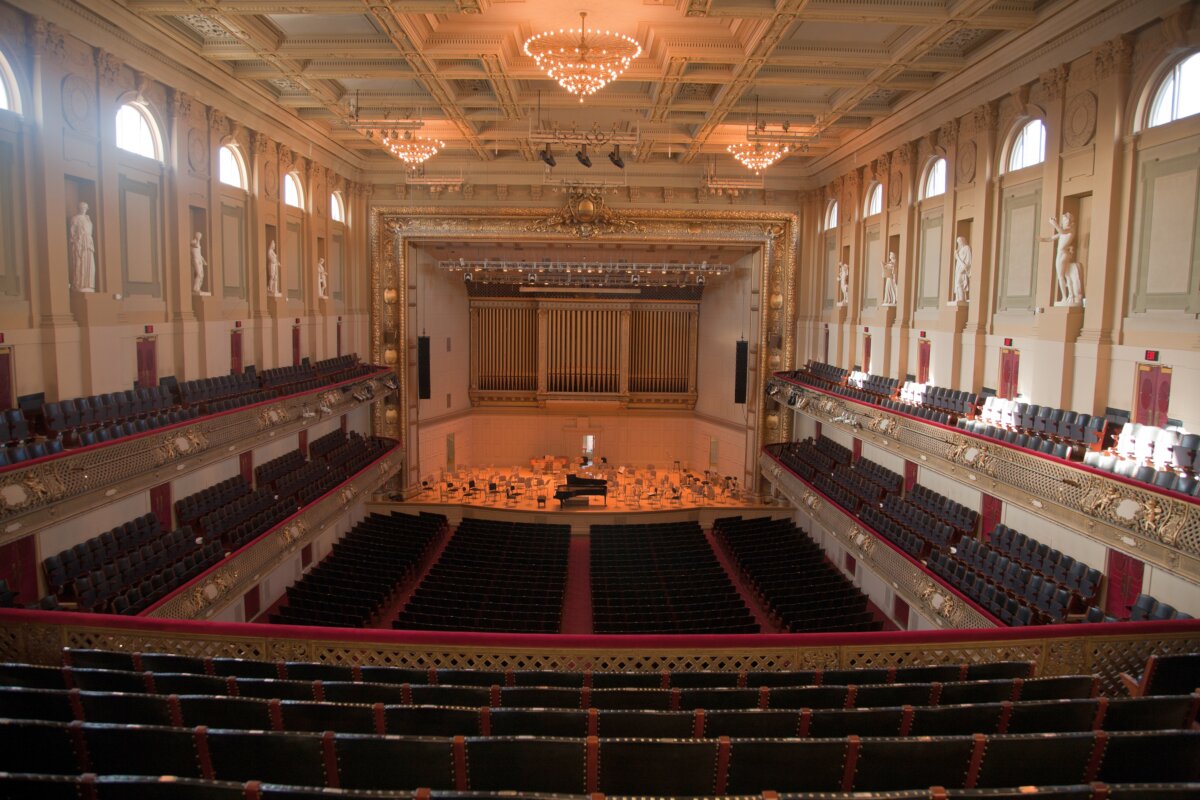
There we were, a group of us, at the remarkable Symphony Hall in Boston, Massachusetts. The ceilings are beautifully sculpted. Trim everywhere is gilded. The chairs are leather. Statuary from the ancient world rests on sconces all around the room. The interior is perfectly preserved, and the acoustics are perfect.
The Boston Philharmonic was performing Gustav Mahler’s 3rd Symphony, 100 minutes of astonishing beauty and majesty, played with breathtaking virtuosity by the professional musicians before us, with a boys’ choir in the loft for the famous fifth movement. The evening was a deep investment of time but worth every minute. It felt like home for the romance of the times that gave rise to such achievement.
The concert hall was opened in 1900, a time that, in many ways, was the height of interior design and when the symphonic repertoire had reached its apotheosis of perfection. Spirits were high in those days, coming after half a century of amazing innovation and progress.
Remember that this was before the Great War revealed what depths governments were capable of, so optimism among the intelligentsia and arts-going public was as high as it had ever been.
Listening to this piece in this venue provides a remarkable solace for the disappointments and fears of our own times. The music triggers a kind of nostalgia, even though it is timeless. One can hope that it will always be with us as a way of pointing to the highest ideals.
The audience cheered louder and longer than I can remember having witnessed, which was a particular delight. Every section of the orchestra was singled out, and the mezzo-soprano, whose presence was constrained but loomed large, was presented with roses and cheered to the rafters. The eight-person French horn section did the hard work of the evening and was repaid the only way the audience knew how: cheers and shouts for minutes.
This is all to the good. For most of recorded history, musicians, actors, dancers, and painters occupied a surprisingly low rung. They were rarely seen as noble or respectable figures. Instead, they were often regarded as decadent, emotionally indulgent, attached to frivolous and imaginative fripperies, and, crucially, low-born. Their profession carried an air of moral suspicion and social inferiority.
In ancient Rome, for example, no self-respecting citizen of the senatorial or equestrian class would have dreamed of allowing his sons or daughters to pursue the arts as a profession. Acting, in particular, was considered deeply disreputable. Roman actors (histriones) were often slaves or freedmen, and the profession was legally and socially stigmatized.
Even successful performers could be barred from certain civic rights. Philosophers such as Plato were deeply ambivalent about the arts, fearing that poets and dramatists stirred dangerous emotions and distracted citizens from reason and duty. In many Greek city-states, while drama and music were central to religious festivals, professional performers themselves were often looked down upon as itinerant or mercenary. St. Augustine himself was concerned that music itself constituted a divergent path from salvation itself.
This dismissive attitude toward “the talent”—as we casually call performers today—persisted across cultures and eras. In medieval Europe, traveling minstrels and players were frequently lumped together with vagabonds and beggars in the eyes of the law. Guilds and respectable society kept a careful distance.
Even in Renaissance Italy, where artists achieved unprecedented fame and patronage, many painters and sculptors still had to fight the perception that they were glorified craftsmen rather than intellectuals or gentlemen. Michelangelo himself bristled at being treated as a mere artisan by some of his patrons.
The bias seems to run deeper than any particular historical moment. It shares striking similarities with the long-standing prejudice against merchants and traders. Both artists and merchants were seen as people who dealt in intangibles—beauty, emotion, pleasure, or profit—rather than in the solid, tangible virtues of land, warfare, law, or religious authority.
Both groups appeared to live by their wits, their charm, or their ability to manipulate desire, both in performance and financing. In hierarchical, agrarian, or martial societies, such fluidity and dependence on the approval of others carried the whiff of servility or moral compromise.
Of course, there were exceptions. Court musicians in some eras enjoyed high status. A handful of superstar painters or composers could achieve wealth and titles. But these were anomalies that proved the rule: The class as a whole was viewed with suspicion or condescension.
The derogatory feeling toward performers was not always undeserved—some artistic scenes have indeed been marked by excess, instability, and moral laxity—but mostly it seems to have stemmed from a deeper, almost instinctive cultural bias against those who make their living by evoking feeling, fantasy, and beauty rather than by producing necessities or enforcing order.
Even today, echoes of this ancient prejudice linger beneath the surface. We celebrate celebrity artists with one hand while quietly dismissing the “artsy” types as impractical or unserious with the other.
You can see it in funny old movies, such as “42nd Street,” “Gold Diggers of 1933,” and other narratives surrounding old Busby Berkeley movies with their spectacular display of dancers in complicated arrangements. The stories reveal how, during the Great Depression, the artists were among the first rung of luxury to be cut off.
The song “We’re in the Money” is actually about how women who moved to the city to perform in shows figure out how to get along in other ways should a show fail, a subtle slap at the profession itself, with a wink and a nudge.
Even now, you see a class structure at work in the arts as well-to-do families do their desperate best to steer their children away from the arts and toward business, law, and medicine. This is not only because of the income differences but mainly because of what inhabiting artistic professions suggests about social status.
The period in which the artists began their social dramatic ascent was in the 18th and 19th centuries, the same period of remarkable economic growth and technological change. Art was no longer seen as a sideshow to civilization but essential to it. At the same time, the merchant too achieved the same with the realization of how central commerce innovation was to prosperity.
Truly great societies elevate the arts, not merely their most commercial or fashionable expressions, but the works that reach toward the transcendent, the beautiful, and the true. Their presence signals that something profound is intact: a recognition that human life is about more than survival, power, or material comfort. It suggests confidence, generosity of spirit, and a healthy hierarchy of values. A civilization that reveres its greatest artists is, in the end, revering its own highest possibilities.
Mahler’s 3rd symphony, which was released in 1896 and debuted in the United States in 1902, made its appearance at about the same period as Boston’s Symphony Hall opened its doors to the public, complete with its gilding and statuary. This turning away from the ancient bias and toward a confident outlook on the highest art—along with the valorization of musical talent and conductors—represents the many ways in which progress had been made real.
So long as symphonies this mighty and wonderful are making their way to our cities, not all is lost. We must keep the talent and energies alive, even in dark times, or everything will be in vain. For my own part, no matter how dark the world around me might feel, my spirits will always be lifted when I think about such glorious works of art. Seeing them live is like no other experience.
Views expressed in this article are the opinions of the author and do not necessarily reflect the views of The Epoch Times.
 Friends Read Free
Copy
Facebook
Tweet
Friends Read Free
Copy
Facebook
Tweet