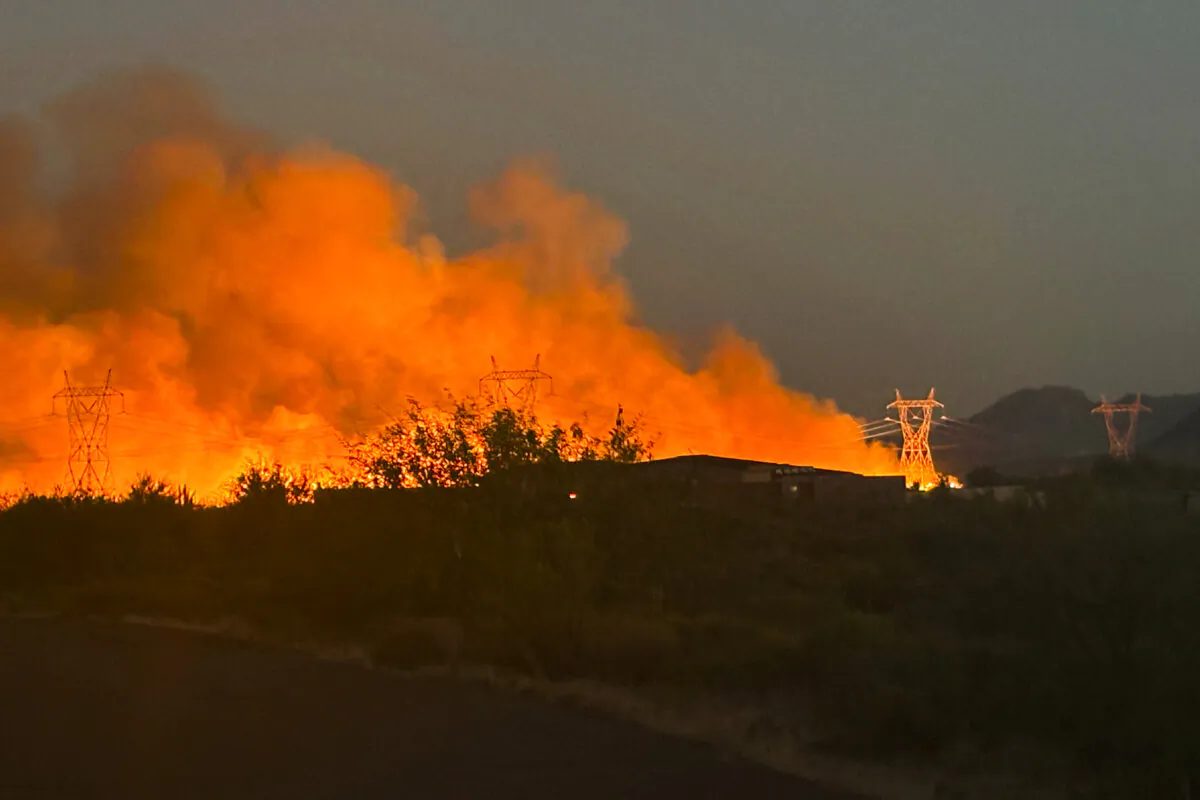

PHOENIX—A new interagency dispatch center is boosting Arizona’s wildfire response with artificial intelligence-powered cameras that officials say can detect fires earlier and speed emergency crews to the scene.
On March 27, Gov. Katie Hobbs unveiled the new camera technology aimed at strengthening wildfire prevention ahead of peak season.
Arizona’s wildfire season typically runs from mid-March through early September.
“Every minute and every second counts when a wildfire breaks out,” Hobbs said in a statement.
“We are leveraging emerging technologies and staying ahead of the curve to keep people safe and mitigate the threat of wildfires, while making it easier for our first responders to do their jobs.”
She called the technology a “generational leap” in community protection and a long-term investment in public safety.
The new AZFIRECAM project uses seven 360-degree cameras to detect smoke and alert the Arizona Interagency Dispatch Center (AIDC), which opened in March, enabling faster response in the critical early moments of a wildfire.
“AI wildfire cameras are a major advancement in early wildfire detection, giving our firefighters and dispatchers the critical intelligence they need to respond faster and better protect our communities,” State Forester and Department of Forestry and Fire Management Director Tom Torres said in a statement.
“These cameras are an investment not only for the department but for the entire state of Arizona.”
The seven wildfire detection cameras will be deployed statewide in Sawmill, north of the Hualapai Mountains; at Blake Ranch in Mojave County; in Wittmann in western Maricopa County; at Foreman Wash near Tucson; in Dudleyville and Suffering Gulch, northeast of Oracle Junction in Pinal County; and in the Chiricahua region, south of the Dragoon Mountains.
In February, the state broke ground on the $4.2 million, 7,000-square-foot AIDC, a new hub aimed at streamlining response during wildfires.
Located in Deer Valley, the AIDC oversees the coordination of resources for wildfires and other emergency situations across the state.
The facility, now three times larger than its previous location, handles thousands of operational and logistical requests each year for both immediate and extended response efforts.
The center deploys aircraft, field crews, equipment, and personnel throughout Arizona and provides support to federal and state agencies nationwide.
It also monitors incidents statewide and issues comprehensive reports to inform response strategies.
Among the most common causes of wildfires are sparks from dragging safety chains, tire blowouts, and other vehicle-related incidents, according to Arizona Interagency Wildfire Prevention.
“It only takes one spark on dry grass, leaves, branches, or pine needles to start a wildfire,” the agency’s website reads. “Even live trees and brush are dry enough to easily ignite.”
Arizona has faced a volatile wildfire trend in recent years: 2,519 fires burned nearly 1 million acres in 2020; 1,774 fires destroyed more than 500,000 acres in 2021; and in 2022, 1,248 fires consumed 145,422 acres.
 Friends Read Free
Copy
Facebook
Tweet
Friends Read Free
Copy
Facebook
Tweet