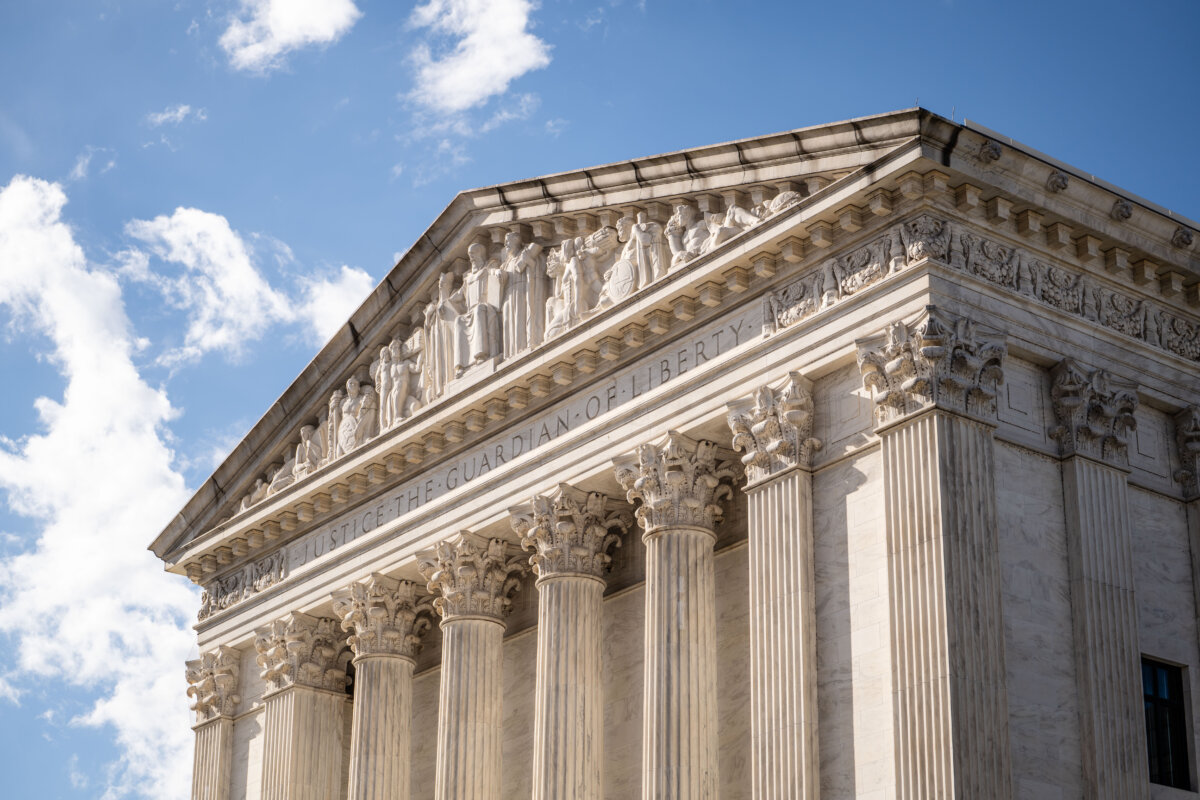

More than 200 congressional Democrats have signed onto an amicus brief to the Supreme Court in support of legislative limits on the president’s ability to fire key officials in independent agencies.
Submitted on Nov. 14, the brief came as part of a case in which the justices are expected to rule on whether President Donald Trump’s removal of Federal Trade Commission (FTC) member Rebecca Slaughter was invalid. Trump has asked the Supreme Court to reverse a lower court order reinstating Slaughter, alleging that Congress intruded on presidential authority by limiting the reasons for which he could remove her.
The case, known as Trump v. Slaughter, is calling into question a 90-year-old Supreme Court precedent and could have lasting effects for the nation’s separation of powers.
In their amicus brief, 206 congressional Democrats and Sen. Bernie Sanders (I-Vt.) told the justices that the legislative process should determine whether presidents should have a particular cause for removing members of agencies such as the FTC.
“If the President believes that there is reason to reconsider the removal protection for the FTC or other independent agencies, he can certainly make that argument to Congress, and ultimately to the people themselves,” they said. “But the Court should leave the current debate over the ongoing desirability of the for-cause removal provisions where it belongs—within the legislative process.”
Slaughter has invoked the FTC Act of 1914, which states that commissioners can only be removed for “inefficiency, neglect of duty, or malfeasance in office.” When Trump sent a message to fire Slaughter, he did not identify any of the reasons identified by the FTC Act. According to the Justice Department, he shouldn’t have to because of Article II of the Constitution, which vests the president with the executive power of the federal government.
One of the questions before the Supreme Court is whether to overrule Humphrey’s Executor v. United States, a landmark precedent from 1935. In a unanimous decision, the court stated that the FTC Act didn’t intrude on the president’s authority. Although the FTC is part of the executive branch, the Supreme Court held in Humphrey’s that Congress could set limits on removing members because of the structure of the commission and its responsibilities.
More specifically, it stated that the commission shouldn’t be considered “an arm or eye of the executive,” which would allow the president, head of the executive branch, to remove the agency’s officials without cause.
“To the extent that it exercises any executive function—as distinguished from executive power in the constitutional sense—it does so in the discharge and effectuation of its quasi-legislative or quasi-judicial powers, or as an agency of the legislative or judicial departments of the Government,” the precedent ruling reads.
The Justice Department told the Supreme Court in October that its prior decision mischaracterized the nature of the FTC’s power, which the administration stated was executive, and that the decision might have been outdated.
“The FTC has accumulated executive powers that Humphrey’s Executor never considered,” the Justice Department stated.
In their amicus brief, the members of Congress defended their ability to pass for-cause removal restrictions such as those in the FTC Act. Article I of the Constitution offered “broad power to structure agencies to best effectuate their missions.” They also highlighted multimember boards with removal protections as reinforcing constitutional values.
“Specifically, multimember boards reinforce the constitutional design of dividing power among multiple actors,” the brief reads. “They also promote democratic accountability and effective governance, protect individual liberty, and ensure due process.”
However the court rules, its decision could impact the future of the federal bureaucracy. Both the administration and congressional Democrats tied Humphrey’s Executor to the proliferation of other independent agencies.
The Supreme Court has offered tentative rulings on Trump’s decisions to fire individuals from some of those agencies, such as the National Labor Relations Board and Consumer Product Safety Commission. But Slaughter’s case, in particular, could set the tone for how courts decide those cases and future ones like them.
 Friends Read Free
Copy
Facebook
Tweet
Friends Read Free
Copy
Facebook
Tweet