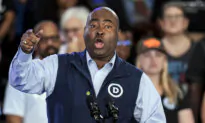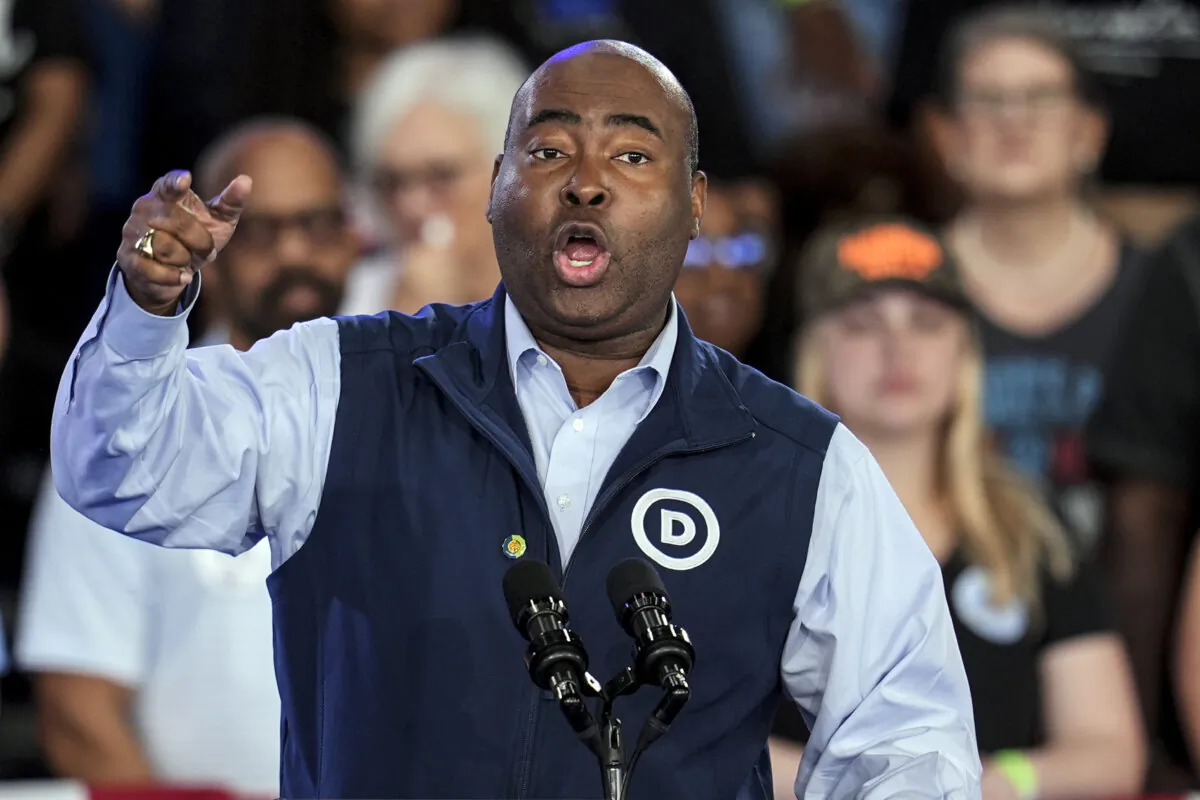

Former Democratic National Committee Chairman Jaime Harrison is urging his party to view the 2026 midterms as an opportunity similar to that of 2006, when Democrats won control of Congress during President George W. Bush’s second term.
In a blog post published on Aug. 25, Harrison recalled the lead-up to the 2006 midterms, when voters delivered a win for Democrats in Washington.
“Democrats remember the punch in the gut that was 2004,” he wrote, drawing comparisons to the mood in the party after 2024 losses.
“We lost the White House, we bled House seats, and we watched a string of Senate races slip away, especially across the South. The mood in the party felt heavy. People wondered whether the map had moved for good. Then came something that always changes politics. Overreach.”
He cited the Iraq War and the Bush administration’s efforts to privatize Social Security as policies that shifted public sentiment, while corruption scandals added to voter discontent.
Harrison said Democrats made gains that year by investing in party infrastructure and contesting races across the country.
“I was the Executive Director of the House Democratic Caucus in 2006, and I saw this shift happen up close,” he wrote.
“We did not just sit back and wait for the wave. We built it.”
He argued that Democrats now face a comparable moment following President Donald Trump’s 2024 election win and unified Republican government.
“Republicans passed the Big Beautiful Bill and then told the country to trust them,” Harrison wrote.
He wrote that it is his belief—as it is the belief of many Democrats—that the bill’s effects will be received negatively in communities across the United States.
The One Big Beautiful Bill Act, passed by Congress and signed into law by Trump earlier this summer, made the president’s 2017 tax cuts permanent. It also provided tax breaks on tips, overtime pay, and Social Security income while directing new funding to defense and border security.
Republican leaders have said that the legislative package will streamline government and spur economic growth, warning that without it, most families would soon face a tax increase. They have also defended the law’s restructuring of safety net programs, saying that it will promote work, reduce dependency, and ensure benefits for Americans.
The law includes new Medicaid eligibility requirements and reimbursement changes that the Congressional Budget Office has projected could increase the number of uninsured Americans by 7.7 million.
Republicans dispute that estimate, pointing to provisions such as a new Rural Hospital Stabilization Fund aimed at offsetting impacts on health care access. Democrats have criticized the law as harmful to working families, saying it could lead to hospital closures, higher premiums, and reduced access to care.
Harrison also pointed to what he called a “pattern” of Republican actions that could be negatively perceived by voters, including “attacks on universities and research,” “purges of diversity and inclusion programs,” “cuts to public media,” and “redistricting games in red states.”
He also compared frustration over the Iraq War in 2006 to how “the ongoing tragedy in Gaza is shaping similar disillusionment” today.
Democrats themselves faced infighting during their summer meeting in Minneapolis over the Israel–Gaza issue.
Harrison outlined four steps Democrats should take to prepare for 2026: First, organize early, then organize again; second, recruit everywhere; third, register voters relentlessly; and fourth, draw a sharp choice.
He called for Democrats to run candidates in all 435 House districts, expand voter registration, and sustain party investments at the state level.
“Every rally, every speech, every town hall should have volunteers registering new voters,” Harrison wrote. “Take the passion and turn it into votes.”
He pointed to gubernatorial races in Nevada and Michigan in 2026 and senatorial races. He said Roy Cooper in North Carolina, Sherrod Brown in Ohio, Annie Andrews in South Carolina, and Chris Jones in Arkansas will be strong candidates if they win their primaries next year.
“I have seen this party take a bleak set of odds and turn it into a mandate,” Harrison wrote.
 Friends Read Free
Copy
Facebook
Tweet
Friends Read Free
Copy
Facebook
Tweet