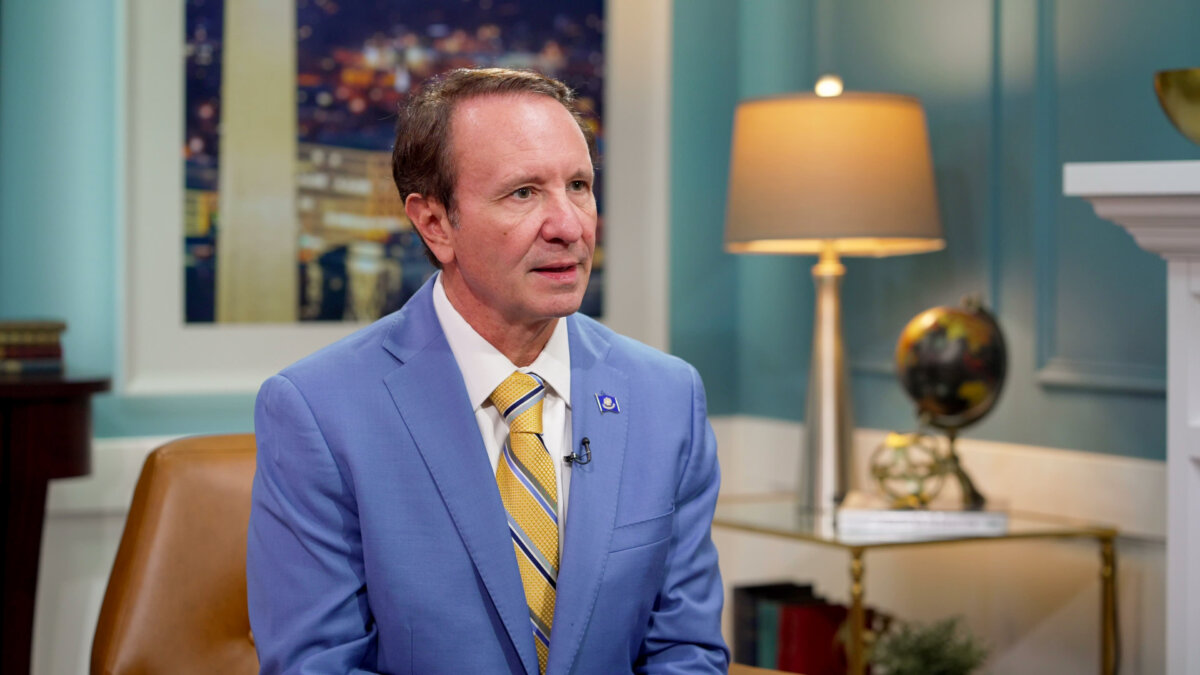

WASHINGTON—Louisiana Gov. Jeff Landry says his state is stuck in the middle of a conflict between “one law and the U.S. Constitution,” and he is hopeful that the U.S. Supreme Court will use two joined cases currently before it to finally “untangle” the situation.
Landry in an interview with EpochTV’s “American Thought Leaders” host Jan Jekielek said he didn’t think the justices would completely eliminate Section 2 of the Voting Rights Act, but that they would probably “narrow it.”
“I think that [Chief Justice John Roberts] is tired of all of the redistricting cases going up to the court,” Landry said. “Each time they seem to issue an opinion on a case, they only further entangle themselves in additional redistricting litigation, and so I think the court is exhausted with redistricting cases, and this is their opportunity to finally put them to bed.”
Section 2 of the Voting Rights Act prohibits states from passing laws that discriminate against voters based on “race or color.” In recent years, courts have interpreted that section to mean that when a state is able to draw congressional maps that include a majority-African American district, they must do so.
That interpretation seems to rub up against the Equal Protection Clause of the 14th Amendment, Landry said, and that friction is at the heart of the case of Louisiana v. Callais, on which the Supreme Court heard oral argument on Oct. 15.
“The state of Louisiana has been embroiled and embattled inside of redistricting litigation since the 90s, since the court came out with what they called the ‘Gingles test,’” Landry said.
That test, based on the 1986 Thornburg v. Gingles case, is used to determine whether a state has drawn its congressional map in a way that dilutes minority voting power.
That dilution can happen if a state splits up a concentrated minority population between several districts, resulting in minority groups being unable to vote as a bloc in any one district, sometimes referred to as “packing and cracking.”
To prove vote dilution, the minority group must show three things: The group is politically cohesive, it tends to vote as a group, and it is large enough to be a majority in a single-member district.
Louisiana’s 2022 district map, which defines the state’s six congressional districts, was hit with a lawsuit when minority voters argued it should contain a second mostly black district, since that demographic makes up one-third of the state’s population.
A federal judge agreed.
“She said, ‘Either you’re going to draw new congressional districts, granting Louisiana a second minority-majority district,’ or she was going to draw them for us,” Landry told Jekielek in an interview that will air on Oct. 17.
“I believe that the right way to draw a congressional district is through the legislature, so I called them in. I said: ‘Listen, ladies and gentlemen, this is your opportunity. If you don’t draw it, she’s going to draw it. If you draw it, you’re in control.’ They drew it.”
But then, a group of non-minority voters said the new maps were unconstitutional because they were drawn based on racial considerations. Those voters also sued the state, and those combined cases were heard by the Supreme Court on Oct. 15.
Landry said he hopes the cases will serve as a vehicle to do away with such judicial interference.
“We did what we were instructed to do by a federal judge … Federal judges should not be involved in political processes, or telling legislators or mayors or police chiefs how to govern, and that’s what’s been going on over the last 20 to 30 years,” he told Jekielek.
“And hopefully this case will remove the federal courts from a legislative function.”
In 2013, the Supreme Court struck down one portion of the Voting Rights Act that required some states—those with a history of race-based voter discrimination—to get federal approval before changing any of their voting laws.
The governor said that such measures—including the Gingles test—had a valid place in the past when minority voter suppression was common, but are probably no longer necessary.
“The Constitution is colorblind,” Landry said.
“The Voting Rights Act ensured that there were no discriminatory practices in limiting people’s rights to vote or to access the ballot, and so we’ve come a long way in that 50-plus years. We have a majority of the Congressional Black Caucus that has been elected … in districts that are not Voting Rights Act-mandated districts. We’ve had a black president … I think that the test is no longer needed.”
The legal battles have taken a heavy toll on his state over the last decade.
“Look, we spent over $40 million since 2012 litigating congressional redistricting cases,” Landry told Jekielek.
“That’s $40 million I couldn’t spend on schools in classrooms, on teacher pay raises, on roads, bridges; services that actually help the people of Louisiana.”
The governor also said the timing of the court’s decision may have an effect on the upcoming midterm elections.
Under a rule called the Purcell doctrine, courts refrain from changing election laws in the middle of an election. If the ruling is delayed as a result of this doctrine, it will have more effect on the 2028 election, Landry said.
 Friends Read Free
Copy
Facebook
Tweet
Friends Read Free
Copy
Facebook
Tweet