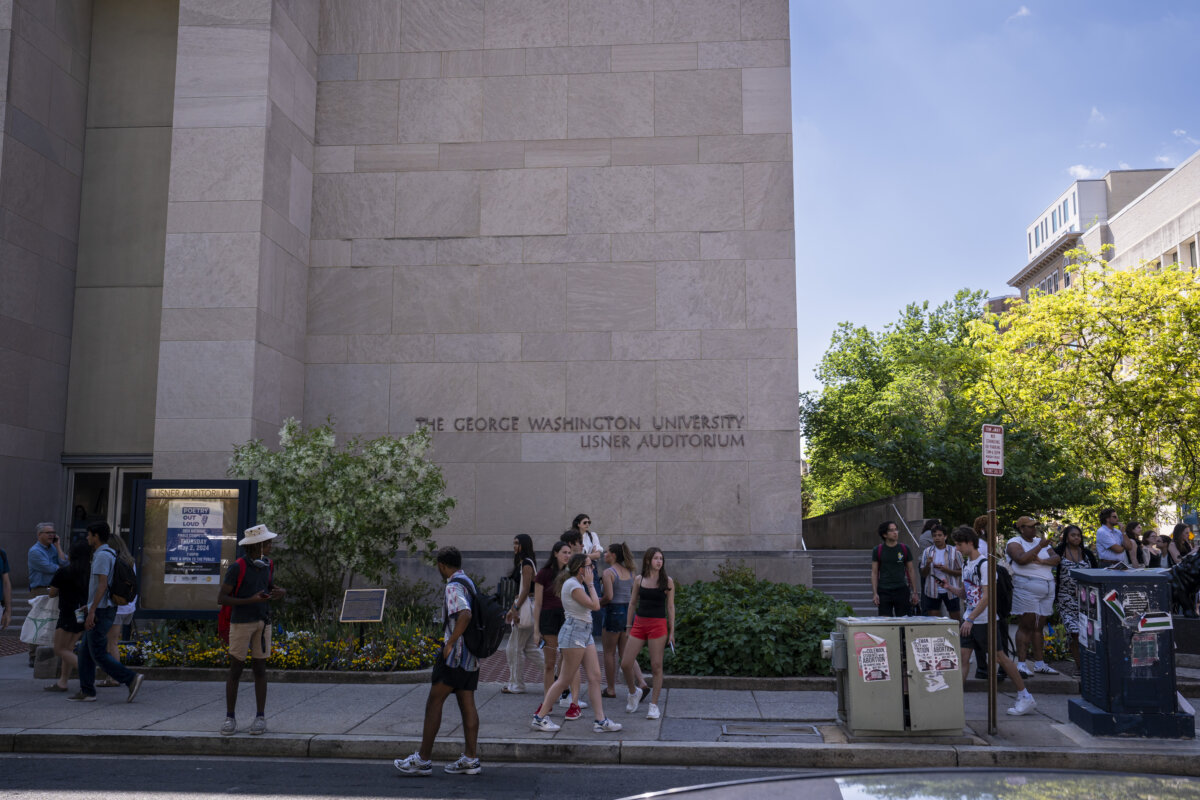

George Washington University and 52 other medical schools are going to require more education on nutrition for future doctors, federal health officials said on March 5.
The schools have pledged to mandate that students complete a minimum of 40 hours of nutrition education across their undergraduate programs, or complete a “minimum 40-hour competency equivalent,” beginning in the fall, the Department of Health and Human Services said.
“This is how we make America healthy again,” Health Secretary Robert F. Kennedy Jr. said at a briefing in Washington.
He said later that the commitment “shifts [the] system towards prevention, instead of perpetual prescriptions.”
The schools include George Washington University, Tufts University, and the University of Utah. A full list is available at HHS.gov.
“This is a truly historic day,” University of Nebraska President Dr. Jeff Gold said at the briefing.
Some school officials felt that a different method was more appropriate, so they will be implementing a 40-hour competency equivalent, based on guidance developed by Kennedy’s agency, officials said.
There are approximately 163 schools in the United States that offer doctor of medicine degrees, with about 100,000 students.
Kennedy has for months lamented that medical schools do not provide more nutrition training. He said at a rally in Texas in February that when he broached the subject, schools told him that they needed to teach for tests, which did not include nutrition questions.
A survey of medical schools published in 2015 found that most failed to provide at least 25 hours of nutrition education, and that such instruction was largely still provided in preclinical courses.
“Many U.S. medical schools still fail to prepare future physicians for everyday nutrition challenges in clinical practice,” the researchers wrote.
A survey of medical students released in 2023 found that they reported receiving an average of 1.2 hours of nutrition education per year.
“Funding and curricular changes should be allocated towards expanding the nutrition curriculum across U.S. medical schools,” researchers reporting the results said.
And researchers in 2024 determined that three-quarters of medical schools in the United States do not require clinical nutrition classes.
The Association of American Medical Colleges, a nonprofit, has said that schools do not provide enough nutrition training but that nutrition education has been increasing. Personnel with the association and other entities such as the American Medical Association worked with health officials to reach the agreements with the 53 schools.
“We applaud the administration for recognizing that if we’re serious about prevention, nutrition must be foundational in medical education,” American Medical Association President Dr. Bobby Mukkamala said in a statement.
“Giving physicians the skills to have impactful conversations with our patients about food and lifestyle is one of the most practical, immediate steps we can take to improve health and prevent disease.”
 Friends Read Free
Copy
Facebook
Tweet
Friends Read Free
Copy
Facebook
Tweet