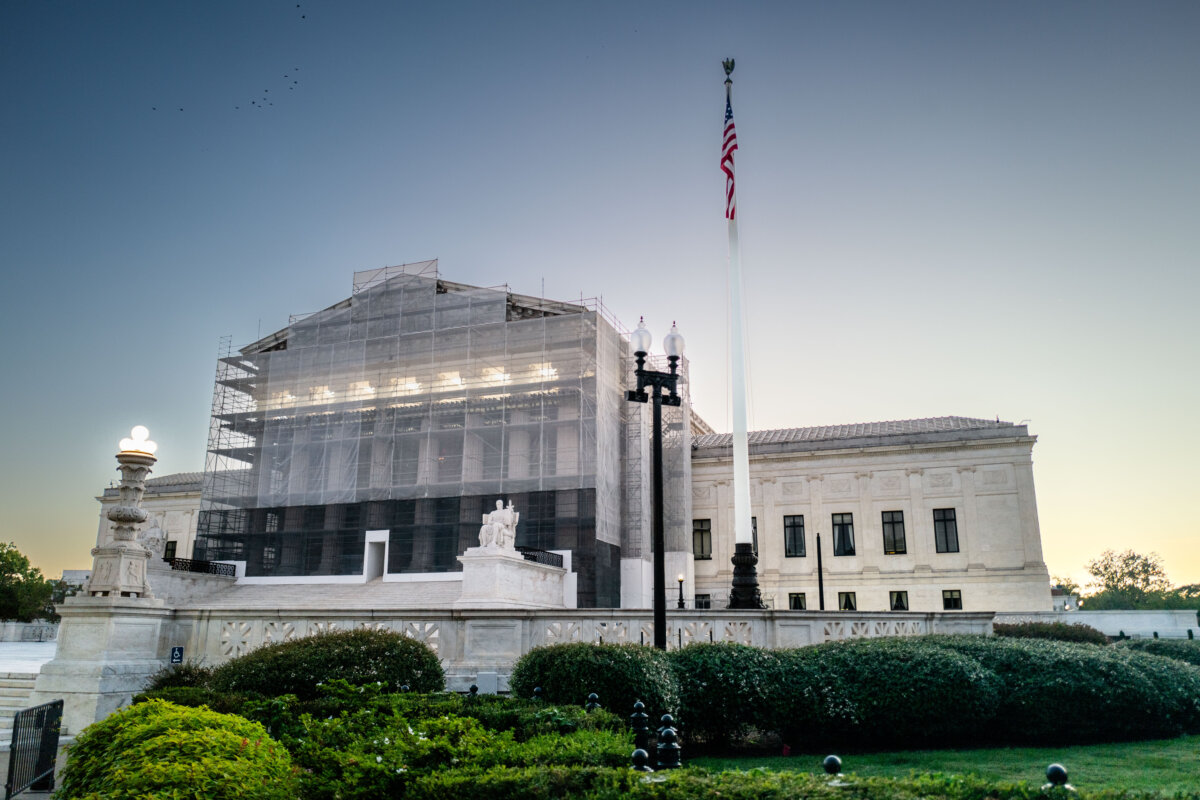

The Supreme Court held oral argument on Oct. 14 in a case that prompted the justices to wrestle with whether crime victims’ restitution should be considered a form of punishment under the Constitution.
The ex post facto clause of the Constitution prohibits Congress from retroactively punishing someone for conduct that was legal at the time it was performed.
The case before the Supreme Court focuses on a man named Holsey Ellingburg Jr., who was convicted in 1996 of committing a bank robbery in Georgia. Ellingburg was sentenced to nearly 27 years in prison and five years of supervised release, and was ordered to pay more than $7,500 in restitution.
While serving his sentence, he made multiple payments, but he argued before the Supreme Court through his attorney, that the federal government was seeking to charge him for a longer period of time than was allowed under law.
At the time he committed the robbery in 1995, Congress had passed the Victim and Witness Protection Act, which required criminals to pay restitution for 20 years after a judgment had been entered against them. Because Ellingburg was convicted and sentenced in 1996, he argued that he should have been able to stop submitting payments in 2016—regardless of how much he still owed at the time.
The federal government said he should continue paying restitution, as well as accrued interest, because in the year that Ellingburg was convicted, 1996, Congress passed another law known as the Mandatory Victims Restitution Act (MVRA), that required criminals to pay for a longer period of time, and to pay interest.
The new law allowed defendants to stop paying 20 years after either a judgment was issued against them or they were released from prison, whichever was later.
Ellingburg argued that applying the MVRA to him unconstitutionally imposed an ex post facto punishment. His position is that the continued restitution payments were ex post facto because they represented a criminal penalty and stemmed from a law that was passed after he committed his crime in 1995.
After Ellingburg challenged the continued restitution in federal court, his case eventually reached the U.S. Court of Appeals for the Eighth Circuit, which held last year that Ellingburg’s continued restitution payments did not violate the ex post facto clause because those payments were a civil remedy rather than a criminal punishment.
Oral Argument
During the Oct. 14 session, the Supreme Court heard a range of arguments. Ellingburg’s attorney, Amy Saharia, argued that the appeals court was wrong and that the MVRA imposed a criminal punishment in a manner that violated the Constitution.
The federal government, represented by Assistant to the Solicitor General Ashley Robertson, joined Ellingburg in arguing against the appeals court decision but nevertheless supported the restitution obligation. Robertson said that while the restitution ordered under the MVRA was a form of criminal punishment, it did not violate the ex post facto clause.
Instead, the Trump administration argued that the federal government has the authority to alter the duration of a punitive restitution obligation.
The government asked the Supreme Court to vacate the appeals court’s decision and send it back so that court can reach a similar result with different reasoning.
Another attorney, John Bash, appointed by the Supreme Court to argue in favor of the Eighth Circuit’s decision, told the justices that the MVRA advanced a “pure compensation regime that parallels the tort system,” adding that it was “characteristic of the civil tort system.”
Bash encountered pushback from multiple justices, including Justice Elena Kagan who said that “compensation can be a form of punishment.”
Much of the exchange between Bash and the court focused on how to interpret Congress’s intent in passing the MVRA. Kagan, along with Justices Ketanji Brown Jackson and Neil Gorsuch, asked questions that suggested they thought that Congress was using the restitution as a form of punishment.
Justice Samuel Alito seemed skeptical of the idea that restitution was a criminal punishment rather than a civil remedy. While speaking with Saharia, Alito noted that victims could enforce the restitution as a judgment lien under state law. “Are you aware of any criminal punishments that victims can enforce personally?” he asked.
Later, Alito suggested to Robertson that Congress had used language to indicate it was interested in assisting victims. “If Congress says our intent is to assist victims, isn’t that open and shut then?” he asked.
Saharia said the MVRA was probably the only instance of that, but added that the law didn’t give victims “the full range of civil enforcement mechanisms.” She said that “it’s telling that Congress treated restitution just like criminal fines.”
However, Kagan questioned why a punitive law would allow victims to come forward later to offer proof of further damages—as the MVRA does—saying that such a provision seemed “very odd if the statute is primarily punitive.”
 Friends Read Free
Copy
Facebook
Tweet
Friends Read Free
Copy
Facebook
Tweet