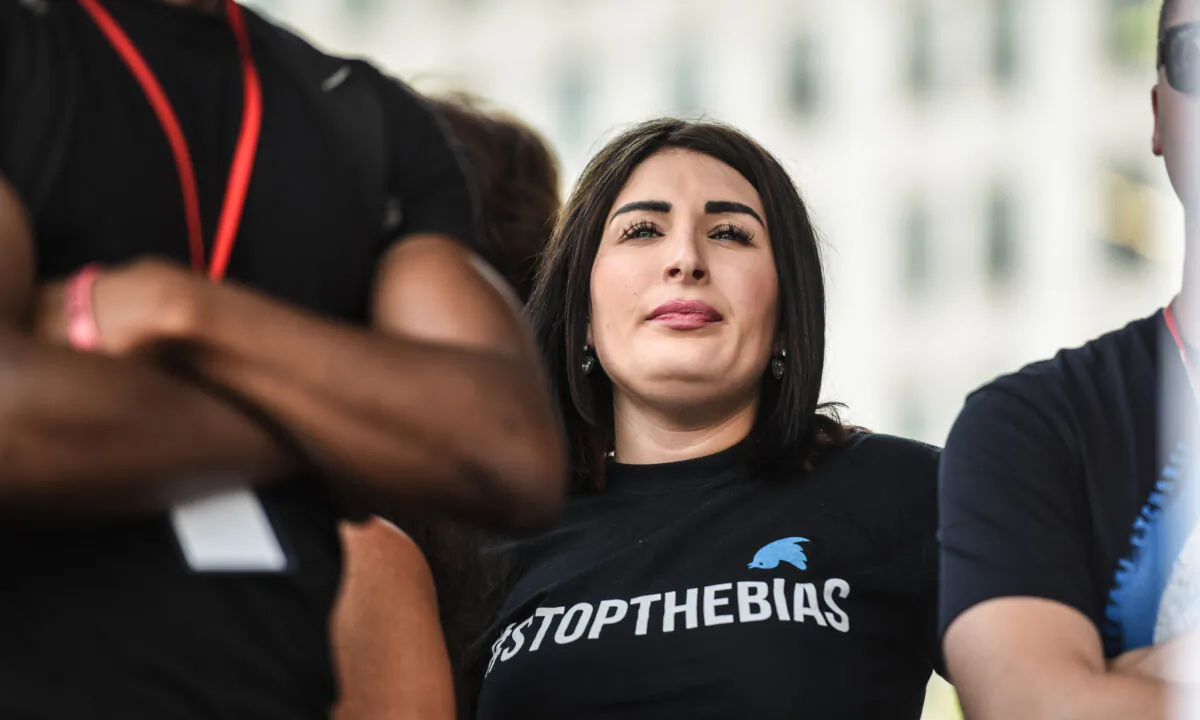

The U.S. Supreme Court on Oct. 6 declined to hear an appeal filed by conservative influencer Laura Loomer, who accused social media companies of conspiring to suppress her speech and undermine her congressional campaigns.
Loomer sued Meta and Twitter—now rebranded as X—in 2022 over her removal from the platforms.
Twitter suspended Loomer in 2018 for what it described as hateful conduct. Facebook banned her in 2019, along with other high-profile people it labeled as “dangerous individuals.”
These censorship efforts, she said, had undermined her bids for Congress in Florida’s 21st and 11th districts in 2020 and 2022, respectively.
“Social media is critical to campaigns, especially during COVID-19 restrictions that limited traditional campaigning methods like door-to-door canvassing and public events,” her lawyers wrote in a June 25 petition to the Supreme Court. “Loomer had no social media for any of her campaigns due to social media bans.”
Loomer’s original complaint named a range of defendants, including Twitter and its former CEO, Jack Dorsey; Meta and its CEO, Mark Zuckerberg; consumer goods maker Procter & Gamble; and several unidentified federal employees.
In her petition to the Supreme Court, she alleged that the companies and officials conspired “with Google, YouTube, and Instagram to unlawfully censor conservative political speech,” specifically targeting her campaign communications to sway federal elections.
The lawsuit also alleged that Procter & Gamble pressured Meta to ban her and others unless they publicly disavowed affiliation with the right-wing group Proud Boys. She also alleged that federal officials, including personnel from the FBI and White House, collaborated with Meta and X to “suppress conservative content,” citing Facebook’s temporary suppression of the New York Post’s 2020 Hunter Biden laptop story.
A federal judge in San Francisco dismissed the case in 2023 on several grounds, including res judicata, or that a claim cannot be relitigated once a court has issued a final judgment. The judge found that Loomer’s claims against Meta and X were barred because her prior lawsuit alleging an “anti-conservative” conspiracy among Twitter, Facebook, Google, and Apple addressed the same facts. That lawsuit was dismissed in 2020 by the District of Columbia Circuit Court of Appeals.
The judge also held that Meta and X were protected under Section 230, the federal law that generally shields online platforms from liability for content moderation decisions.
The court further rejected Loomer’s Racketeer Influenced and Corrupt Organizations Act (RICO) claim, finding that her allegations described lawful business practices rather than racketeering activity.
In March, the San Francisco-based Ninth Circuit Court of Appeals agreed with the dismissal, saying that Loomer made no plausible argument that the companies violated RICO.
“The operative complaint simply alleges that there was a RICO enterprise because the Defendants had the ‘common goals of making money, acquiring influence over other enterprises and entities, and other pecuniary and non-pecuniary interests,'” the appeals court wrote. “These allegations are not sufficient to plausibly allege Defendants constitute ‘a continuing unit that functions with a common purpose.'”
In her petition to the high court, Loomer countered that the Ninth Circuit erred and said the case deserved a review.
“These issues are of paramount national importance, as they implicate the fairness of federal elections and the integrity of public discourse in the digital age,” her legal team wrote to the justices. “The Court’s review will provide critical clarity on these legal questions, ensure accountability for platforms and their collaborators, and safeguard democratic processes.”
The justices did not take up the case. In a brief statement, the court noted only that “Justice [Samuel] Alito took no part in the consideration or decision of this petition.”
It was not immediately clear why Alito recused himself.
Loomer’s account was reinstated after Elon Musk, who proclaimed himself a “free speech absolutist,” acquired Twitter in 2022 in a $44 billion deal.
“I may not ever get the justice I deserve, but I’m still standing with my head tall after being knocked down by the most powerful tech companies in the world,” she wrote on X following the Supreme Court’s decision.
The Epoch Times reached out to Loomer, Google, Meta, and Procter & Gamble for comment but did not receive a response by publication time.
 Friends Read Free
Copy
Facebook
Tweet
Friends Read Free
Copy
Facebook
Tweet