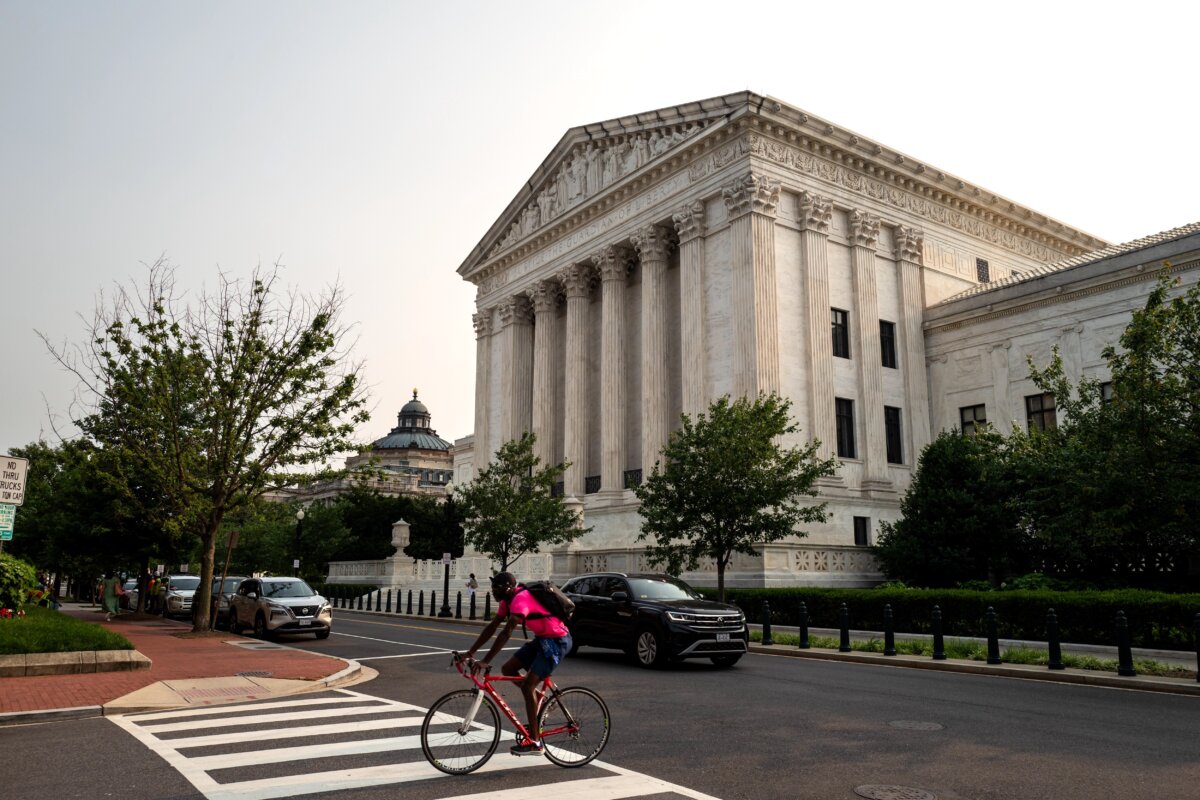

The Supreme Court has rejected Texas’s attempt to sue the federal government over nuclear waste storage in the state.
A majority of the court said Texas and a business known as Fasken Land and Minerals weren’t entitled to a review of the Nuclear Regulatory Commission’s decision to license a temporary storage facility. The court declined to address the bigger question of whether that type of licensing was allowed under law.
Justice Brett Kavanaugh wrote the majority opinion. Justice Neil Gorsuch dissented and was joined by Justices Samuel Alito and Clarence Thomas.
The U.S. Court of Appeals for the Fifth Circuit handed the state a win when it ruled that two laws—the Nuclear Waste Policy Act and the Atomic Energy Act—did not allow the federal government to license private facilities.
A majority of the Supreme Court, however, said that neither Texas nor Fasken were party to the Nuclear Regulatory Commission’s licensing proceeding and therefore couldn’t challenge it in court.
“Texas and Fasken are not license applicants, and they did not successfully intervene in the licensing proceeding. So neither was a party eligible to obtain judicial review in the Fifth Circuit,” Kavanaugh wrote.
“For that reason, we reverse the judgment of the Court of Appeals and do not decide the underlying statutory dispute over whether the Nuclear Regulatory Commission possesses authority to license private off-site storage facilities.”
The commission had approved licensing for a group known as Interim Storage Partners with a proposed site in the Permian Basin, which is a large oil field in Texas.
Gorsuch’s dissent argued that the majority wrongly saw its hands as tied in handling the issue. He reasoned that because both Texas and Fasken participated in aspects of the commission’s licensing proceeding, that was all that was needed for them to challenge the issue in court.
Gorsuch also raised concerns about the impact of nuclear waste on the state. “Radioactive waste poses risks to the State, its citizens, its lands, air, and waters, and it poses dangers as well to a neighbor and its employees,” he wrote.
Kavanaugh, meanwhile, pointed to the wording of a law known as the Hobbs Act. He said it allowed only a “party aggrieved” by the licensing proceeding. “Importantly, a ‘party’ aggrieved is not synonymous with a ‘person’ aggrieved,” Kavanaugh wrote.
Gorsuch’s dissent went on to say that Texas and Fasken were right in their challenge to the commission’s ability to license private companies to store spent nuclear fuel at facilities located away from reactors. A federal law known as the Nuclear Waste Policy Act “prohibits that course” of action, Gorsuch wrote.
 Friends Read Free
Copy
Facebook
Tweet
Friends Read Free
Copy
Facebook
Tweet