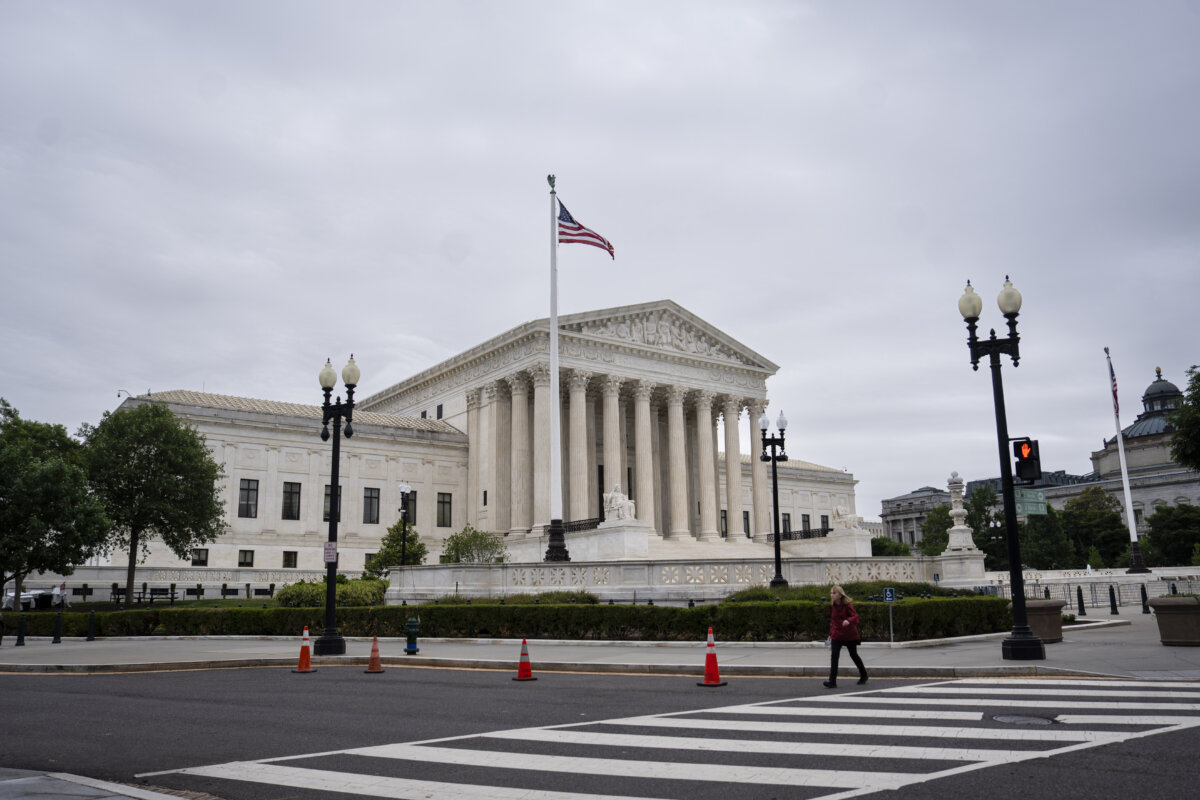

The U.S. Supreme Court on June 8 ruled that an energy trade association may pursue its challenge to Biden-era restrictions on consumer gas furnaces and commercial water heaters.
The high court’s decision comes after the Department of Energy, now under President Donald Trump, switched sides in the dispute and asked the court to undo an appellate court ruling that disallowed the lawsuit. The department is also currently in the process of revising the regulation that is in dispute.
The nation’s highest court summarily ruled on the case, American Gas Association v. Department of Energy, in an unsigned order without holding an oral argument. The court did not explain its decision, and there were no recorded dissents.
The justices vacated a ruling of the U.S. Court of Appeals for the District of Columbia Circuit and sent the case back to that court for further consideration.
Lawyers call this process, which disposes of cases without holding an oral argument, GVR, which stands for grant, vacate, and remand. The Supreme Court follows this procedure when it wants lower courts to reconsider their rulings using a new legal framework from a recent decision without delving deeply into the specifics of the cases.
The American Gas Association sued the Biden-era Department of Energy in December 2023 over its energy conservation standard for furnaces and heaters, accusing the Biden administration of adopting rules that make traditional, non-condensing natural gas furnaces unavailable to most Americans. Non-condensing refers to traditional gas-fired appliances that use a single heat exchanger and vent exhaust gases directly to the outdoors.
In other words, the association argued that non-condensing gas appliances could generally not meet the new departmental standards.
If the rule is not blocked or reversed, non-condensing furnaces will become illegal to manufacture in 2028, even though they account for about 55 percent of the market for natural gas furnaces across the nation, according to the association.
“This ruling from DOE will push American families with natural gas heat into a corner—when their furnace goes out, they’ll be forced to choose between retrofitting for electric with the increased month-to-month utility bills that entails or engaging in a costly and time-consuming renovation to retrofit their home for a completely different type of natural gas furnace,” the association’s president and CEO, Karen Harbert, said at the time.
The department said at the time that the rule would help combat climate change and save billions of dollars in heating costs.
The energy efficiency standard for residential gas furnaces now at issue, which was finalized in September 2023, specifically targeted non-weatherized gas furnaces and those used in mobile homes. The rules require such gas furnaces to achieve an annual fuel utilization efficiency of 95 percent.
In the association’s petition filed with the Supreme Court, the group said a divided D.C. Circuit in its November 2025 decision declined to “second-guess” the department’s interpretation of a federal statute known as the Energy Policy and Conservation Act that ought to have limited departmental authority. Twenty-one states supported the petition.
The appeals court deferred to the agency’s supposed expertise in interpreting the statute by claiming that it must be applied to a specific set of facts, the petition said.
“In doing so, the D.C. Circuit essentially resurrected Chevron deference, directly undermining this Court’s decision in Loper Bright Enterprises v. Raimondo,” the petition said.
In that landmark June 2024 ruling, the Supreme Court overturned the Chevron deference doctrine, a bureaucracy-empowering judicial doctrine that critics said led to the explosive growth of the federal government in recent decades.
The 2024 decision has made it more difficult for unelected government officials to generate new regulations. For years, the doctrine forced judges to defer to the legal interpretations of federal agency officials who chose how to enforce federal laws they deemed ambiguous.
The D.C. Circuit’s ruling “reflects not only legal error but also practical folly,” the petition said. “Under its novel statutory interpretation, the Department of Energy adopted energy efficiency standards that will force millions of Americans with gas appliances to either renovate their homes or switch to electric appliances.”
With the change in administrations, the department shifted positions and began supporting the association’s position in the case.
U.S. Solicitor General D. John Sauer filed a brief on April 28, urging the high court to vacate the circuit court’s judgment and return the case to that court for further proceedings in light of the government’s new position.
He said that under the Energy Policy and Conservation Act, the department is not allowed to enforce standards that have the effect of banishing from the market products that have distinct “performance characteristics.”
Consequently, the department has now “determined that the rules at issue are factually and legally flawed, and the agency is considering a new rulemaking in which it would correct those errors,” Sauer said.
“A GVR would permit the court of appeals to take account of those developments and the Department’s revised position in the first instance, including by potentially holding this case in abeyance pending a new rulemaking,” he added.
The Sierra Club, an environmentalist group, along with New York Attorney General Letitia James, had urged the Supreme Court not to take up the case.
They said the D.C. Circuit was correct in holding that non-condensing technology is not a legally protected performance characteristic, and that court ruling did not violate Loper Bright by deferring to the department’s interpretation of what is meant by a performance characteristic.
The court also relied on other “relevant interpretive tools,” James and the group said in a brief filed last month.
In its new ruling, the Supreme Court directed the D.C. Circuit to reconsider the case in light of the position Sauer argued in his brief. It is unclear when the appeals court will take up the case.
Harbert, the head of the American Gas Association, hailed the new ruling.
“We welcome the Supreme Court’s decision to protect the American people from this unlawful regulation that would increase costs for families and businesses and ban an entire class of appliances,” she told The Epoch Times.
“We will continue to work to ensure all Americans can make choices about the energy and appliances in their homes.”
The Epoch Times reached out for comment to the Department of Energy, James, and the Sierra Club. No replies were received by publication time.
Tom Ozimek contributed to this report.
 Friends Read Free
Copy
Facebook
Tweet
Friends Read Free
Copy
Facebook
Tweet