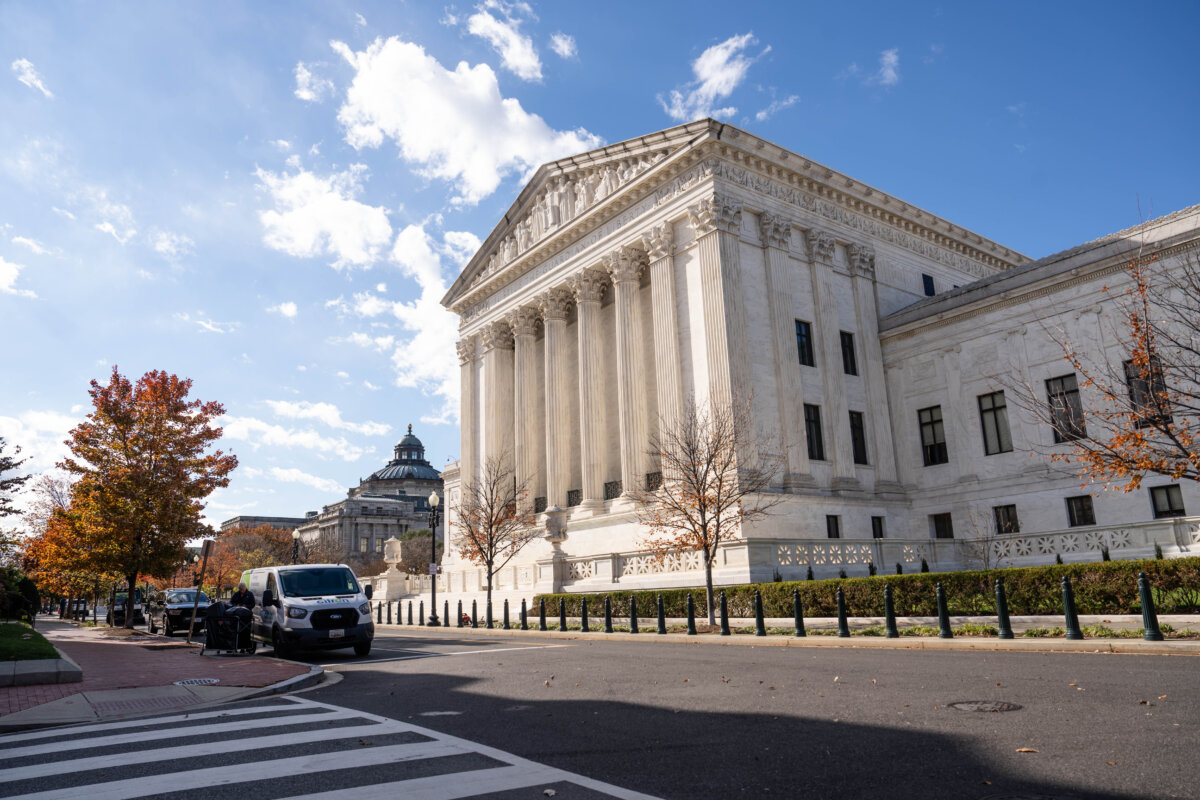

The Supreme Court seemed divided but largely skeptical on Nov. 10 of a Rastafarian’s attempt to sue prison officials in their individual capacity for shaving his dreadlocks.
Damon Landor has refused to cut his hair as part of what court papers describe as a “Nazarite vow.” But in 2020, a group of prison guards shaved his head despite a federal appeals court ruling that doing so would violate his rights under a law known as the Religious Land Use and Institutionalized Persons Act.
Before the Supreme Court was the question of whether Landor could obtain damages from the guards by suing them in their individual capacities.
A portion of that law states that individuals can “obtain appropriate relief against a government” and defines “government” as including “any person acting under color of state law.”
Zachary Tripp, an attorney who represented Landor, told the justices that language clearly allowed the type of suit Landor was attempting to bring. However, multiple justices seemed to doubt the law had that level of clarity.
“The hard part, as I see it for your case, for me, is that you need a clear statement and ‘appropriate relief,’ you know is not as clear as it could be in encompassing damages,” Justice Brett Kavanaugh said.
Multiple justices also noted that appeals courts had interpreted the law differently from how Landor did.
“The courts of appeals have continued to reject the position you’re articulating here,” Kavanaugh said.
At one point, Justice Amy Coney Barrett asked Tripp how the meaning of the statute was obvious or clear “if every circuit is coming out differently” than the way he was interpreting the law.
Part of the questioning focused on another case from 2020 known as Tanzin v. Tanvir. In that case, the Supreme Court held that a sister statute, known as the Religious Freedom Restoration Act, that used similar language allowed individual capacity suits.
Although the language was the same, Congress enacted the laws under different authorities. More specifically, the Religious Freedom Restoration Act was enacted as part of its authority under the 14th Amendment. The Religious Land Use and Institutionalized Persons Act was enacted as part of Congress’s power under the Spending Clause.
That difference raised questions about how the law viewed individuals involved with the cases. When the U.S. Court of Appeals for the Fifth Circuit ruled on Landor’s case, it stated that the law’s use of the Spending Clause set up a contract-like situation, with liability assigned to the parties involved.
That liability, it said, should apply only to actual parties to the contract, such as a state government that receives federal funding. Because guards in their individual capacity are not parties to a particular contract, they cannot be held liable in that capacity.
Justice Neil Gorsuch indicated during questioning that he thought guards were third parties that shouldn’t be held liable by Landor.
“If we’re looking to background contract principles, to the extent they’re relevant … it wouldn’t seem to encompass these defendants, and … every circuit court in the country would appear to be correct,” he said.
Justices Sonia Sotomayor and Ketanji Brown Jackson seemed sympathetic to Landor’s case. She said at one point that ruling for Louisiana would constitute a “new road” and “put at risk dozens of federal statutes.”
Jackson, meanwhile, said she was trying to understand how Congress could have been clearer with its language.
“It says a person may assert a violation of this chapter as a claim or defense in a judicial proceeding and obtain appropriate relief against a government,” she said.
“If that doesn’t refer to money damages being brought by an individual for a violation of [the Religious Land Use and Institutionalized Persons Act], what could Congress have meant by appropriate relief here?”
 Friends Read Free
Copy
Facebook
Tweet
Friends Read Free
Copy
Facebook
Tweet