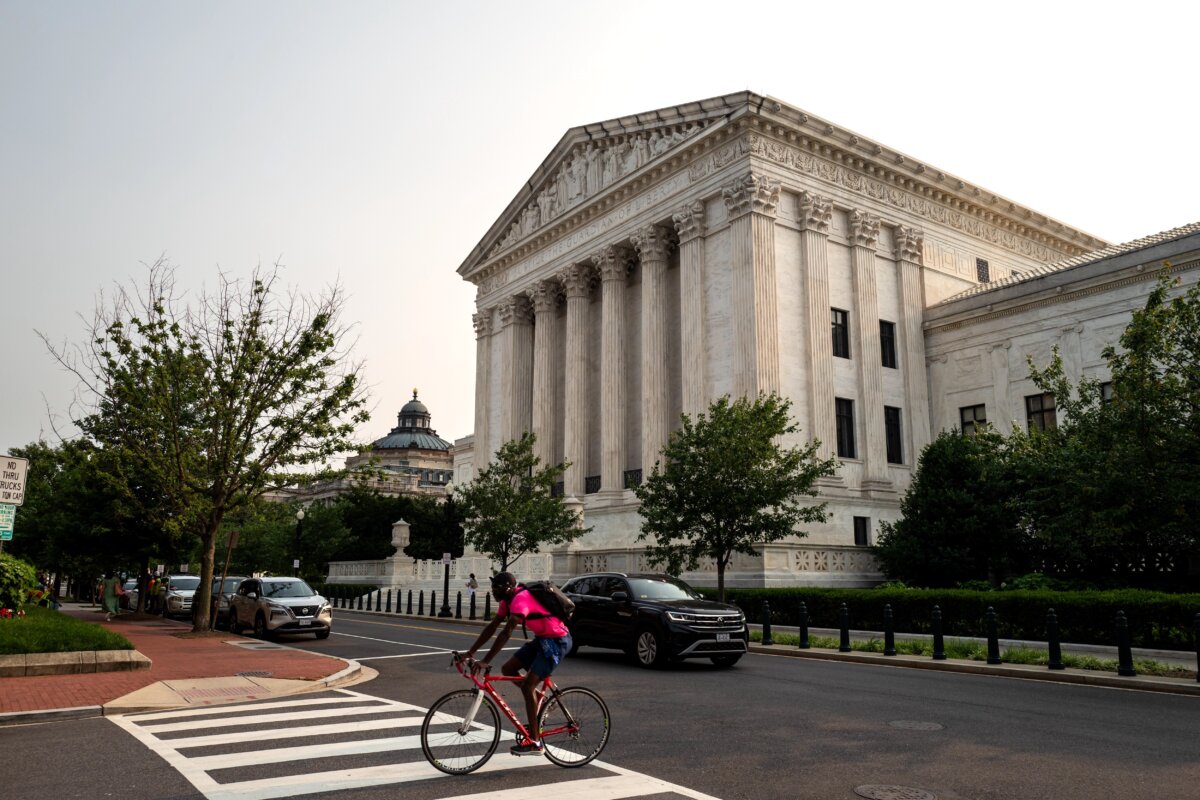

Two educational toy companies have asked the Supreme Court to weigh in on President Donald Trump’s tariffs, potentially teeing up an opportunity for the justices to decide whether he is encroaching on congressional authority.
Learning Resources and Hand2Mind had both sued in the District of Columbia, while other companies sued in the Court of International Trade. So far, courts have temporarily halted rulings against Trump in those cases.
In a petition on June 17, Learning Resources and Hand2Mind asked the court to review whether Trump properly invoked the International Emergency Economic Powers Act.
They and others have argued that the law doesn’t allow the president to implement tariffs.
“The … tariffs are causing enormous uncertainty and financial distress for American businesses,” the petition read.
The companies told the justices that Congress has exclusive power to set tariff policy under the Constitution and that Trump has bypassed the legislative branch. Although Congress can authorize presidents to impose tariffs, the companies said that wasn’t the case with the International Emergency Powers Act.
“President Trump, through a series of executive orders, has repeatedly bypassed Congress to impose tariffs unilaterally. … With the stroke of a pen, he has dramatically changed United States tariff policy,” the companies said.
The law contains a section that allows the president to regulate imports, but it’s unclear what that means. The Trump administration has argued that it includes tariffs but has received pushback from the Court of International Trade.
In two other cases, the Court of International Trade blocked Trump’s tariffs because the International Emergency Economic Powers Act didn’t allow “unbounded” tariffs like the president’s. That decision was temporarily halted by the U.S. Court of Appeals for the Federal Circuit, which is expected to hear arguments on the issue in July.
The federal judge who oversaw the toy companies’ case said on May 29 that the phrasing allowing Trump to regulate imports didn’t encompass tariffs. A subsequent order stayed that block while the case played out in the U.S. Court of Appeals for the District of Columbia Circuit.
In announcing a set of tariffs in April, Trump said trade imbalances had created an emergency situation for the country. “Large and persistent annual U.S. goods trade deficits have led to the hollowing out of our manufacturing base; inhibited our ability to scale advanced domestic manufacturing capacity; undermined critical supply chains; and rendered our defense-industrial base dependent on foreign adversaries,” he said.
The Justice Department told the district court that it didn’t have jurisdiction to review the issue, and it should instead be litigated in the Court of International Trade. It also said that regulating imports included tariffs and that Congress had validly delegated to the president the power to impose tariffs.
 Friends Read Free
Copy
Facebook
Tweet
Friends Read Free
Copy
Facebook
Tweet