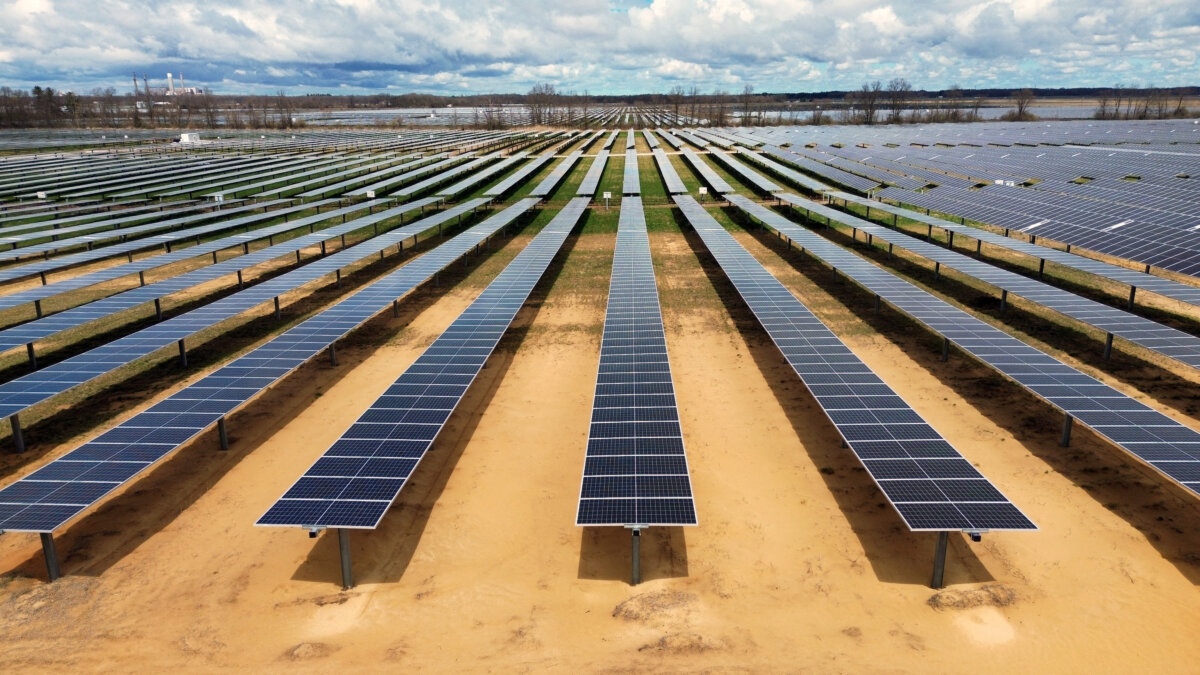

A U.S. judge has struck down a Trump administration policy implemented last year that made it harder for wind and solar energy projects to claim federal tax subsidies.
In a ruling on Saturday, Judge Colleen Kollar-Kotelly of the U.S. District Court for the District of Columbia said the Treasury Department’s IRS had failed to give an adequate reason for eliminating a longstanding definition for what it means for a project to be considered under construction.
Under federal law, renewable energy projects must begin construction by July 4 of this year or enter service by the end of 2027 to qualify for a 30 percent tax credit.
In August 2025, the Treasury Department released guidance that tightened the criteria for wind and solar energy projects to receive federal tax credits.
The guidance follows President Donald Trump’s July 7 executive order directing the department to enforce the One Big Beautiful Bill Act, which he signed into law on July 4 and effectively ends renewable energy tax credits for projects that have not begun construction.
The executive order to end federal subsidies for wind and solar energy projects cited concerns over the reliability of these energy sources and dependence on foreign-controlled supply chains.
In his order, Trump stated that reliance on “‘green’ subsidies” poses a national security risk by making the United States dependent on supply chains controlled by foreign adversaries.
“Ending the massive cost of taxpayer handouts to unreliable energy sources is vital to energy dominance, national security, economic growth, and the fiscal health of the nation,” the order stated.
The lawsuit challenging the IRS rules was filed last year by the plaintiffs, including environmental groups Oregon Environmental Council and Natural Resources Defense Council, consumer advocacy organization Public Citizen, the city of San Francisco, and renewable energy consulting firm Woven Energy.
Their suit argued that the rule change would make electricity more expensive and stop renewable energy projects from being built.
“This decision puts an important check on the administration’s actions, which are driving up energy prices for everyday Americans in cities and towns across the country,” San Francisco attorney David Chiu said in a statement.
“We will continue to fight for the market fairness and predictability that allow clean energy providers to build projects that benefit us all.”
Kollar-Kotelly, who is 83, has blocked and struck down several actions by the Trump administration.
In 2017, during Trump’s first term, she blocked a ban on transgender individuals serving in the military.
Last year, she blocked a directive that would have required people to provide proof of U.S. citizenship to register to vote.
The case concerned Executive Order 14248, which Trump signed on March 25, 2025, with the goal of preventing illegal immigrants from voting.
In January, Kollar-Kotelly struck down key parts of the order that tightened citizen verification requirements for voter registration, ruling that Trump exceeded his authority.
In April, a federal judge blocked the Trump administration’s efforts to halt federal approvals for wind and solar projects.
Chief U.S. District Judge Denise Casper in Boston issued a preliminary injunction on April 21 at the request of a coalition of renewable energy groups.
The injunction blocks five specified agency actions, including Department of the Interior review rules, a wildlife permitting ban, land-use limits, an Army Corps memo, and a legal opinion that had tightened permitting and slowed wind and solar approvals.
The judge said the plaintiffs were “likely to succeed on the merits of their claims” that the Interior Department and other agencies adopted policies that violate the Administrative Procedure Act, which governs how U.S. agencies make and justify policy decisions.
Her ruling applies to members of the plaintiff organizations, which include RENEW Northeast and Alliance for Clean Energy New York.
“This is an undeniable victory for members of our coalition and the broader clean energy industry, as well as American households and businesses,” the groups said in a joint statement at the time.
Aldgra Fredly, Zachary Stieber, Matthew Vadum, and Reuters contributed to this report.
 Friends Read Free
Copy
Facebook
Tweet
Friends Read Free
Copy
Facebook
Tweet