
SEOUL—Demonstrations demanding a new election shifted on June 6 to a vote-counting center in Seoul following a ballot shortage controversy during the June 3 election to select local government heads, local council members, and superintendents of education across South Korea.
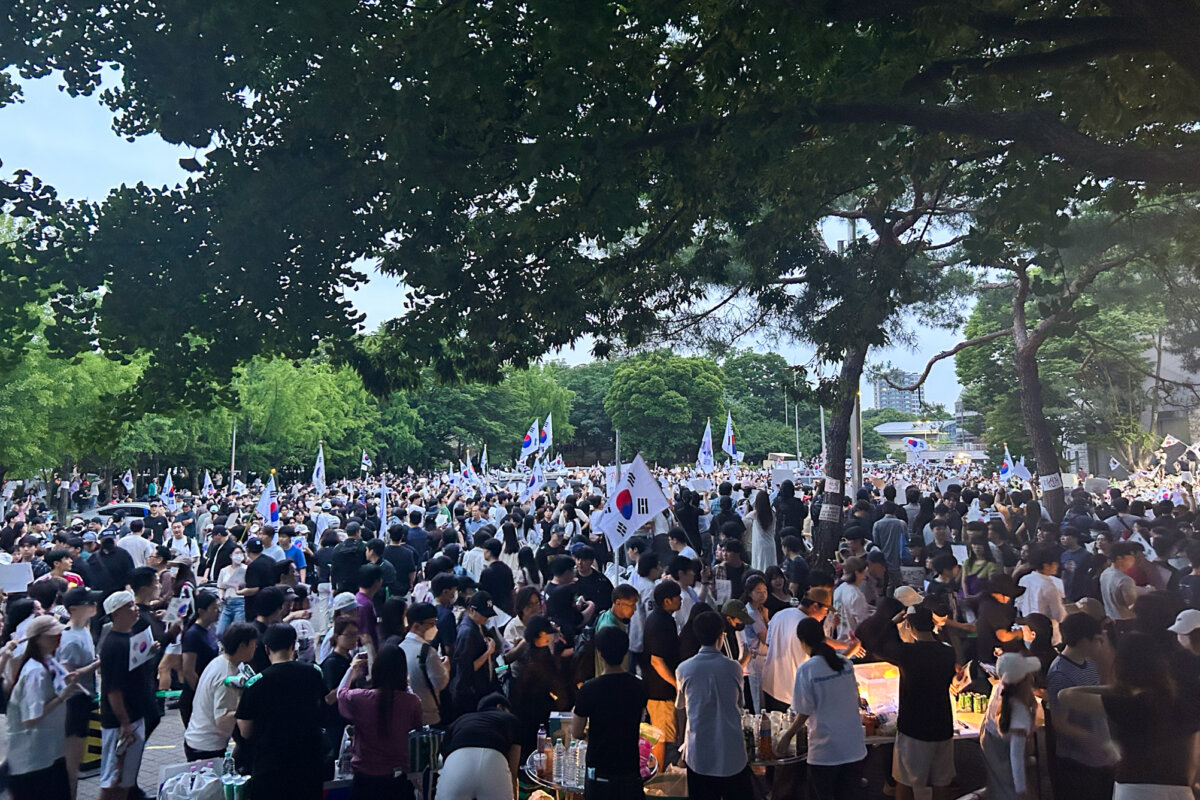
On the afternoon of June 6, approximately 20,000 citizens—based on unofficial police estimates—had gathered around the vote-counting center established at the Olympic Park Handball Gymnasium in Seoul’s Songpa District.
Participants called for a new election while waving South Korean flags and holding handmade signs.
Protesters described their actions as “peaceful citizen monitoring.” They said that following reports of ballot shortages, delayed voting, and some voters allegedly leaving polling stations without being able to vote, they could not rely solely on election authorities and government agencies to address the situation.
Unlike many organized demonstrations, this protest has been characterized by spontaneous citizen participation.
“The most impressive thing I saw today was people with different political views engaging in respectful discussions and encouraging one another to respect minority opinions,” a volunteer who gave only his surname, Park, said. “Watching people try to resolve disagreements through mature dialogue gave me hope for Korean society.”
Park said he had spent the entire day directing citizens toward the counting center from the entrances of Olympic Park, leaving his voice hoarse. He explained that he came after seeing social media reports of ballot boxes being removed from the Jamsil 7-dong No. 2 polling station the previous day and wanted to help in some way.
The signs carried by demonstrators also stood out. Rather than professionally printed placards commonly seen at organized protests, many participants had written messages such as “re-election” by hand on sheets of paper. Some individuals even used Chinese characters, reflecting their belief that the Chinese Communist Party was involved in the election irregularities.
Although public figures including history lecturer Jeon Han-gil, People Power Party politician Lee Jin-sook, and People’s Power Party Supreme Council member Kim Min-soo visited the site on June 5, the June 6 gathering was largely led by citizens.
Kim had urged supporters to gather near the Blue House area on June 6, citing a registered rally there. However, most participants returned to the vote-counting center.
Many attendees emphasized to The Epoch Times that they were not participating as supporters of the political left, right, or any particular party. Rather, they said they were exercising their constitutional rights as citizens to protect the integrity of the electoral process.
Participants surrounded the Handball Gymnasium, which serves as the counting center, and blocked as many as 10 entrances, seeking to prevent the removal of ballots.
Under Korean election law, a distinction exists between blank ballot papers and completed ballots that contain voter markings. Protesters stated that their concern was not the movement of unused ballot papers but rather completed ballots reflecting voters’ choices.
They said that once election authorities completed all procedures and transferred the ballots, it would become more difficult to identify additional evidence of election mismanagement or to advance calls for a reelection.
Earlier that day, National Election Commission Chairman Roh Tae-ak publicly apologized, accepted responsibility for deficiencies in election management, announced his resignation, and promised a thorough investigation. Some demonstrators, however, argued that those measures were insufficient. One man in his 70s told The Epoch Times, “He shouldn’t be running away—he should be going to prison.”
The gathering outside the counting center began at about 9:30 a.m. on June 5, after two ballot boxes from the Jamsil 7-dong No. 2 polling station were transported there under police supervision. What began with roughly 100 to 200 people reportedly grew to about 2,000 by late afternoon and continued expanding throughout the weekend.
The crowd included people of all ages—from seniors to families with young children. A 37-year-old woman from Suwon who attended with her husband and 6-year-old daughter said she had brought a wagon and blankets for the child. “We don’t plan to stay all night, but we want to remain here as late as possible and make our voices heard,” she said.
Another participant remarked that the large number of parents with strollers reminded him of previous civic protests involving families.
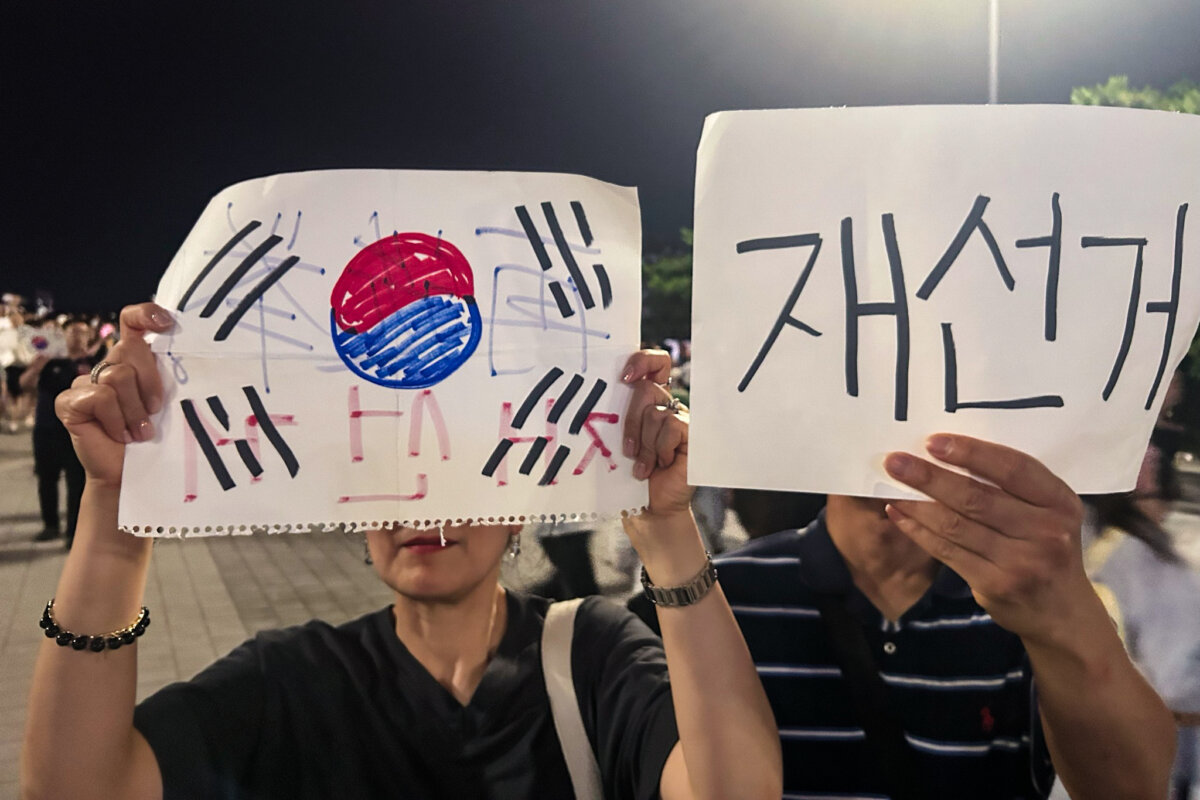 Handwritten signs demanding a new election in Seoul, South Korea, on June 6, 2026. (Khasub Lee/Epoch Times Korea)
Some demonstrators prepared for an overnight stay with mats and blankets, while others distributed snacks and water. They explained that the supplies had been donated by private individuals and encouraged people to share information about the event on social media, saying that media coverage was inadequate.
Bae, a 52-year-old father attending with his elementary school-aged child, said the protest had produced an unexpected benefit: restoring the image of the South Korean flag.
“In the past, the national flag was often viewed as something associated only with older conservative groups and was sometimes looked down upon socially,” he said. “Today felt different.
“The fact that today is Memorial Day makes it even more meaningful, and I’m grateful that so many young people have taken the lead.”
As of the time of reporting, no major physical clashes have occurred between police and demonstrators at the Songpa counting center. Some participants said that while certain police officers had behaved aggressively the previous day, tensions were low on June 6.
Meanwhile, police maintained communication with demonstrators while strengthening security measures. Officers also adjusted pedestrian routes for attendees of a nearby K-pop concert scheduled for the same day.
 Friends Read Free
Copy
Facebook
Tweet
Friends Read Free
Copy
Facebook
Tweet