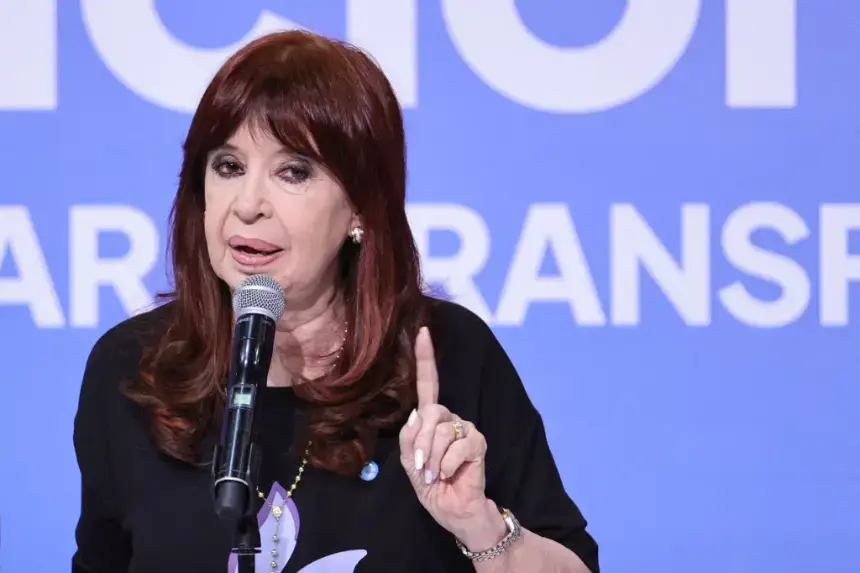

Argentina’s highest court upheld the six-year prison sentence for Cristina Fernández de Kirchner, after rejecting the appeal filed by the former president’s defense team.
The Supreme Court of Justice of the Argentine Nation said in its June 10 ruling that the Fourth Chamber of the Federal Court of Cassation “unanimously rejected the appeal filed by the defense of Cristina Fernández de Kirchner,” who was president of Argentina from 2007 to 2015 and vice president from 2019 to 2023.
“Thus, it upheld her sentence, insofar as it is relevant, to six (6) years in prison, special disqualification from holding public office for life, legal costs, and the costs of the proceedings, considering her criminally responsible for the crime of fraudulent administration to the detriment of the public administration,” the ruling stated.
The decision was issued after the former president was convicted in a case known as “Vialidad.” The case involved alleged irregularities in the awarding of 51 roadwork contracts in the province of Santa Cruz, in the Patagonia region, to companies owned by businessman Lázaro Báez during the administrations of Néstor Kirchner, who was president of Argentina from 2003 to 2007, and Fernández de Kirchner, who was Néstor Kirchner’s wife and who succeeded him in office. Báez was also convicted in the case.
“The appellant has not complied with the requirement of autonomous reasoning, which requires that the extraordinary appeal contain a detailed account of the facts of the case that are relevant to the main issue, allowing them to be linked to the issues raised as being of a federal nature through a concrete and reasoned critique of the arguments on which the contested judgment was based,” the Supreme Court ruled.
“Given that such deficiencies cannot be remedied in the appeal, when the extraordinary appeal does not meet the requirement of independent reasoning, the complaint must be dismissed.”
The 72-year-old former president was sentenced in the case on Dec. 6, 2022, although she was not detained because of both the privileges she enjoyed as vice president of the country at the time and a pending review by the Criminal Cassation Chamber.
On Nov. 13, 2024, the Fourth Chamber of the Federal Criminal Cassation Court upheld the conviction against Fernández, who subsequently appealed to the Supreme Court.
On June 13, the former president spoke out on social media.
“On Tuesday, when the puppet triumvirate that serves as a fiction of the Supreme Court of Justice carried out the economic power’s order to ban me from office, placing a stranglehold on the popular vote, my lawyers filed a request with Oral Court No. 2 for house arrest at my home in the Monserrat neighborhood,” Fernández said in a post on social media platform X.
“This is not a privilege. On the contrary, it is for strict reasons of personal safety. On the one hand, there are institutional reasons,” she wrote. “I was president for two consecutive terms and, according to current regulations, I must have lifetime protection: it is mandatory and I cannot voluntarily withdraw from it.”
The Epoch Times has contacted Fernández de Kirchner for additional comments.
On Nov. 14, 2024, the Argentine government, currently headed by Javier Milei, withdrew Cristina Fernández’s pensions as former president and widow of former President Néstor Kirchner, estimated at nearly 22 million Argentine pesos (about $18,700), after she was convicted.
“Retirement for former leaders is a privilege that should not exist in Argentina, especially if the person receiving it has been convicted of defrauding millions of Argentines from the highest echelons of power, who saw their hopes dashed at the hands of politics,” presidential spokesman Manuel Adorni said at the time.
“During President Milei’s term, Argentina will not allocate funds to anyone convicted of corruption who has tarnished the honor and dignity of Argentines.”
 Friends Read Free
Copy
Facebook
Tweet
Friends Read Free
Copy
Facebook
Tweet