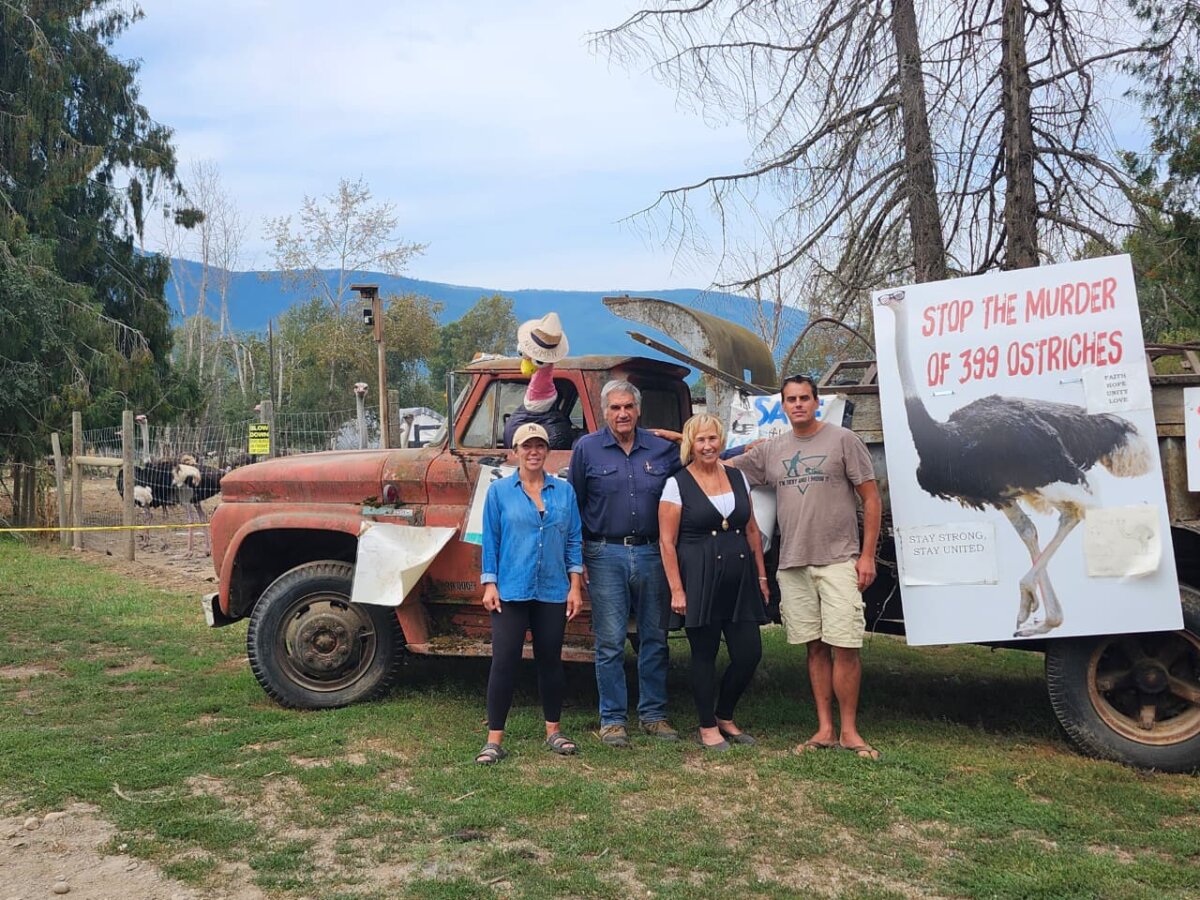

EDGEWOOD, B.C.—A B.C. ostrich farm is weighing its options in its fight to stop its flock of 399 ostriches from being killed as a federal cull order could descend on their property at any time following failed court challenges to stop the order.
Universal Ostrich Farms (UOF) in the rural community of Edgewood, B.C., has become the centre of international attention following an order by the Canadian Food Inspection Agency (CFIA) to cull its flock at the beginning of this year after saying it found two cases of H5N1 avian flu last December.
According to the CFIA, the ostrich herd poses a threat to humans and animals, and the birds’ form of H5N1 contains a genotype tied to a human infection in Ohio, bringing up concerns of mutation and public health danger.
The CFIA says the cull order is being done in accordance with the World Organization for Animal Health’s “stamping out” policy. It also said it will pay up to $3,000 for each ostrich killed.
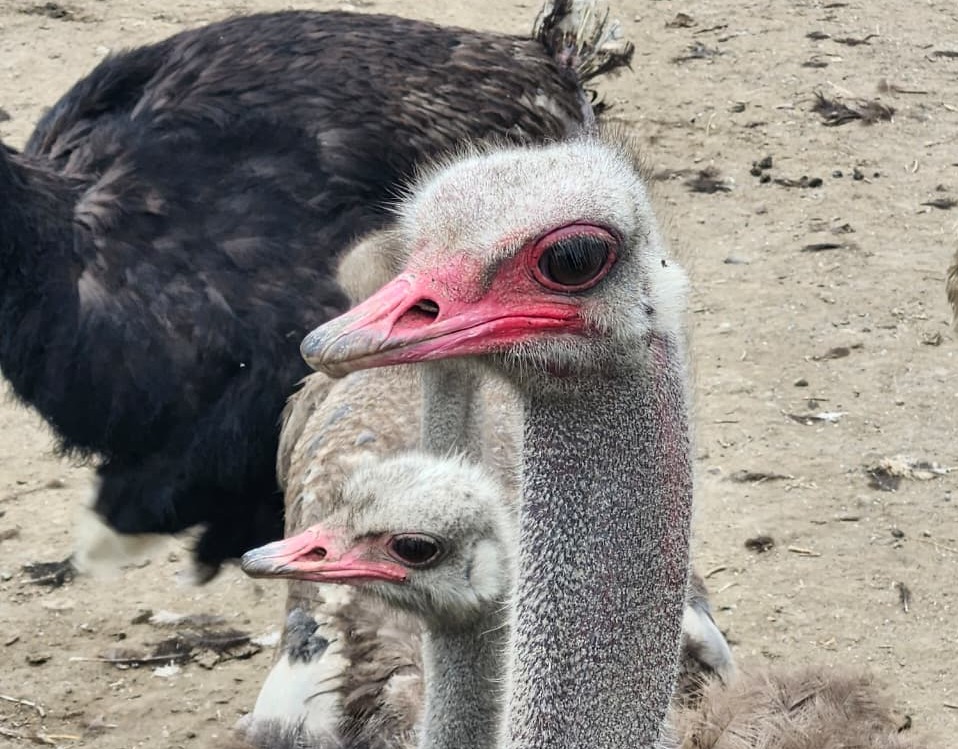
Farm spokesperson Katie Pasitney says the CFIA is being unreasonable and ruining a valuable opportunity to study the antibodies found in the eggs of her ostriches, particularly those of an older age.
“They’ve [CFIA] eroded the trust between the organization and the people who should be relying on them for proper outbreak response and to support them, like Canadian farmers and small farmers and large farmers and poultry industries,” Pasitney said in an Aug. 27 interview with The Epoch Times from her Edgewood home.
The CFIA has previously told The Epoch Times that testing by its National Centre for Foreign Animal Disease “conclusively determined” that the infected ostriches at the farm have a highly pathogenic avian influenza (HPAI) and “in completing full genome sequencing determined that the current HPAI infection in these ostriches is a novel reassortment not seen elsewhere in Canada.”
“Allowing a domestic poultry flock known to be exposed to HPAI to remain alive allows a potential source of the virus to persist,” CFIA said.
Pasitney, daughter of co-owner Karen Espersen, denies the CFIA’s statements and says the birds have had no symptoms in 226 days and have valuable medical research potential.
“We were also challenging that the ostrich should never have been put in the poultry category for Canadian Food Inspection Agency because they’re not poultry. They’re a red meat, flightless, big breasted bone bird,” Pasitney said, adding that they wouldn’t have been under the “stamping out” policy.

US Politicians Come Out in Support of Farm
Pasitney appeared in an Aug. 25 virtual press conference with Dr. Mehmet Oz, administrator for the U.S. Centers for Medicare and Medicaid Services, and American billionaire John Catsimatidis in support of saving the birds. Pasitney said that Catsimatidis and Andy Sabin recently contributed a combined US$35,000 to help with legal fees.
“If they’re killed, we’re not going to end it there. There’s going to be massive investigations on why the rush to kill these animals,” Catsimatidis said in the Aug. 25 press conference.
Oz said on Aug. 25 that the birds are an “incredible opportunity” to advance scientific research and that it “makes perfect sense for America and Canada to co-operate on this,” while U.S. Secretary of Health and Human Services Robert F. Kennedy Jr. has previously penned a letter to the CFIA asking for the cull to be stopped.
Oz has also previously offered for the ostriches to be relocated to his Florida ranch.
In addition, Pasitney said the U.S. Food and Drug Administration has offered to perform testing on the birds free of charge, but is not being permitted to do so by the CFIA, which previously denied UOF’s request to independently test their ostriches.
Lost Appeals
After the farm lost its final appeal in Ottawa earlier this month, Pasitney said around 50 people came to camp out over the Aug. 23 and 24 weekend to show their support, with dozens still camped out on Aug. 27.
At the farm, a field of tents with Canadian flags and signs saying “Save our Ostriches” and “Ostriches Can Save Lives!” sit in the next lot over to the quarantined ostriches, as supporters from across Canada stroll into Pasitney’s farmhouse to discuss strategy on the morning of Aug. 27.
Jeff Gaudry of Enderby, B.C., is one of Pasitney’s longtime supporters who’s been involved since the cull order and has been coming regularly to stay on the farm each week since April.
Gaudry said there is a core group of about two dozen supporters who regularly camp out on the farm and many more who actively support them, such as the hundreds of people who came out to a concert in July featuring trucker convoy leader Tamara Lich and a Rolling Stones cover band.
Gaudry, who was in Ottawa for the trucker convoy, said he’s particularly concerned with international groups like the World Health Organization and World Organization for Animal Health, which he says are infringing on basic freedoms.
Fellow supporters Rob Wilkinson of Kelowna, B.C., and James Semple of St. Thomas, Ont., are camped out on the property and say saving the ostriches is important for the future of freedom in Canada and resisting government overreach.

Local MP
Conservative MP Scott Anderson who represents the local riding of Vernon—Lake Country—Monashee, also intends to discuss the situation in a caucus gathering.
“I intend to bring it before the caucus,” Anderson said in an Aug. 28 interview with The Epoch Times. “I think we do need international agreements. I think we need all of that stuff. What I object to is the high-handedness behaviour, the lack of testing that they’ve [CFIA] actually done, and the complete arrogance—scientific arrogance. I think it’s simply saying: ‘No, the law says we can do it, so we’re going to do it, by God.'”
B.C.’s NDP Premier David Eby said in May that he’s “frustrated” the CFIA won’t show more flexibility in its approach to the dispute.
Support has also come from Alberta Premier Danielle Smith and Ontario Premier Doug Ford, both of whom say an alternative to the cull should be pursued and the medical research potential of the surviving birds should be studied. Pasitney added that while several MLAs want to do whatever they can to help, their jurisdiction at the provincial level is limited.
Pasitney points out that the CFIA could come at any time to begin liquidating the herd despite the significant popular and political support being received.

Pasitney said that saving the ostriches is about far more than just her farm’s livelihood: it’s about potential life-saving research from her ostriches that could be used to create natural health products and give a significant boost to virus prevention and diagnosis in humans and animals. Several peer-reviewed studies point to ostrich oil as helpful in the treatment of wounds and burns as well as its nutritional benefits in being high in omega fatty acids. Pasitney said the farm had also discovered a weight loss treatment using ostrich oil that they had planned to develop prior to the cull order.
She also pointed to the immune potential in their ostrich eggs against avian flu, COVID, and pseudomonas virus, which Pasitney said has been verified by scientists such as Dr. Steven Pelech of the University of British Columbia and Yasuhiro Tsukamoto of Kyoto Prefectural University in Japan.
Between Dec. 14, 2024, and Jan. 14, 2025, 69 of the ostriches died, but the remaining birds survived, Pasitney says. She disputes the accuracy of polymerase chain reaction tests done on two of the dead ostriches in December showing the presence of avian influenza.
The CFIA says that it has not received sufficient documentation proving immunity research potential from the ostriches and adds that there is a lack of appropriate on-site facilities to conduct controlled trials. “There are ongoing risks to animal and human health and Canada’s export market access,” the agency says.
CFIA has not said when it plans for the cull order to be carried out.
 Friends Read Free
Copy
Facebook
Tweet
Friends Read Free
Copy
Facebook
Tweet