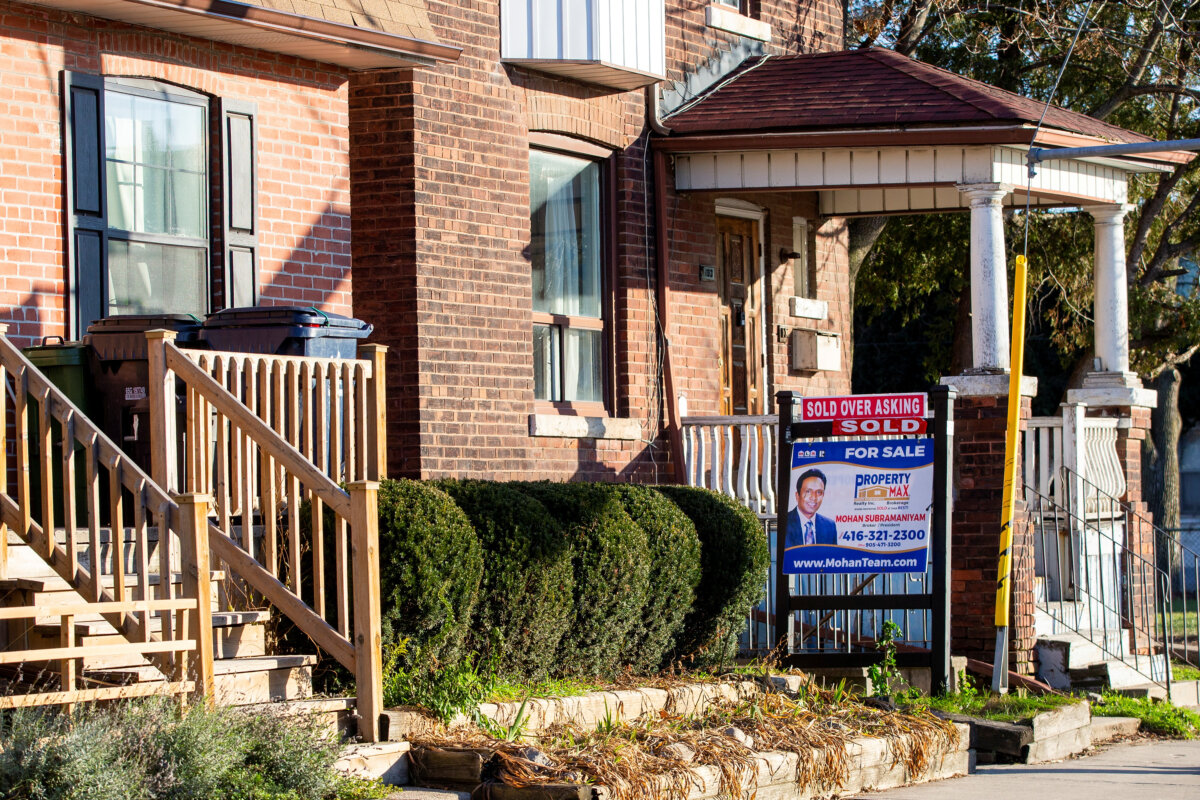

Nearly 10 percent of Toronto-area mortgage holders will struggle to refinance or renew with a different lender next year if home prices stay at their current low levels, the Bank of Canada says.
This year’s financial stability report from the central bank projects that 9 percent of borrowers in the Greater Toronto Area (GTA) and 4 percent nationally will not meet the qualifications to refinance their loans in 2027 because their home values have declined significantly since the inception of their mortgage, restricting their access to equity.
If home prices were to fall by another 10 percent, that share would rise modestly to 7 percent nationally and 12 percent in the Toronto area, the report said.
The cost of an average home in Canada has decreased by approximately 5 percent over the last year, and by 20 percent since the peak observed in 2022, the bank said. That decrease in value will be detrimental to households that are already stretched thin financially.
“Households that need to refinance to manage their payments may not qualify if they have too little equity to meet lenders’ requirements,” the report authors wrote, noting that using a home’s equity is a common method of refinancing a loan.
Households with no financial cushion risk falling behind on their payments. For these homeowners, refinancing to a longer term or with a different lender may not be feasible, as they lack the income and home equity required to qualify.
“Those with weaker income growth may have less flexibility because the decline in home prices has reduced equity buffers and made refinancing more difficult,” the federal banking regulator said.
The most significant decline in real estate prices has occurred in the GTA, where the average home price is 33 percent lower than it was in March 2022.
Analysis conducted by regional housing experts reveals that the average house price, which was $1.96 million in February 2022, has decreased to $1.48 million as of last month. When adjusting for inflation, a Toronto property that sold for $1.96 million in February 2022 would require a selling price of $2,243,120 today to match the increasing cost of living.
As property values have decreased, an important lending measure referred to as the loan-to-value (LTV) ratio has worsened for homeowners. This ratio reflects the debt a homeowner carries compared to the market value of their property.
The Bank of Canada provides detailed tracking of this specific trend in its financial stability reports, showing how rising LTV ratios directly increase default risks when households face upcoming mortgage renewals under tighter credit conditions.
The central bank’s projections are formulated based on scenarios for individuals renewing their mortgages in 2027, who have a current LTV ratio that surpasses 80 percent. If, for instance, a homeowner’s mortgage represents 80 percent of the property’s value, this results in an LTV ratio of 80 percent. Ratios that surpass 75 percent are deemed risky by the central bank.
A risky or high LTV ratio makes refinancing and amortization extensions difficult because if an outstanding balance is close to the home’s value, lenders view it as high-risk. In Canada, conventional refinances are strictly capped at 80 percent LTV, and amortizations generally max out at 25 years.
Federal lending standards for insured mortgages stipulate that the gross debt service ratio, or the proportion of household income allocated to housing costs, must not surpass 39 percent. And the total debt service ratio, which represents the percentage of household income used for both housing and debt expenses, is limited to a maximum of 44 percent.
Homeowners in the GTA are already defaulting and falling behind on mortgage payments at a significantly faster pace than the rest of Canadians because their loans are larger thanks to Toronto’s real estate market being among the priciest in the nation, according to Canada Mortgage and Housing Corporation (CMHC) deputy chief economist Tania Bourassa-Ochoa.
When they renew their loans at higher interest rates, the monthly payments become even more daunting.
“In Toronto’s struggling housing market, the mortgage arrears rate in the region has more than quadrupled from post-pandemic lows,” Bourassa-Ochoa said in a report earlier this year. “While arrears remain low, they’re projected to continue rising over the next year.”
She noted that while vulnerabilities are becoming apparent in high-priced markets like Toronto, regions with high exposure to tariffs are also increasingly at risk.
“Job losses are already evident in certain industries and regions heavily impacted by tariffs,” she said. “We may see a growing number of households struggling to meet both non-mortgage and mortgage payments.”
 Friends Read Free
Copy
Facebook
Tweet
Friends Read Free
Copy
Facebook
Tweet