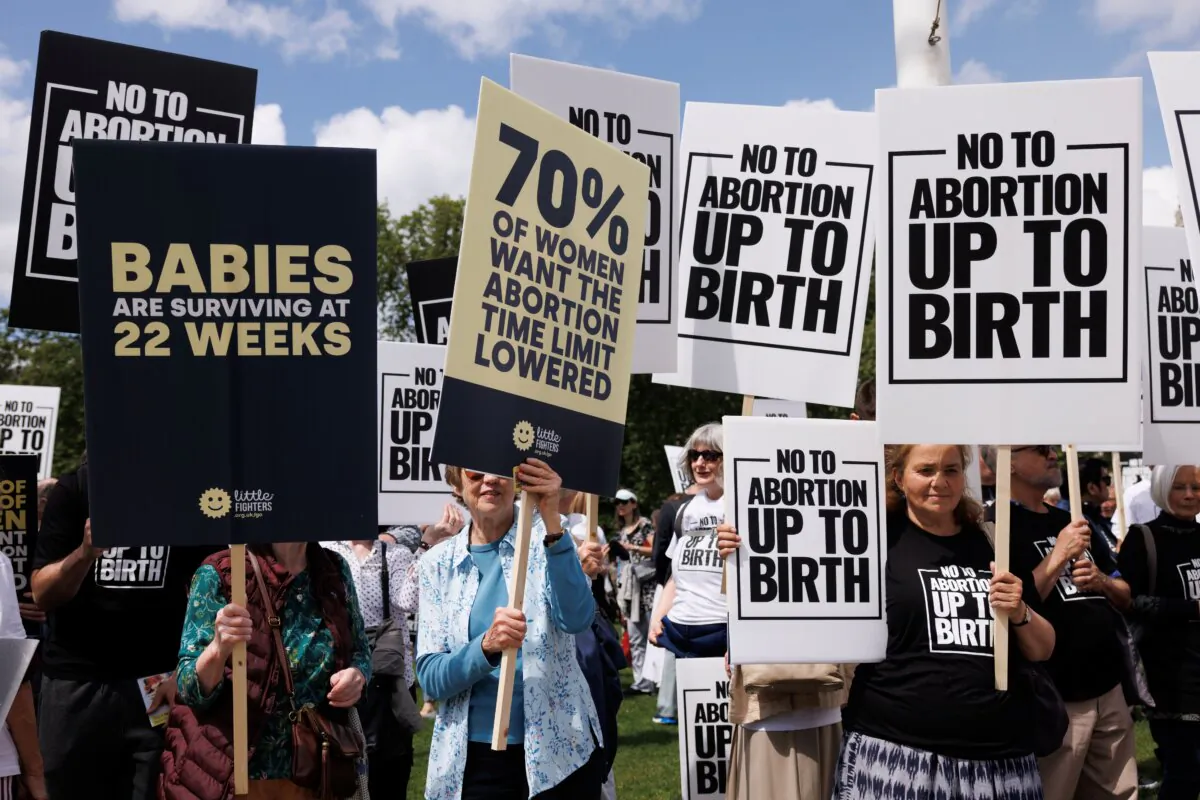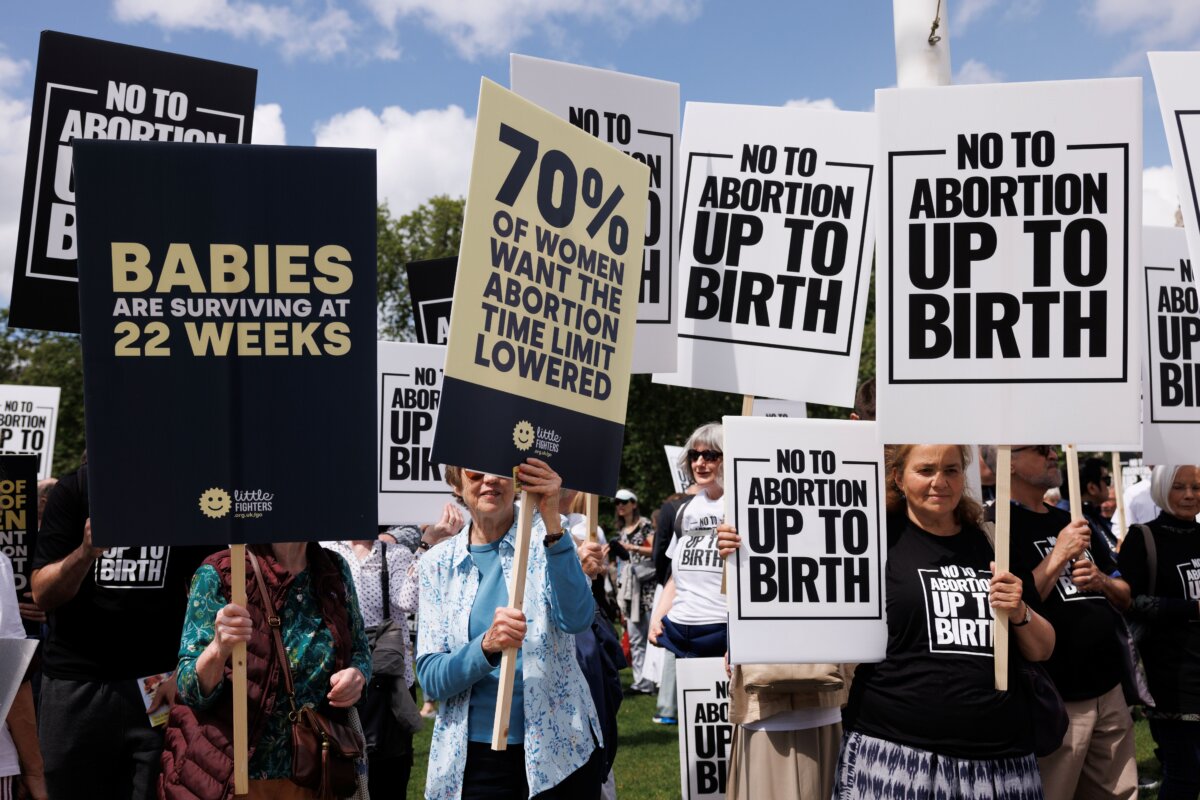

British lawmakers in the House of Lords backed a legislative amendment on March 18 to decriminalize women who have abortions at any point until birth.
If the amendment becomes law, it will mean no women in England and Wales can be prosecuted for having an “illegal” abortion for any reason, including sex selection.
Some abortion advocates welcomed the amendment, while critics say it would allow “infanticide” without consequences.
The legal limit for abortions across the UK is 24 weeks, with abortion only allowed after that in specific circumstances. Abortion has been legal in England, Wales, and Scotland since 1967 and in Northern Ireland since 2019.
The legislation still needs to be voted through the House of Commons, where MPs previously backed the amendment.
Labour Member of Parliament (MP) Tonia Antoniazzi introduced the amendment to the House of Commons last June, saying she was moved to do so after seeing women investigated by police over suspected illegal abortions.
In a late evening vote, the House of Lords rejected an attempt to overturn the decision by MPs to decriminalize women who terminate their own pregnancy.
Conservative peer Baroness Monckton put forward an amendment to remove the “radical proposal” of decriminalizing abortion up until birth from the draft law. She said this was passed too swiftly in the Commons “without any evidence, scrutiny, public consultation or impact assessment.”
Monckton said decriminalization endangers women “by removing the current legal deterrent against administering an abortion away from a clinical setting right up to birth.”
The House of Lords rejected her amendment by 185 votes to 148, a majority of 37.
A separate amendment backed by the Lords would mean that a small number of women who have been prosecuted for illegal abortions will be pardoned, and details of women who were cautioned will be deleted from police records.
Current Law
Under current law, it is legal for a woman to take prescribed abortion pills at home only if she is less than 10 weeks pregnant.
The upper chamber rejected a bid to make it mandatory for a pregnant woman to have an in-person consultation before being prescribed pills for a home abortion.
The previous Conservative government changed the regulations during the first COVID-19 lockdown in March 2020, allowing women in the early stages of pregnancy to have home abortions following a phone or video consultation, with the change made permanent in 2022.
Conservative peer Baroness Stroud said that in-person consultations are safer because they allow women’s gestational stage to be reliably determined, offer a degree of protection against possible coercion, and allow for health risks to be assessed.
Labour peer Baroness Blackstone, who chairs the trustees of the Royal College of Obstetricians and Gynaecologists (RCOG), said that online or telephone consultation for abortion is “effective, safe and improves access to care.” The RCOG has long pushed for decriminalization.
The House of Lords rejected a bid to return to compulsory in-person consultations.
Peers rejected another two amendments—one to create an offense of obtaining abortion pills by lying, and another to require an in-person consultation to obtain abortion pills in the case of pregnant girls aged under 18.
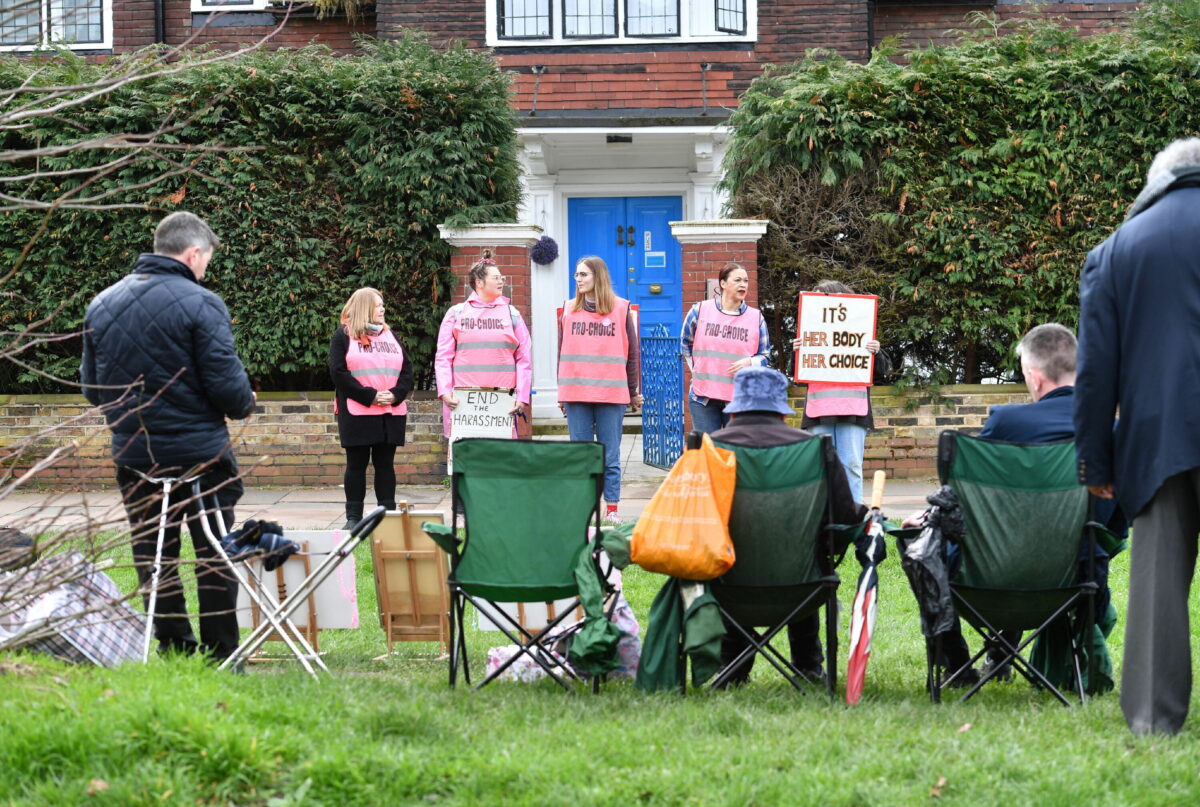
Under the amendment, medics or others who facilitate an abortion after the 24-week time limit would still face prosecution.
Under the Abortion Act of 1967, abortion is allowed in England, Wales, and Scotland if signed off on by two doctors who agree it is in the best interests of the mother or her existing children. This includes for early terminations where pills are taken at home.
In Northern Ireland, which has a strong Catholic tradition, abortion was decriminalized only in 2019. It is legal for any reason up until 12 weeks if approved by one health professional, and between 12 and 24 weeks if two doctors agree it is in the mother’s best interests.
Across the four nations of the UK, late-term abortions after 24 weeks are allowed only if there is a serious risk to the health or life of the mother, or there is a high probability the baby would be born with serious abnormalities or be unlikely to survive.
Reactions
Justice minister Baroness Levitt told peers that the current Labour government “maintains a neutral stance on abortion in England and Wales.”
Conservative Party leader Kemi Badenoch said on X that she does not support the amendment backed by the Lords, which goes “too far.”
“I am pro-choice, but I do not support abortion up to full term,” the mother of three said.
“It was rushed, with just two hours of debate that ignored many fundamental issues. It will lead to dire outcomes for many women and babies, especially vulnerable women who are at risk of coercion.”
The British Pregnancy Advisory Service (BPAS), the UK’s leading provider of abortion advice and procedures, welcomed the pro-abortion amendments’ passage, which it has campaigned for since 2016.
“For too long, women have faced the possibility of police involvement at one of the most vulnerable moments in their lives, with some investigated, prosecuted and left with permanent criminal records for ending their own pregnancies,” said Heidi Stewart, Chief Executive of BPAS, in a statement after the vote.
Catherine Robinson, spokeswoman for Right to Life, said the decriminalization amendment is “one of the most extreme pieces of legislation ever to pass the House of Commons and the House of Lords.”
“There is no public appetite for this change, and it was not part of the Government’s manifesto.”
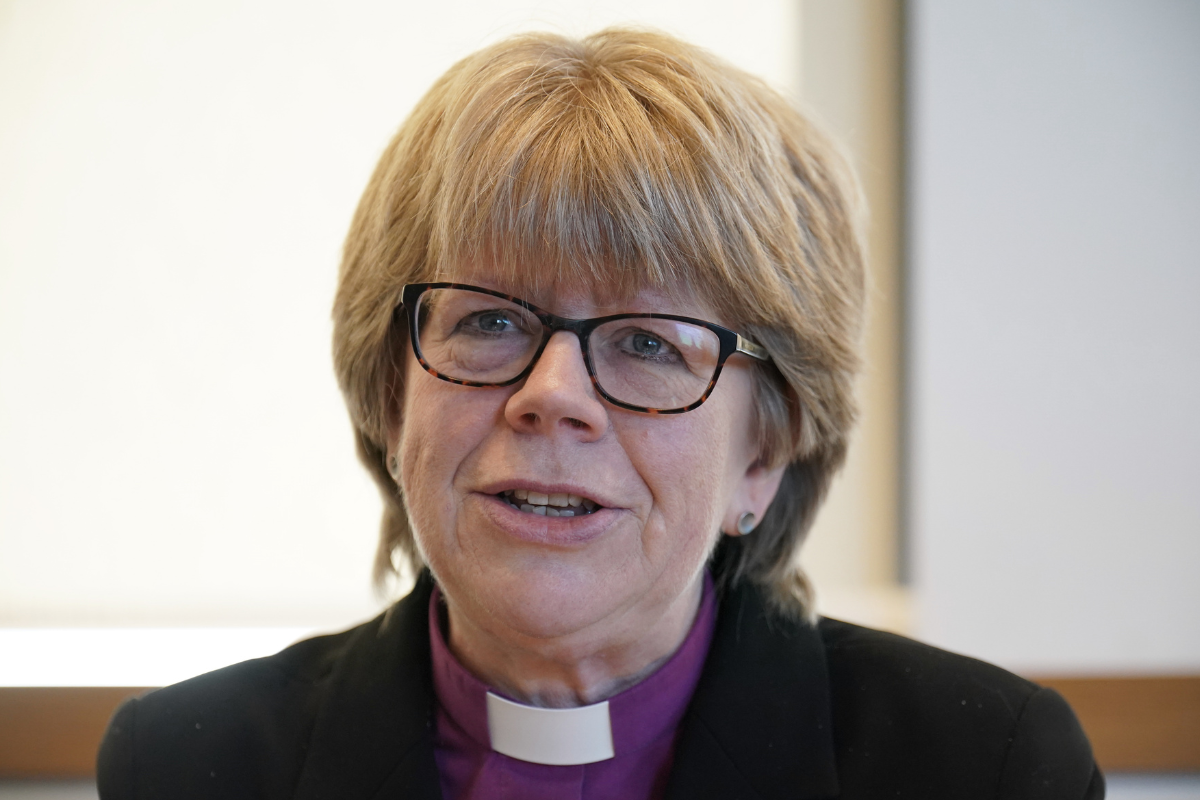
The Archbishop of Canterbury, Dame Sarah Mullally, told peers she opposed the decriminalization of women terminating their own pregnancies, because it “risks making an imperfect situation worse.”
“Though its intention may not be to change the 24-week abortion limit, it undoubtedly risks eroding the safeguards and enforcement of those legal limits and, inadvertently, undermining the value of human life,” she said.
Public Opinion
Polling carried out in 2017 by ComRes found that just one percent of the UK population supported extending abortion limits to birth, although the survey did not directly ask about decriminalization.
More recent polling by YouGov in 2023 showed that while 65 percent of Britons backed abortion on request before 24 weeks, just 17 percent supported it without restriction after that.
Abortion complications become likely as pregnancy progresses, no matter which method is used. A government review carried out in England from 2017 to 2021 found there were 0.4 complications per 1,000 abortions at two to nine weeks, rising to 23.8 per 1,000 at 20 weeks or later.
The most recent statistics available show there were 277,970 abortions in England and Wales in 2023, the highest number since the procedure was legalized, and an increase of 11 percent compared with the previous year.
Abortions after 24 weeks are rare in the UK, according to official statistics, with 260 cases recorded in England and Wales in 2022—around 0.1 percent of the total—while around 1 percent are performed after 20 weeks.
 Friends Read Free
Copy
Facebook
Tweet
Friends Read Free
Copy
Facebook
Tweet