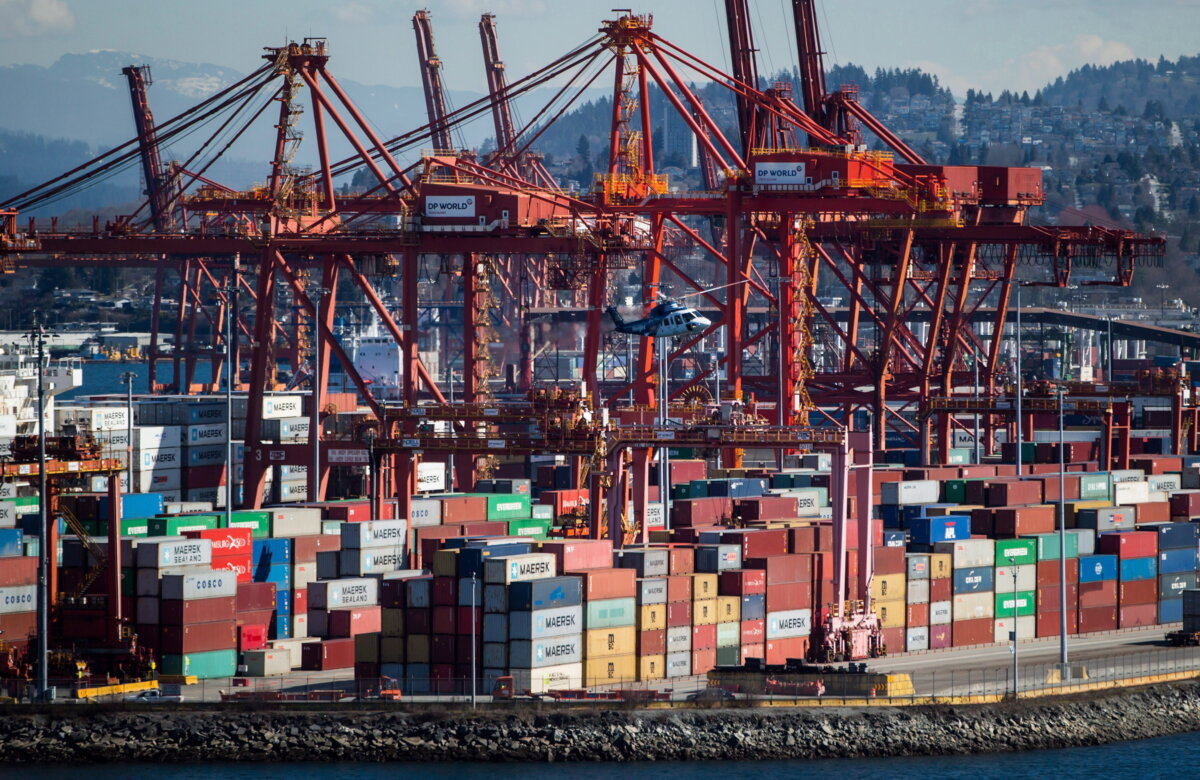

Canada’s current account deficit reached an all-time record of $21.2 billion in the second quarter of 2025 amid a trade dispute with the United States, according to data from Statistics Canada.
Canada’s current account, which reflects a nation’s international transactions with the global economy, rose by $19.8 billion in the second quarter of 2025, primarily due to an expansion of the country’s goods deficit resulting from declining exports. Goods exports fell by 13.1 percent in the second quarter of the year.
Canada’s goods exports fell by 13 percent from $212 billion in the first quarter to $182.2 billion in the second. Canada’s exports value has hit its lowest amount since the fourth quarter of 2021. Imports also fell by 4 percent, declining from $212.5 billion in the first quarter to $201.8 billion in the second.
The decrease in exports was led by a 20.5 percent decline in energy products, 16.6 percent decrease in automotive vehicles and parts, and a 16.6 percent fall in consumer goods.
As for imports, the decline was led by 12.1 percent fall in motor vehicles and parts, a 3.9 percent dip in consumer goods, and a 11.7 percent decrease in energy products, while imports of metal products rose by 18.6 percent.
Statistics Canada said the decline in goods exports was “widespread” and linked to the implementation of tariffs on Canadian goods by the United States. The White House has levied a series of tariffs on Canada, including 35 percent tariffs on goods not compliant with the United States-Mexico-Canada Agreement, 50 percent tariffs on steel and aluminum, 25 percent tariffs on vehicles and auto parts, and 10 percent tariffs on energy and potash.
The statistics agency also noted that the “sharp appreciation” in the value of the Canadian dollar relative to the U.S. dollar led to a reduction in Canadian exports, with the Canadian dollar rising from approximately 69 cents to the U.S. dollar in March to 73 cents by June. Canada’s trade surplus with the United States fell from $31.3 billion in the first quarter to $10.1 billion in the second.
Exports of services declined by 1.2 percent to reach $54.6 billion in the second quarter, while imports of services fell 1.9 percent to $54.5 billion.
Canada’s travel services surplus decreased by 10 percent, falling from $2.8 billion in the first quarter to $2.5 billion in the second quarter, driven by a decrease in spending by Canadian travellers in the United States.
The second quarter of the year marked the highest foreign divestment in Canadian securities since 2007, Statistics Canada said, noting that investors decreased their exposure by $16.8 billion following a $5.8 billion reduction in the first quarter. The divestments in the second quarter came from a $10.3 billion reduction in Canadian bonds, a $3.6 billion reduction in market instruments, and a $3 billion reduction in equity and investment fund shares.
 Friends Read Free
Copy
Facebook
Tweet
Friends Read Free
Copy
Facebook
Tweet