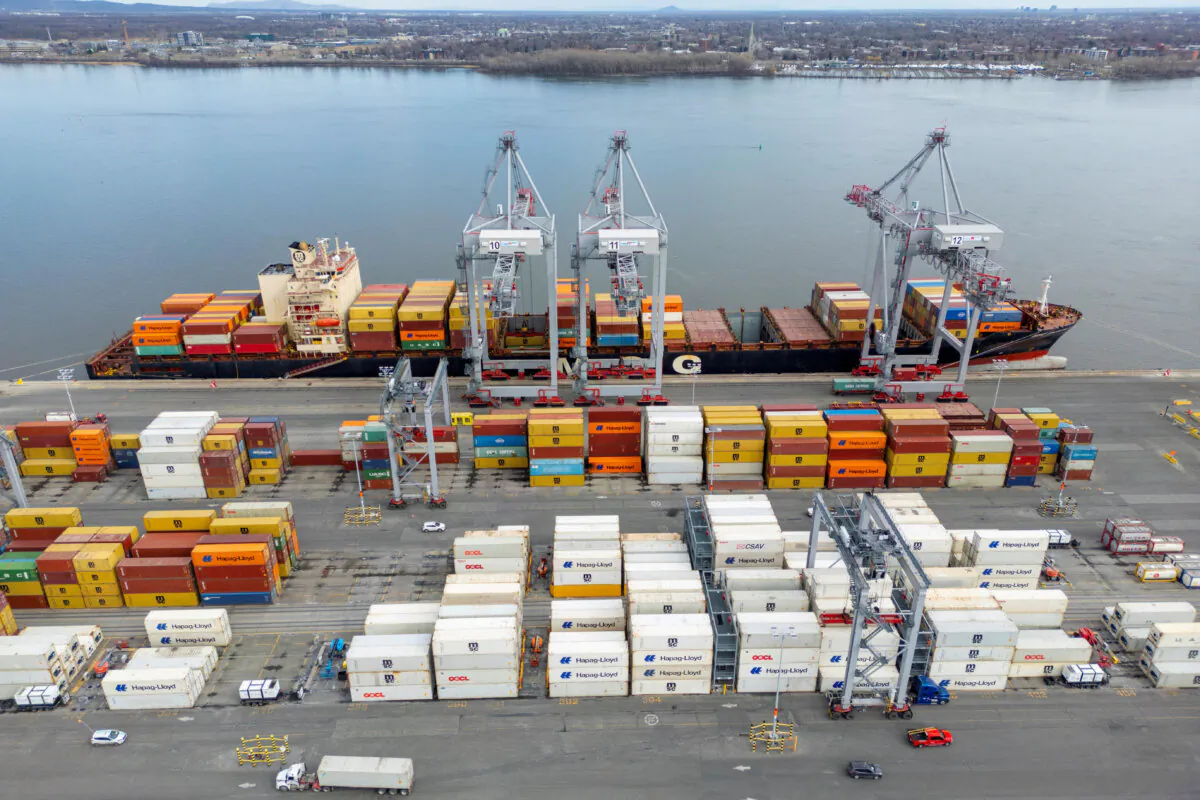

Canada’s Gross Domestic Product (GDP) shrank by 1.6 percent on an annualized basis in the second quarter of 2025 due to a decline in exports and business investment stemming from U.S. tariffs, after rising by 0.5 percent in the first quarter.
Statistics Canada said in its Aug. 29 briefing that these declines were offset by businesses accumulating inventory, higher household spending, and lower imports of various goods. Overall, Canada’s economy grew at an annualized rate of 0.4 percent in the first six months of the year.
The Bank of Canada had previously predicted in its July Monetary Policy Report that Canada’s economy would contract by approximately 1.5 percent in the second quarter. The lower-than-expected growth could increase the likelihood of the Bank of Canada lowering interest rates further, as the bank held rates steady at 2.75 percent in July.
StatCan said exports fell by 7.5 percent in the second quarter of the year after rising by 1.4 percent in the first quarter. Exports of vehicles fell by 24.7 percent, while exports of industrial machinery and equipment dipped 18.5 percent and travel services decreased by 11.1 percent.
The United States imposed 25 percent tariffs on Canadian vehicles and automotive parts in April. Canadian exports had risen by 1.6 percent in the first quarter of 2025, led by a 16.7 percent rise in passenger vehicles, and a 16.7 percent increase in industrial machinery and equipment in preparation for tariffs.
StatCan also said that in the second quarter, international imports declined by 1.3 percent after rising by 0.9 percent in the first quarter. Canada saw imports of passenger vehicles fall by 9.2 percent and travel services drop by 8.5 percent, while imports of metal products, such as gold, silver, and platinum, rose by 35.8 percent.
Business investment fell by 0.6 percent in the second quarter, with investment in machinery and equipment seeing a 9.4 percent decline. StatCan said “every group recorded declines” in business investment except for computers and computer equipment.
Business investment in non-residential buildings also fell by 3.3 percent. However, the delivery of a high-value import in Newfoundland and Labrador, designed for an oil product off the coast of the province, led to a 3.6 percent rise in engineering structures. Overall non-residential business investment saw positive growth as a result.
Business inventories also accumulated at a faster pace than in the first quarter, with businesses accumulating $30.1 billion in inventories in the second quarter compared to $10.8 billion in the first. Manufacturing and wholesale trade industries led in accumulating inventories, while retail investors also acquired large amounts of precious metals like gold and silver.
Household spending increased by 1.1 percent in the second quarter after a meagre 0.1 percent rise in the first quarter, thanks to a 5.6 percent rise in spending on new vehicles and a 1.3 percent rise in insurance and financial services. However, consumers spent 3.2 percent less on electricity and 3.9 percent less on alcoholic beverages.
The household saving rate, which is a measure of how much households are saving out of their disposable income, fell from 6 percent in the first quarter to 5 percent in the second. Disposable income rose by 0.3 percent in the second quarter, with weaker growth in salaries and wages pulling that number lower. StatCan noted that household incomes were “relatively weak across several components.”
If Canada’s economy were to again contract in the third quarter, the country would officially be in a recession, since it is defined by two consecutive quarters of negative GDP growth.
StatCan said on Aug. 28 that Canada’s current account, which reflects a nation’s international transactions with the global economy, reached a deficit record of $21.2 billion in the second quarter of the year. The measure rose by $19.8 billion that quarter primarily due to the expansion of Canada’s goods deficit resulting from declining exports.
Goods exports fell by 13.1 percent in the second quarter of the year, declining from $212 billion in the first quarter to $182.2 billion in the second, StatCan said. Imports also fell by 4 percent, declining from $212.5 billion in the first quarter to $201.8 billion in the second.
 Friends Read Free
Copy
Facebook
Tweet
Friends Read Free
Copy
Facebook
Tweet