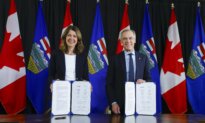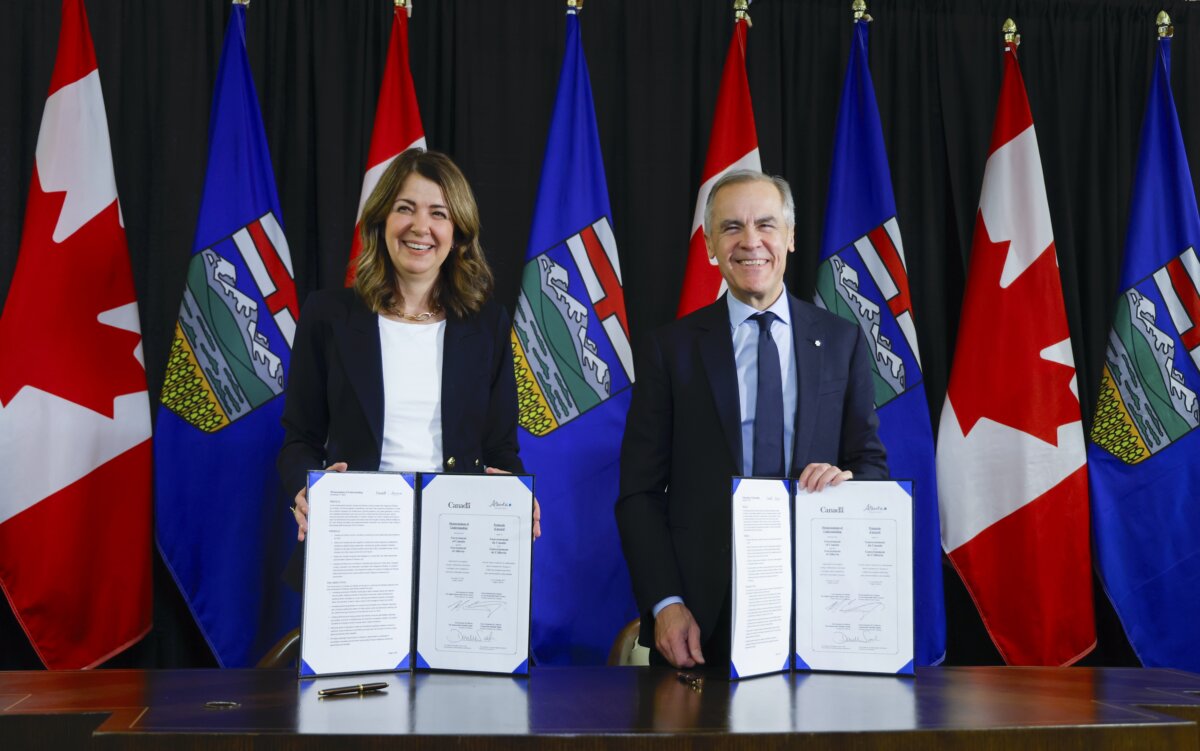

Prime Minister Mark Carney and Alberta Premier Danielle Smith say the proposed oil pipeline from Alberta to British Columbia does not have to go to B.C.’s northwest coast, as they are open to exploring alternate pipeline routes.
Alberta and Ottawa signed a memorandum of understanding (MOU) on Nov. 27, 2025, establishing a framework to explore the development of one or more privately financed oil pipelines to Canada’s West Coast, potentially capable of transporting up to one million barrels of Alberta bitumen per day to Asian markets.
The agreement also removes some Trudeau-era energy policies, such as potentially adjusting the oil tanker ban off of B.C.’s northwest coast, to allow oil to be shipped to Asia via tankers, in exchange for emission-reduction commitments from Alberta.
Alberta Deputy Energy Minister Larry Kaumeyer had previously said he expected the route would go to Kitimat, B.C., or Prince Rupert, B.C., both of which are on the province’s northwest coast and fall under the oil tanker ban. Meanwhile, B.C. Premier David Eby has said he would “welcome” a pipeline that goes to the Lower Mainland or southern B.C., but that he opposes any alteration of the oil tanker ban.
Carney was asked by reporters at a Jan. 29 press conference at the first ministers’ meeting in Ottawa whether a potential pipeline through British Columbia has to go to the northwest coast. Carney replied that the goal of the pipeline is to transport bitumen to Asian markets, and specific routes are not outlined in the MOU.
“Work is being done to explore the feasibility of various routes, and there are many factors that affect feasibility, starting with indigenous support as well as technical and economic considerations,” he said.
Smith told reporters at the press conference she has heard the concerns about the original routing of the Northern Gateway Pipeline project, which was set to go to Kitimat and was rejected by Coastal First Nations more than a decade ago. She said Kitimat is “not on the table as one of the ports that we’re looking at,” adding that there are “too many channels that have to be navigated.”
She also said alternative routes to boost oil exports are “already emerging,” and there is also a “very interesting potential proposal for oil by rail,” which would go off the East coast and give Canada access to European markets.
“North, south, east, west—we’re willing to go in every direction,” Smith said, adding her government aims to complete the pipeline proposal by June.
“We are hoping that the federal government can move swiftly on making a decision so we can get down to technical details on that,” she said. “I’m very confident that once approved, we will have one or more strong proponents in the private sector willing to work with us to build it.”
Asked by reporters to comment, Eby replied, “Premier Smith is committed to keeping us updated on her progress, and I look forward to that.”
Pipeline Opposition
Eby has criticized Alberta’s pipeline proposal, saying it is “not a real project” since it hasn’t secured a private proponent. He has maintained that he is opposed to any partial or full lifting of the oil tanker ban on B.C.’s northwest coast.
Eby met with Carney and Smith on Jan. 28 and told reporters the meeting was “civil” in tone, but that his opposition to the proposed pipeline hasn’t changed, adding that no substantive changes or developments on the pipeline came out of the meeting.
He said he told Carney and Smith that their signing the MOU without involving his province was “backwards.” He has also previously said that the province and First Nations whose territory the pipeline would affect should have the right to say no to the project.
The MOU calls for immediate engagement with B.C. on the project, and meaningful discussions with indigenous peoples in Alberta and B.C., but it doesn’t mention a veto for either party.
Although the federal government has the right to approve and regulate interprovincial pipelines it considers to be in the national interest under the Constitution Act, Carney has said he won’t override a province’s objections to get a project of national interest built. He has also said he won’t override First Nations opposition to the pipeline.
B.C. First Nations alliance Coastal First Nations said its stance on the pipeline to British Columbia’s northwest coast didn’t change after a meeting with Carney on Jan. 13. The alliance cited concerns about a lack of technology to clean up oil spills.
Coastal First Nations president Marilyn Slett said in November that a pipeline to B.C.’s northern coast would “never happen,” and criticized Ottawa for negotiating with Alberta without involving First Nations.
Paul Rowan Brian contributed to this report.
 Friends Read Free
Copy
Facebook
Tweet
Friends Read Free
Copy
Facebook
Tweet