
News Analysis
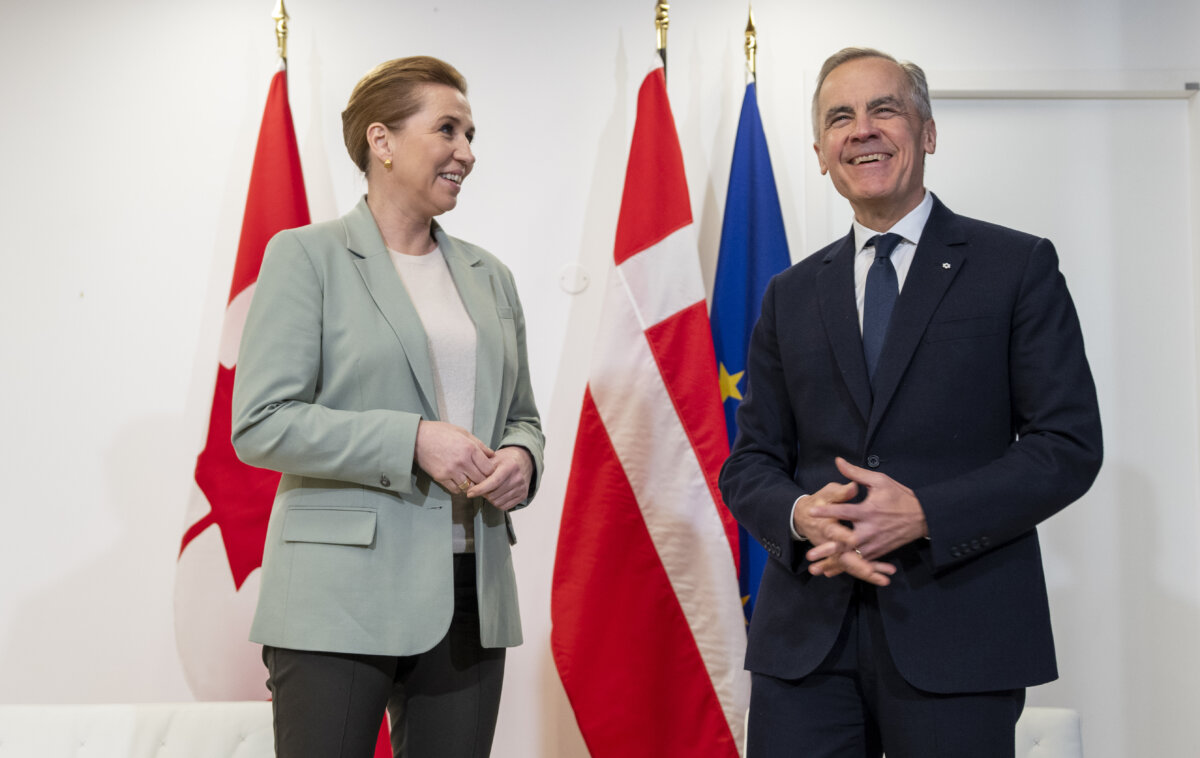
Canada and Denmark have similarly been in the crosshairs of U.S. President Donald Trump, but the two countries’ incumbent governing parties have experienced different fates after leaning politically on that situation to win votes.
What has resonated with the Canadian public to keep the federal Liberals and the Ontario Progressive Conservatives in power has not had the same impact across the pond in the latest election.
With the Danish leader facing a setback in late March, it could serve as a cautionary tale for the Liberals if they’re contemplating calling an early election to take advantage of good polling and the mood of Canadians toward the United States.
A general election was held in Denmark on March 24, and Prime Minister Mette Frederiksen’s Social Democrats had their worst performance since 1903.
Frederiksen had called the early election in late February hoping to benefit from improved polling following her handling of Trump’s push to acquire Greenland. The initial set date for the Danish general election was late October this year.
The Social Democrats were coming off a significant setback in local elections in November 2025, which saw them lose the capital Copenhagen for the first time in 87 years.
Frederiksen gained momentum in the new year as she rebuffed Trump’s plans to acquire Greenland, a semi-autonomous territory that’s part of the Danish commonwealth.
Trump, up to late January, had not ruled out using military force to take Greenland, which he says is vital for defence against China and Russia. After pushback from European nations, he agreed to hold discussions on the level of access the United States needs for security purposes.
Defining the Relationship
While tensions abated in recent weeks, the issue remained vivid for Denmark, and defending sovereignty became a rallying call for Prime Minister Frederiksen.
“We must define our relationship with the United States, and we must rearm to ensure peace on our continent,” Frederiksen said when announcing her decision to call a snap election in February. She called the election “decisive” for charting the future of the country.
For the Canadian public, these circumstances will seem quite familiar. Shortly after Trump won the November 2024 presidential election, he started talking about making Canada the 51st U.S. state and began calling Canadian prime ministers “governors.”
In the case of Greenland, Trump had not ruled out using military force to acquire it until his Jan. 21 speech in Davos, Switzerland.
Trump had not evoked using military force to acquire Canada, but he did at one point say he could use “economic force” to get rid of the “artificially drawn” border between Canada and the United States. This was in early January 2025, before he took office, but similar messaging about his desire for Canada to join the United States continued until after the April 2025 federal election in Canada.
Prime Minister Mark Carney won that election running on a similar theme as the Danish prime minister, such as defending Canadian sovereignty and standing up to Trump with an “elbows up” strategy.
Amid Canadians’ anxieties about U.S. tariffs and Trump’s designs for Canada, the Liberal Party came back from the brink of the political abyss under Prime Minister Justin Trudeau to win a strong minority government under Carney.
The fact that Carney was a newcomer to politics and came with a stacked resume also likely played a role in reversing the Liberals’ fortune, elements the Danish Social Democrats did not benefit from.
In comparison, Ontario Premier Doug Ford called a snap election a few days after Trump took office, saying he needed a strong mandate to push back on the United States. Voters gave Ford a third-straight majority after he was first chosen as premier in 2018.
Domestic Issues
Frederiksen had been in power since 2019, and her bump in support due to her stance toward Trump was not sufficient to offset domestic concerns around affordability, immigration, and clean drinking water.
Her Social Democrats still won the largest share of votes in the March 24 election, but the party dropped to 38 seats compared to the 50 seats won in 2022. The left-wing ruling coalition headed by Frederiksen fell short of the sought-after majority, winning 84 seats in the 179-seat parliament. The right-wing bloc won 77 seats.
Given the structure of Danish politics, with a dozen parties gaining seats based on their percentage of the votes and governments emerging from coalitions, Frederiksen still has a chance to return as prime minister.
Next Election
There is currently no indication the Carney Liberals would suffer the same fate as the Danish Social Democrats were they to call a snap election in the hopes of securing a majority government.
The Liberals have maintained a comfortable lead in the polls over the Conservatives, and the gap between Carney and Tory Leader Pierre Poilievre is even greater on the metric of favourability as prime minister.
Although the Liberals could soon gain a razor-thin majority by way of the three byelections slated for April, taking advantage of good polling to obtain a more solid majority is also a possibility. A slim majority has some challenges and is not sheltered from unforeseen developments in the House of Commons, including having to deal with dissenting MPs in caucus. The Liberals currently have 170 seats, two shy of a majority.
But there are also risks in calling an early election if voters think it isn’t warranted—as when David Peterson’s Ontario Liberal Party lost to Bob Rae’s NDP in the 1990 provincial election in one of the most notable upset elections in Canadian history.
But the federal Liberals are also running against the clock, having been in power since 2015. At some point, Carney’s polling could see the drag if his plan to boost economic growth and bring down the cost of living doesn’t bear fruit.
The Conservatives had surged in the polls in 2024 as Trudeau was growing less popular amid an affordability crisis and rising violent crime. Rejection of the Liberals was such that the Conservatives were able to win a byelection in the Liberal stronghold riding of Toronto—St. Paul’s. The Tories pulling a similar upset in the ridings recently left vacant by former ministers Chrystia Freeland and Bill Blair would be very surprising.
When the Liberals face voters next in a general election, whenever that is, they will have to decide if they run the Trump playbook again. It might be hard to avoid given the geographical proximity with the United States, the impact of Trump’s policies on Canada, and the dividends the strategy paid the first time around. On the other hand, the Danish experiment could provide some food for thought.
Of course, a general election taking place three years from now would almost certainly not be as heavy on Trump, as the president would no longer be in office, with his term ending in January 2029.
 Friends Read Free
Copy
Facebook
Tweet
Friends Read Free
Copy
Facebook
Tweet