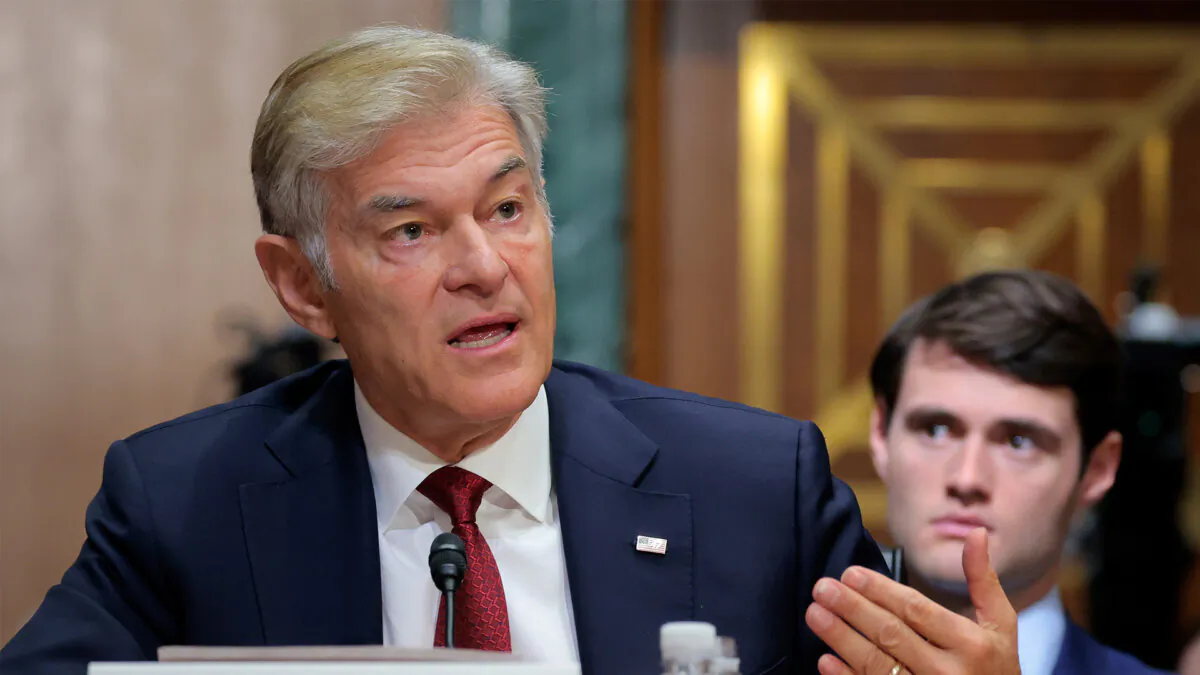

U.S health official and former television personality Dr. Mehmet Oz says culling a herd of ostriches at a B.C. farm would be a mistake because the animals offer an “incredible opportunity” for scientific research.
The Canadian Food Inspection Agency (CFIA) ordered nearly 400 birds at Universal Ostrich Farms in Edgewood, B.C., to be culled after 69 ostriches died in an outbreak of avian flu on the property in December 2024 and January 2025.
The farm owners are opposing the cull order and say their birds have immunity from the virus and should be studied.
Oz, who is now the administrator of the U.S. Centers for Medicare and Medicaid Services, said the animals have survived “potentially devastating” avian flu infections, adding that the CFIA order would amount to “slaughter” and is based on rules from a “bygone era.”
He made the comments in an Aug. 25 news conference with New York radio talk show host and billionaire John Catsimatidis and Katie Pasitney, whose mother co-owns the B.C. ostrich farm.
Catsimatidis has previously offered to financially contribute to the farm.
Oz said the herd of ostriches should be sent to the United States so scientists can research what helped the birds survive the avian flu outbreak. Study of the birds could provide valuable insights to assist in addressing a possible future avian flu outbreak in humans, he noted.
“They have secrets in them that we can learn from, and it makes perfect sense for America and Canada to co-operate on this,” he said.
Oz told Catsimatidis on his radio show that he had been in touch with the B.C. farm after a decision to uphold the cull order was released by Canada’s Federal Court of Appeal on Aug. 21.
Oz previously offered to take in the birds at his Florida ranch, and told Catsimatidis that he would still allow the birds on his property if Prime Minister Mark Carney permitted it. Oz said he had spoken about his plan to other U.S. health officials, including Director of the National Institutes of Health Jay Bhattacharya.
“We are all excited about learning enough about what’s going on that we might be able to transfer that knowledge back to Canada and the rest of the planet,” Oz said.
U.S. Secretary of Health Robert F. Kennedy Jr. previously wrote a letter to the CFIA asking for it to scrap the cull order.
CFIA said that its disease response to avian flu was intended to “protect both public and animal health.”
“The CFIA takes the responsibility to protect the health of animals and Canadians extremely seriously as we conduct these disease control measures,” CFIA said in an Aug. 21 statement, adding that it also seeks to minimize the impacts on the $6.8 billion domestic poultry industry and the Canadian economy as a whole.
The agency said it will not disclose the dates for the planned culling of the animals to the public beforehand.
Court Cases
The farm owners attempted to overturn the cull order in Federal Court, but lost the case on Aug. 21 after the court ruled that the CFIA’s “stamping out” policy was reasonable. It also concluded the criteria to apply the rule had been met in the case.
The stamping out policy is defined by the World Organization for Animal Health as a way to control the spread of avian flu. It states that if the flu is discovered, steps must be taken to destroy any animals or items that were infected or exposed. It also states the environment must be decontaminated.
The Federal Court upheld the initial cull order in June. The farm owners appealed the ruling, which ended with the Aug. 21 decision. They also previously applied for a judicial review of the CFIA order, but it was denied.
The lawyer for the farm previously said they were hoping to appeal the Federal Court decision to the Supreme Court.
The Canadian Press contributed to this article.
 Friends Read Free
Copy
Facebook
Tweet
Friends Read Free
Copy
Facebook
Tweet