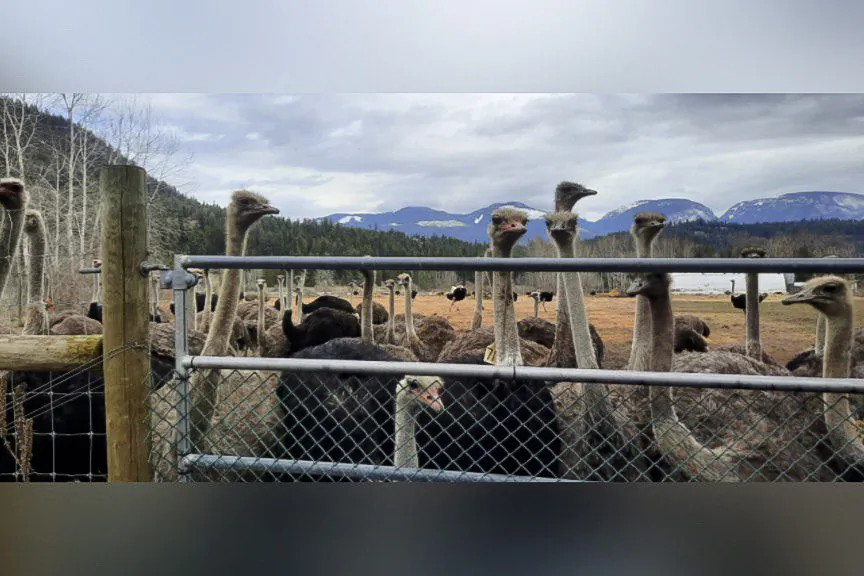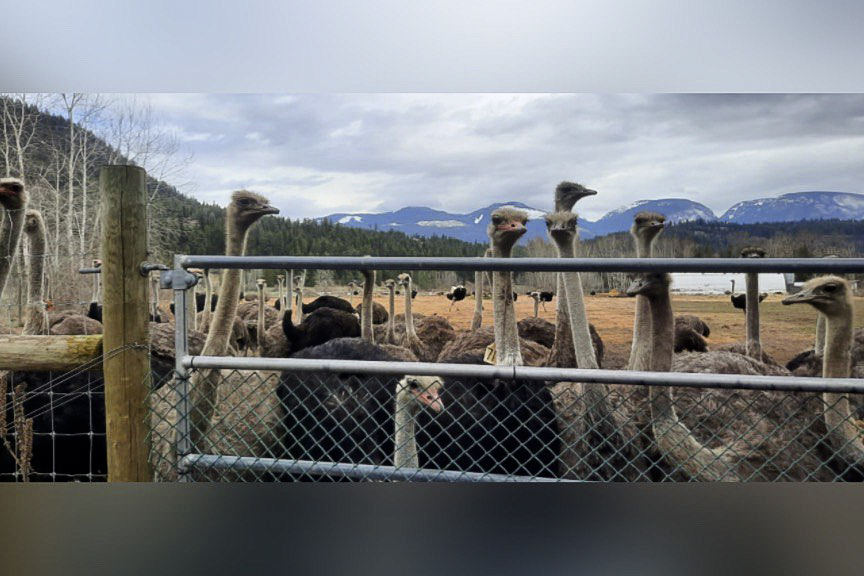

The Federal Court of Appeal has rejected an application to cancel a cull order for a flock of ostriches in B.C. that were infected with avian flu.
The court denied the application by Universal Ostrich Farms for a judicial review of a Canadian Food Inspection Agency (CFIA) order to cull about 400 birds at the farm.
The CFIA ordered the birds at the Edgewood, B.C. farm to be culled after 69 ostriches died in an avian flu outbreak on the farm in December 2024 and January 2025.
The farmers opposed the cull, saying their birds had immunity from the virus and were being used for research.
A Federal Court upheld the cull order in June, but the farm owners appealed the ruling. They had previously applied for a judicial review of the CFIA order, but it was denied.
The latest Federal Court ruling has also rejected a request to bring new evidence in the case.
“In so concluding, we recognize that our decision might lead to the death of over 400 ostriches owned by the appellant, an outcome that would doubtless be very difficult, both financially and emotionally, for the appellant’s principals,” the ruling said.
“While we have considerable sympathy for them, the law we are bound to apply inevitably leads to the conclusion that this appeal must be dismissed.”
The court said the CFIA’s “stamping-out” policy was reasonable, and the criteria to apply it had been met in the case. The stamping out policy is defined by the World Organization for Animal Health as a way to control the spread of avian flu. The policy states that if the flu is discovered steps must be taken to destroy any animals or items on the property that were infected or exposed, and the environment must be decontaminated.
Katie Pasitney, daughter of the farm owners, called the decision “devastating” in an Aug. 21 post on Facebook.
She said the decision meant that “at any moment, the Canadian Food Inspection Agency could come and kill our healthy ostriches.”
She said the chance of getting their case into the Supreme Court was “low.”
“As of right now we sit with animals that need protection,” she wrote.
Pasitney invited supporters to visit the farm during the upcoming weekend to “meet these incredible animals, take photos, share love, and stand together.”
She said the animals were not just livestock but “living beings that have thrived against all odds.”
CFIA said that its disease response “aims to protect both public and animal health.”
In an online statement the agency said its response also seeks to minimize the impact on the Canadian economy.
“The CFIA takes the responsibility to protect the health of animals and Canadians extremely seriously as we conduct these disease control measures,” the statement said.
The agency also said it does not release operational plans and the dates it plans to cull the animals will not be shared publicly in advance.
The case has drawn international attention, with U.S. Secretary of Health Robert F. Kennedy Jr. writing a letter to the CFIA asking for it to scrap the cull order. U.S. administrator for the U.S. Centers for Medicare and Medicaid Services, Dr. Mehmet Oz offered to relocate the birds to his Florida ranch. Most recently, American billionaire John Catsimatidis offered to financially contribute to the farm.
The court said its role was not to grant exceptions from government policies.
“Rather, our sole role is to determine whether the decisions at issue in this appeal were reasonable in accordance with the deferential standard of review set out in the case law of the Supreme Court of Canada, this court, and other Canadian courts,” it said.
It add that because the stamping-out policy was “reasonable,” the court has “unanimously concluded that this appeal cannot succeed.”
The Canadian Press contributed to this article.
 Friends Read Free
Copy
Facebook
Tweet
Friends Read Free
Copy
Facebook
Tweet