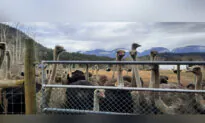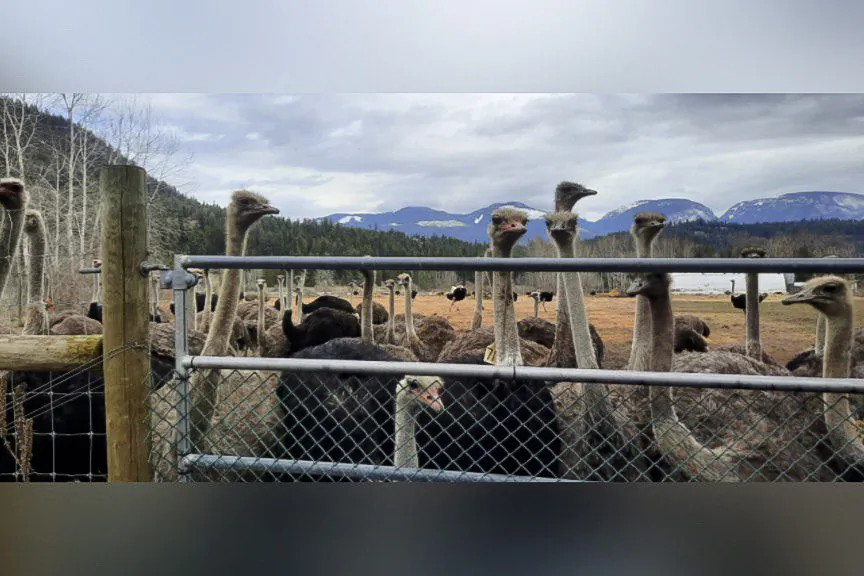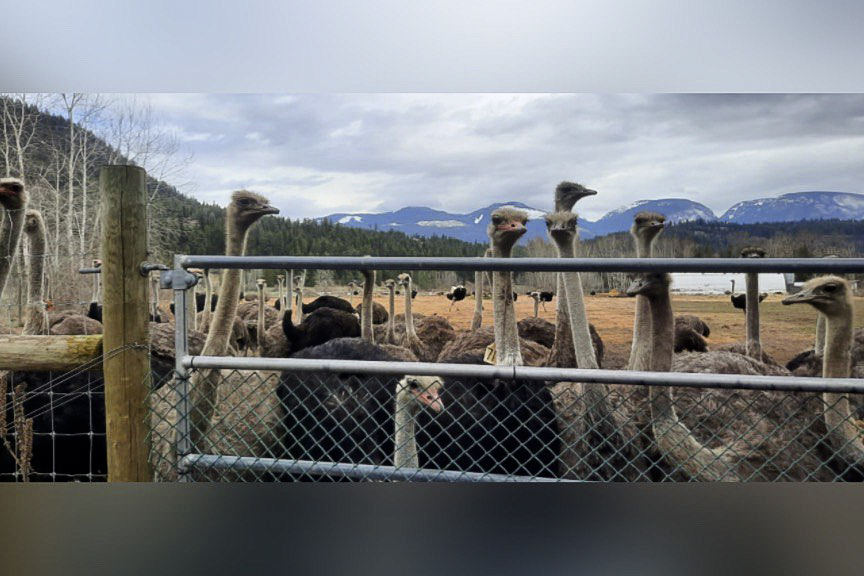

The Federal Court of Appeal has denied the request of the owners of a southeastern B.C. ostrich farm to perform additional avian flu testing on their flock in an effort to prevent a cull mandated by the Canadian Food Inspection Agency.
The decision, released online this week, grants a temporary suspension to the upcoming cull of the farm’s 399 birds. The court will issue its ruling on the farm’s appeal of the cull by the week of July 21.
Universal Ostrich Farm became the centre of protest and media attention after dozens of its ostriches died of avian flu in December 2024 and January 2025, and hundreds of supporters camped out at the farm last month to protest the Canadian Food Inspection Agency’s (CFIA) planned cull of the herd.
The CFIA says the avian flu outbreak at the farm is of particular concern because it is a mutation not seen anywhere else in Canada, an assertion that farm spokesperson Katie Pasitney denies.
“They don’t want us to test them because they know that we’re going to find that all of our ostriches are absolutely negative,” Pasitney said in an interview with The Epoch Times. “They are not shedding the virus. They don’t want the world to see that we have a recovered flock that they almost killed due to the failure in their own policies.”
The CFIA has said failing to cull the ostrich herd poses a risk to public safety, noting that compensation could reach up to $3,000 for each bird.
“Testing by the CFIA’s National Centre for Foreign Animal Disease (NCFAD) already conclusively determined that the Universal Ostrich Farm is an HPAI [highly pathogenic avian influenza] infected premises,” the CFIA said in an e-mail to The Epoch Times. “NCFAD also isolated the H5N1 virus from samples collected from the farm, and in completing full genome sequencing determined that the current HPAI infection in these ostriches is a novel reassortment not seen elsewhere in Canada.”
The owners unsuccessfully challenged the cull in Federal Court earlier this year, and the judicial review was dismissed on May 13 after the judge determined CFIA’s decision to be both “reasonable” and “made in a procedurally fair manner.” The courts also mandated the farm pay $15,000 to the CFIA to cover associated legal costs.
The CFIA announced last month it would proceed with the cull despite more than 200 protesters gathering at the farm and the Regional District of Central Kootenay voting against permitting the agency to dispose of ostrich carcasses in its landfills. It has also rejected requests for the birds to be retested, saying additional tests wouldn’t alter the cull order.
“Additional testing would not alter the decision to apply Canada’s ‘stamping-out’ policy,” which is “the internationally recognized standard and is a primary tool to manage the spread of HPAI and mitigate risks to animal and human health as well as enable international trade,” the agency said in an email.
“We have a duty to protect Canadians from the serious potential risks that Avian Influenza presents to our people and our economy,” the CFIA previously told The Epoch Times.
“Allowing a domestic poultry flock known to be exposed to HPAI to remain alive allows a potential source of the virus to persist.”
The cull was temporarily halted last week when Justice Sylvie Roussel determined that the farm qualified for a stay on the cull order until the formal appeal in July. However, she rejected the farm’s requests to perform independent H5N1 avian flu tests on the birds for the court’s consideration, as well as another request to suspend the CFIA regulations that prohibit such independent testing.
“There are real consequences to the erosion of trust in the agricultural industry, and this is the reason why,” said Pasitney, whose parents own the farm. “We need to push for comprehensive reform packages that restore the trust in Canada’s farming.”
A Call for Change
Pasitney says the flock poses no threat and should be tested independently for ongoing avian flu infections, saying the ostriches have acquired herd immunity to the virus and are a valuable scientific research resource. She says instead of the two polymerase chain reaction tests performed on the animals followed directly by a cull order, the CFIA should have worked with them to further test, quarantine, and monitor the animals until the virus burnt out.
Pasitney says the focus should be on “saving our small farmers instead of pushing them out of their farms,” rather than being in alignment with policies from organizations such as the World Economic Forum, World Health Organization, and United Nations.
The case has received international attention, including from U.S. Health Secretary Robert F. Kennedy Jr.
“We have an olive branch from RFK saying, ‘please collaborate with us. We’re willing to collaborate with you to save this farm and research for better animal and human health.’ They see the potential. And the Canadian Food Inspection Agency just turned their nose up at them,” Pasitney said.
The farm has considered a last resort option of moving the ostriches to the United States, where Dr. Mehmet Oz, the administrator of the Centers for Medicare and Medicaid Services, has volunteered to coordinate the relocation of the birds to Florida.
For her part, Pasitney says the COVID restrictions and lockdown hurt Canadians, which is why there have been hundreds of activists who have rallied to defend her farm from the cull order.
“I know that is why we’re still here is because the truckers got deeply, deeply hurt. The frontline workers got hurt. Now they’re coming after our agricultural sector and our farmers. And I believe that the frontline workers, the truckers, everybody, are coming together right now to see that the farmers don’t become the next mistake.”
Pasitney says she hopes to restore trust and avoid situations where farmers are worried about reporting diseases out of fear agencies will “come in and kill everything” without thorough testing.
“We’re at ground zero,” Pasitney said. “We’re not going to make another mistake like we did during COVID. We’re all going to stand up.”
 Friends Read Free
Copy
Facebook
Tweet
Friends Read Free
Copy
Facebook
Tweet