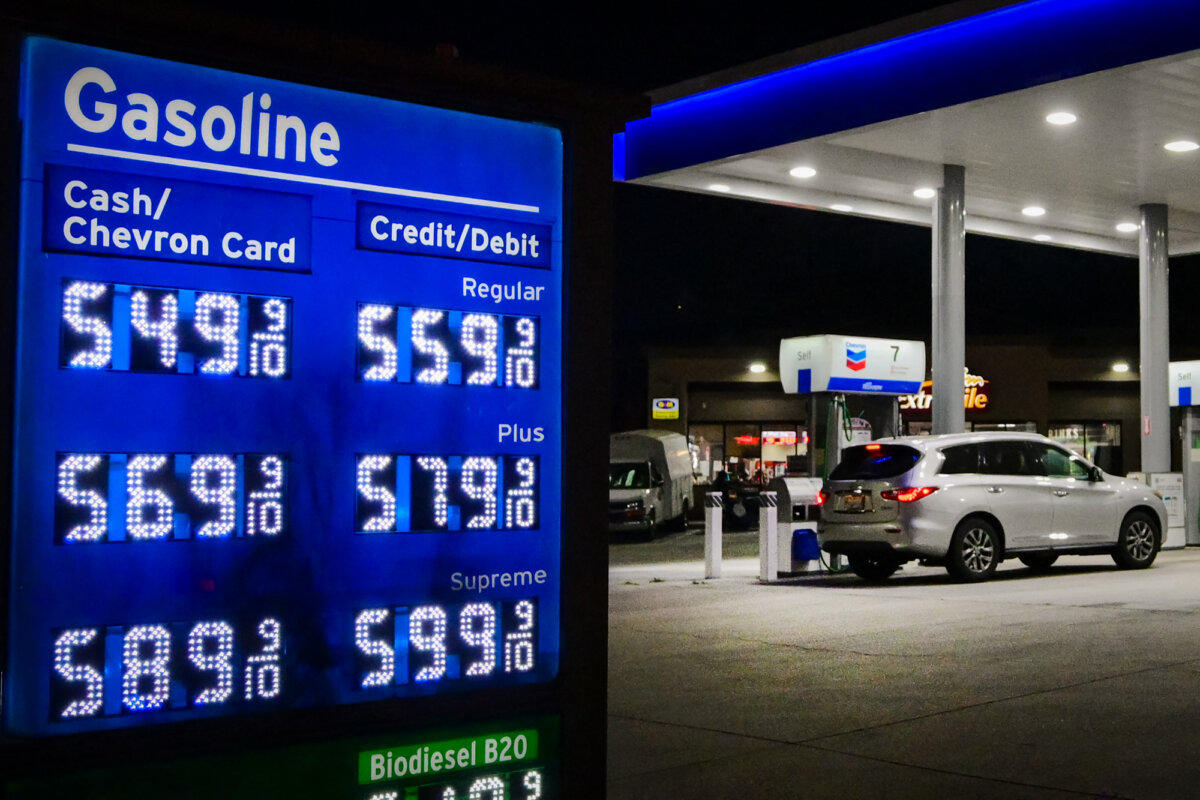

Global oil market analysts expect the Trump administration to issue emergency measures “to attempt to lower prices” in the United States if the Strait of Hormuz isn’t reopened soon, says a veteran market monitor tracking trends that drive pump, grocery, and utility costs worldwide.
Mohammad Darwazah, senior Middle East analyst with London-based Medley Global Advisors, said he believes that engaging the U.S. military in securing the Strait remains on the table as one of the emergency options.
Darwazah said in an hour-long March 18 interview with the president of the nonprofit energy forum United States Energy Association, Mark W. Menezes, that the Trump administration has a range of emergency tools to temper skyrocketing oil and gas prices roiling economies across the globe after the United States launched Operation Epic Fury on Feb. 28, alongside Israel’s own military operation.
Among those tools is the 60-day Jones Act waiver to allow foreign-flagged ships to transport U.S. crude oil to domestic refineries, primarily from Gulf ports to terminals in the Northeast; releasing oil from the Strategic Petroleum Reserve; implementing components of the Defense Production Act; and suspending some environmental regulations and market constraints.
But no matter what actions the Trump administration or any government takes, Darwazah said they won’t compensate for the loss of 10 million barrels of crude and 5 million barrels of derivatives—diesel, jet fuel, polyethylene, fertilizer—as well as helium, methanol, and aluminum that flowed daily from the Persian Gulf before Feb. 28.
“There’s no elixirs, no kind of one policy, no one big lever” that can be pulled to replace the 20 percent of daily global oil consumption now bottled within the Gulf until ships believe it is safe to traverse the Strait of Hormuz, he said.
There’s limited pipeline space to re-route crude exports from the Gulf to the Red Sea, Darwazah said, noting that Saudi Arabia and the United Arab Emirates move up to six-and-a-half million barrels a day to Yanbu via the 750-mile East-West Pipeline but have little spare capacity to expand.
Iran is “talking about escalating their attacks on energy infrastructure” in Saudi Arabia and its Gulf state neighbors, he said, meaning “this could certainly be a risk” to the vulnerable pipeline.
To put a dent in the supply gap, at least 50 to 60 percent of pre-war volume from the Persian Gulf must be restored—a percentage that grows as tankers stack in the Arabian Sea and stored fuels are drained, Darwazah said.
Without “clear diplomatic off-ramps that would allow the strait to reopen in a matter of weeks,” he said, options to restore that vital flow become more narrow and more urgent.
“From a market’s point of view, the perception now is starting to shift towards the need for some kind of military action,” Darwazah said, “which is what the White House seems to be leaning towards.”
Congress’s Repealed Export Ban
Darwazah also noted the option of restoring the 40-year national oil export ban Congress lifted in 2015.
“There is anticipation or chatter, rumors, about, ‘Could the U.S. enact an export ban?’” he said. “This is an idea that has been discussed … [it’s] something to watch very closely.”
Darwazah said under such circumstances, the United States—the world’s largest natural gas producer and liquified natural gas exporter, and a net crude oil exporter—could reconsider the oil export ban that Congress implemented in 1975 following the Arab oil embargo before it was repealed in December 2015.
But doing so “could have major unintended consequences,” he said, noting the idea is frequently raised after natural disasters, such as in the wake of hurricanes in Texas and Louisiana.
Such a move would be vehemently opposed by the nation’s energy industries, Darwazah said, and despite its temporary nature, could affect global markets long after it is lifted.
“If the U.S. suddenly bans exports of crude, you have about 4 million barrels a day that would now stay within the United States,” he said. “Prices would collapse domestically very quickly. You would start to see production being shut-in” by producers rather than shipped and sold on an artificially deflated market.
Among logistical reasons why domestic producers in the United States would “shut-in” stored oil or slow down drilling is, like Saudi Arabia, there’s little “spare capacity” in the nation’s domestic oil and gas pipeline network to move more volume.
“I think, generally, [market analysts] have come to the conclusion that the costs way outweigh the benefits. Doing something like a crude export ban would be extremely destabilizing for global markets,” Darwazah said, “So at the moment, it doesn’t seem like the administration will head towards [an export ban] but, again, it’s something to watch very closely.”
Energy Secretary Chris Wright on March 9 dismissed the idea, saying that the Trump administration was not considering such a ban as a way to control prices.
 Friends Read Free
Copy
Facebook
Tweet
Friends Read Free
Copy
Facebook
Tweet