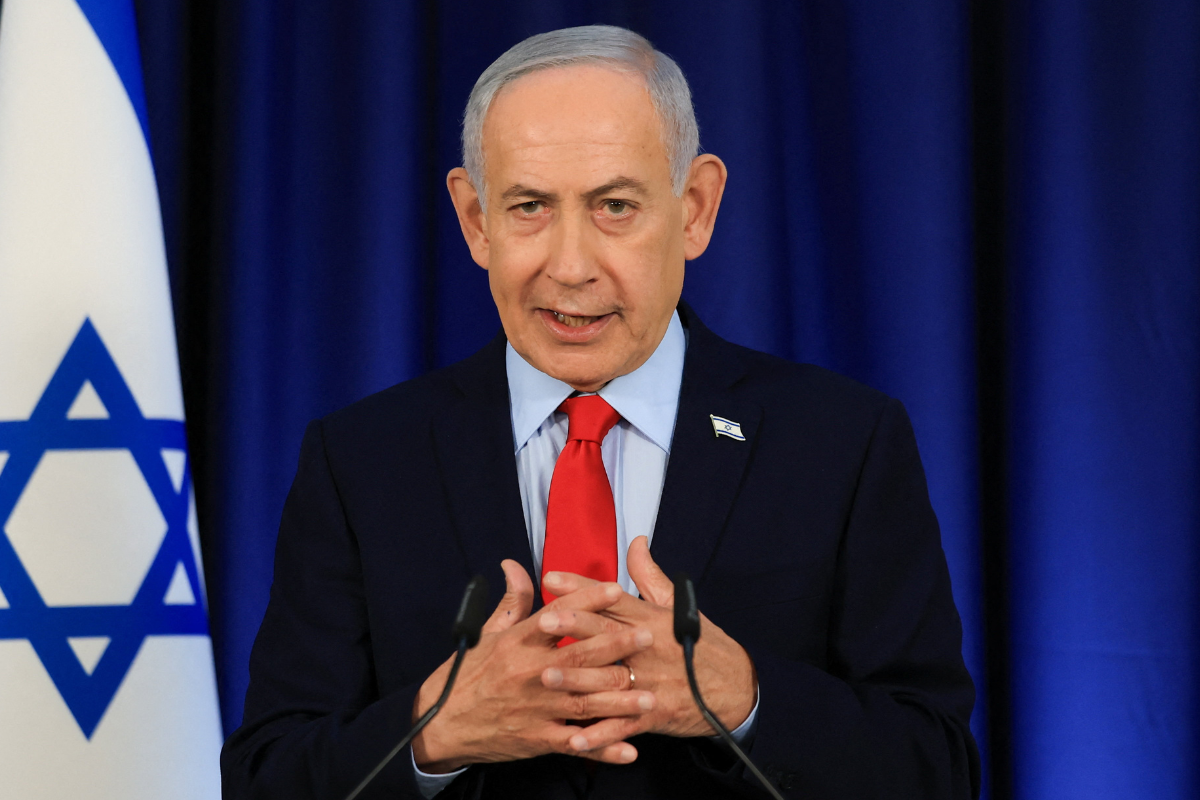

Israeli Prime Minister Benjamin Netanyahu said on May 10 that he hopes to wean Israel off U.S. military support within a decade.
In 2016, under the Obama administration, the United States agreed to give Israel $38 billion in military assistance. The memorandum of understanding covered U.S. fiscal years 2019–2028.
“I want to draw down to zero the American financial support, the financial component of the military cooperation that we have,” Netanyahu told CBS News’ “60 Minutes” on May 10.
He said that it is “absolutely” the right time to reset the U.S.–Israeli financial relationship and that he doesn’t “want to wait for the next Congress.”
The state of Israel has long enjoyed support from both Republicans and Democrats in the White House, the Senate, and the House of Representatives, particularly concerning military aid.
Since the outbreak of war in Gaza, in response to the attack by Hamas terrorists against Israel on Oct. 7, 2023, that left about 1,200 Israelis dead, support from both politicians and the U.S. public has waned.
A Pew Research poll published in March found that some 60 percent of American adults now view Israel unfavorably, and 59 percent said they had little or no confidence that Netanyahu would do the right thing regarding world affairs.
Both those percentages had risen by 7 percentage points from a year earlier.
Netanyahu told “60 Minutes” that the deterioration in support for his nation among U.S. citizens “correlates almost 100 percent with the geometric rise of social media.”
He said that several countries have “basically manipulated” social media in a way that hurt Israel, but he said that he does not support censorship.
Netanyahu said these nations used “bot farms with fake addresses” to break American sympathy toward Israel and rupture the alliance between Washington and Jerusalem, “because they think it’s in their interest.”
“And they do it in a clever way,” he said. “You know, it’s like you hear a text message: ‘I’m a, you know, red-blooded Texan. I always supported Israel. But I can’t stand what they’re doing. I’m turning against Israel.’ And then you trace the address to some basement in Pakistan, you know.”
Defending Israel’s actions in Gaza and Lebanon, Netanyahu said that the Jewish state had “gone to unbelievable lengths” to prevent civilian casualties.

“We text message millions of text messages to them,” he said. “Make millions of phone calls to them, pamphlets, leaflets, you name it, OK? And whereas Hamas and Hezbollah go out of their way to keep their own people in harm’s way, they shoot them.”
Netanyahu said that although there had been civilian casualties in the course of Israel’s actions, “the proportion of civilian casualties, noncombatants to combatants, is one of the lowest in the history of modern urban warfare.”
Although the Israeli leader declined to discuss his nation’s future military plans or a timetable for ending the war against Iran, which Israel is prosecuting in conjunction with the United States, he did say that it was only after conflict had broken out that Israeli planners recognized Iran’s ability to close the Strait of Hormuz.
“It took a while for them to understand how big that risk is, which they understand now,” Netanyahu said.
He said he believes that if the current Iranian regime is weakened or ousted, it will be the end of Hezbollah, Hamas, and probably the Houthis, “because the whole scaffolding of the terrorist proxy network that Iran built collapses.”
When asked whether it was possible to topple the Iranian regime, he said: “Is it possible? Yes. Is it guaranteed? No.”
 Friends Read Free
Copy
Facebook
Tweet
Friends Read Free
Copy
Facebook
Tweet