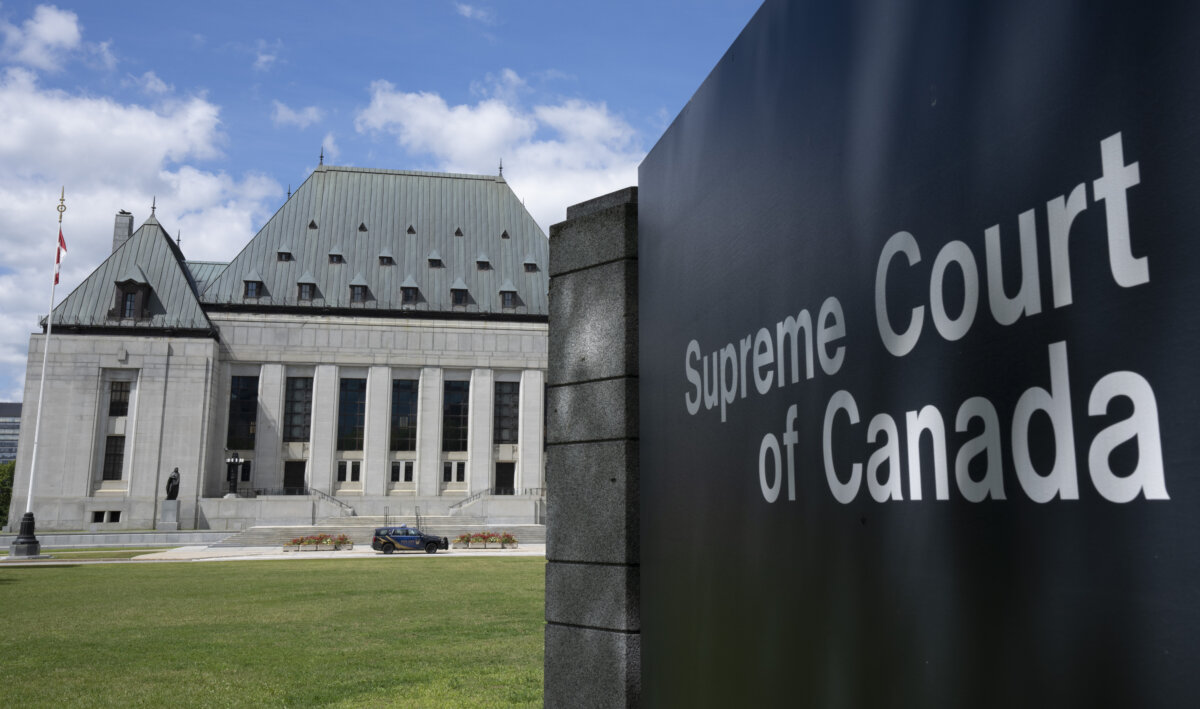

The Supreme Court of Canada has ruled in an 8-1 decision that Quebec’s policy barring asylum seekers from accessing its taxpayer-subsidized daycare program violates the Canadian Charter of Rights and Freedoms.
The March 6 decision found that Quebec’s Reduced Contribution Regulation (RCR) is unconstitutional because it discriminates against women awaiting decisions on their refugee claims who need child care.
“Section 3 of the RCR creates, in its effects, a distinction based on sex,” the decision said, noting that women applying for refugee protection tend to have greater child care responsibilities than men.
The case was brought by Bijou Cibuabua Kanyinda, who came to Quebec from the Congo with her three young children in 2018 and applied for refugee protection. While waiting for her application to be processed, Kanyinda was unable to access Quebec’s subsidized daycare program because the province’s RCR rules allow refugees to access the system only after Ottawa approves their refugee status.
Kanyinda challenged RCR in the Quebec Superior Court and lost to the province at the trial level, but she appealed to the Quebec Court of Appeal and won. The court then ordered that refugee claimants not be excluded from access to daycare.
That ruling was in turn appealed by the Attorney General of Quebec at the Supreme Court of Canada (SCC), resulting in the March 6 decision in Kanyinda’s favour.
The Quebec government had argued that the subsidized provincial daycare system is troubled by excessive demand and long waitlists, and lacks the capacity to let in a large number of children from asylum seekers.
The daily cost to attend a subsidized Quebec daycare amounts to $9.65, according to the latest figures from the province’s Ministry of Families.
In 2024, Quebec said it would need to build 88 more daycare facilities in order to accommodate all the children of refugee claimants, which they estimated would amount to $300 million in additional infrastructure spending and $120 million in subsidies.
Justice Andromache Karakatsanis, writing for the majority in the March 6 decision, said Quebec’s policy specifically violates Section 15 of the Charter guaranteeing equality rights. She said that even though Quebec’s regulation applies to all refugee applicants, it would disproportionately impact women, including making it harder for them to work.
“Blocking access to subsidized daycare threatens to reinforce and worsen economic disadvantage, and further marginalizes women refugee claimants from Quebec society,” Karakatsanis wrote.
The decision rejected Quebec’s defence that restricting subsidized daycare to people with strong ties to the province was reasonable, noting that other groups, such as temporary residents in Quebec, did qualify for the subsidized daycare.
“If these categories of people are considered sufficiently connected with the province, it is difficult to see how refugee claimants, who wish to establish themselves more permanently in Canada, are not,” the majority wrote.
Karakatsanis was joined in the majority by Justices Sheilah Martin, Nicholas Kasirer, Mahmud Jamal, Michelle O’Bonsawin, and Mary Moreau.
Other Opinions
Chief Justice Richard Wagner and Justice Malcolm Rowe put forward concurring opinions based on different reasoning.
Wagner held that refugee claimants are a “vulnerable and marginalized group” subject to “stereotypical reasoning” and that Quebec’s RCR discriminates against them and reinforces their “insular” position in society.
Rowe’s concurrence said that while Quebec had a partly justified goal in limiting subsidized daycare to those with a strong connection to the province, the potential harm caused by RCR to women outweighed the benefits of the restrictions.
The “deleterious effects on the affected women are, unquestionably, severe,” Rowe wrote, adding that the benefits of not allowing refugee claimants to access subsidized daycare were “speculative and marginal.”
The sole dissenting opinion was issued by Justice Suzanne Côté, who wrote that Quebec’s policy does not violate the Charter as it does not explicitly limit daycare access to refugee claimants based on sex.
“The RCR does not create a distinction based on the ground of sex, but rather on the ground of refugee claimant status,” she wrote, adding that if courts force governments to expand benefits they could actually discourage government from funding programs aimed at reducing inequalities.
“Imposing an obligation on the state to provide any benefit in a non-discriminatory manner could paradoxically discourage state initiatives aimed at reducing inequalities,” Côté wrote, adding that the province’s appeal should be allowed and the challenge dismissed.
Ruling
The Supreme Court ruling did not completely strike down the RCR but instead ordered a more specific remedy in which refugee claimants must be eligible for Quebec’s subsidized daycare rate.
The Canadian Constitution Foundation (CCF) intervened in the case to try to clarify exactly what evidence courts can rely on when ruling whether a law is discriminatory and contrary to Section 15 of the Charter. Specifically, the civil liberties group argued that courts should require clear and reliable evidence that a law causes discrimination instead of broad social science claims or generalized arguments.
The majority said strict rules around evidence are not necessary and no “rigid template” is needed to prove discrimination, writing that “no specific form of evidence is required,” meaning that claimants such as Kanyinda can use expert testimony, reports, statistics and even judicial notice in some cases.
Judicial notice is when a court accepts a fact as true without needing specific evidence because the fact is considered widely known or common knowledge.
Canadian Identity Minister Marc Miller said on March 6 that he agrees with the ruling, adding that “targeting refugees and asylum seekers just wasn’t right.”
The court decision drew criticism from Conservative Leader Pierre Poilievre, Parti-Quebecois Leader Paul St-Pierre Plamondon, and others.
Poilievre wrote on X on March 6 that he opposes the Supreme Court ruling and added that “it is time to fix our immigration system and put an end to false asylum seekers in order to protect access to public services for our citizens.”
St-Pierre Plamondon posted a lengthy reaction on X as well, saying the judgment “is yet another argument for independence.”
“In the face of a Canada adrift in ideological drift, we must be able to decide for ourselves whether we want to return to a viable immigration system as it was 15-20 years ago in Quebec,” he said.
 Friends Read Free
Copy
Facebook
Tweet
Friends Read Free
Copy
Facebook
Tweet