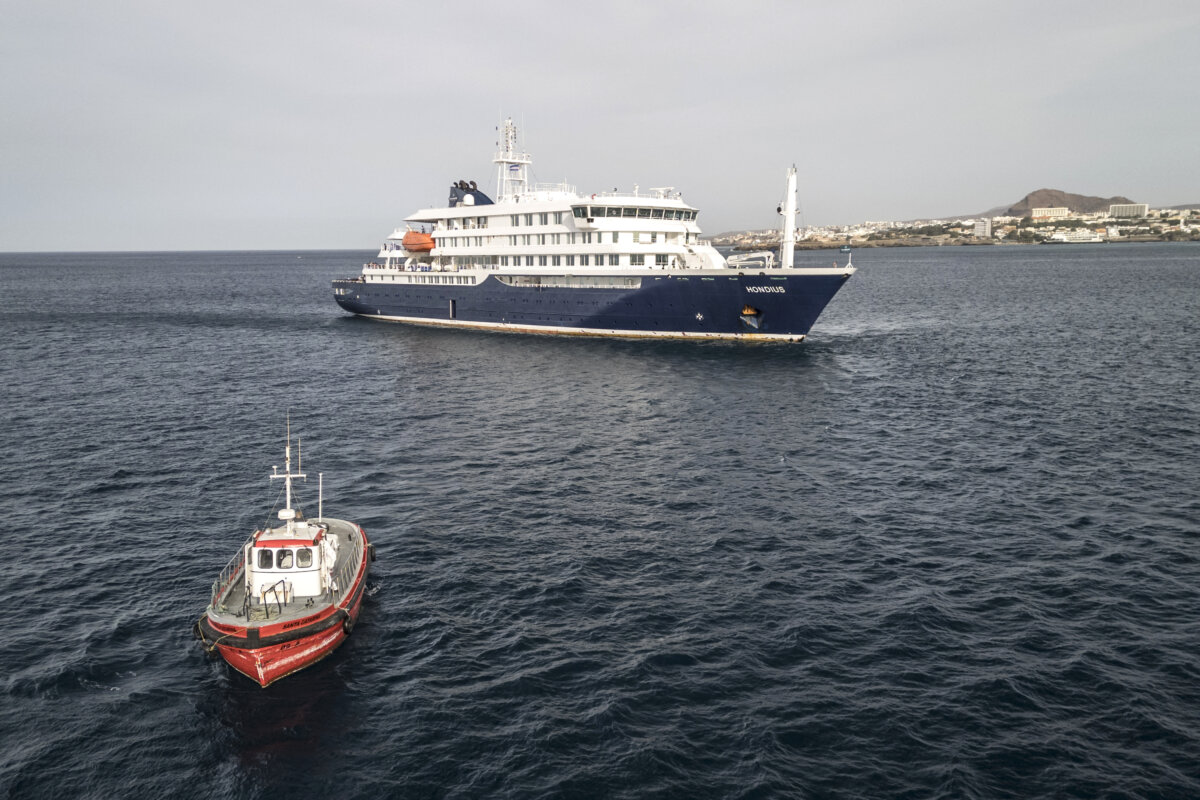

Two Ontario residents who disembarked a luxury cruise ship hit by a deadly hantavirus outbreak have returned home and are currently in isolation, the province’s health minister says.
Foreign Affairs Minister Anita Anand and Health Minister Marjorie Michel confirmed the return of the two Ontario residents who were aboard the MV Hondius and said a third person from Quebec who was on a flight with a symptomatic individual has also been asked to isolate.
“All three are asymptomatic, have received guidance to self-isolate, and are being monitored by local authorities for the development of symptoms,” a joint press release from the ministers said, adding that the Quebec resident is not considered a “high-risk close contact” by the World Health Organization (WHO).
Ontario Health Minister Sylvia Jones told reporters during an unrelated May 7 press conference that it is also believed the Ontario residents are not a transmission risk, but the situation is “fluid.”
“They are actively being monitored and working with the local public health authorities on a daily basis to make sure that the isolation is occurring,” Jones said, adding that the incubation and monitoring period is expected to last for 30 days.
A rodent-borne illness known as hantavirus hit the MV Hondius last month on a weeks-long cruise that began in Argentina on April 1. Four Canadians were aboard the Oceanwide Expeditions vessel when the outbreak began.
Ship operator Oceanwide Expeditions said in a May 7 update that 30 guests left the boat on the remote South Atlantic island of St. Helena on April 24, including two Canadians. The body of a Dutch man who died on April 11 was taken off the ship that same day.
The WHO says eight hantavirus cases, including three deaths, have been reported so far.
The ship was moored off the coast of Cape Verde in western Africa for several days as staff and health officials dealt with the outbreak but it is now sailing for the Canary Islands, according to an Oceanwide Expeditions press release.
“No symptomatic individuals are present on board,” the company said, adding that the vessel is expected to dock at the port of Granadilla on May 10.
The Public Health Agency of Canada is working with international partners to ensure the safety of the Canadians onboard as well as to ensure that all “appropriate public health protocols are followed,” Anand and Michel said in their press release.
“We have stood up a strategic response team, which ensures a coordinated, whole of government approach to this matter,” the ministers said. “In addition to contacting the four Canadians on board, consular support is currently en route to the Canary Islands to monitor the process when the Canadians disembark.”
Hantavirus Transmission
Hantavirus is a respiratory virus transmitted to humans primarily through contact with infected rodent urine, droppings, or saliva. Human hantavirus infection is rare, but the disease is severe and can be deadly.
The only strain of the virus that spreads through person-to-person contact is the Andes virus, the strain involved in the cruise ship outbreak. This particular strain is transmitted mainly by the long-tailed pygmy rice rat found in South America.
The WHO confirmed during a May 5 press conference that “some human-to-human transmission” likely occurred among “really close contacts” on board the ship, like the Dutch man who was the first to die. His wife died just days later after accompanying his body off the ship on April 24.
WHO’s chief of epidemic and pandemic preparedness and prevention Maria Van Kerkhove told reporters it is believed those who fell ill were not infected on the vessel but during off-board trips. She noted that the cruise made stops at several islands with “a lot of rodents.”
The WHO said those who became ill on the ship developed a fever and gastrointestinal symptoms, with a “rapid progression to pneumonia, acute respiratory distress syndrome and shock.”
People began to fall ill aboard the ship between April 6 and 28, according to the WHO. The Dutch couple were the first casualties. A seriously ill British man was taken off the ship on April 27 to receive treatment in a Johannesburg hospital and a German woman died onboard on May 2.
Three additional people were transferred off the ship for medical care on May 6, the cruise company said.
“Two of the individuals remain in a serious condition,” Oceanwide Expeditions said in a press release. “The third, while currently asymptomatic, was closely associated with the individual who passed away on board on 2 May.”
Medical personnel remain aboard the ship to lead medical monitoring during the final leg of the voyage, the company said.
Oceanwide Expeditions has been working with the WHO, the National Institute for Public Health and the Environment, local authorities, relevant embassies, and the Dutch Ministry of Foreign Affairs to deal with the outbreak and to put disembarkment measures in place, the cruise line said.
“Oceanwide Expeditions remains in close and continual discussion with relevant authorities regarding our exact point of arrival, quarantine and screening procedures for all guests, and a precise timeline,” it added.
Once passengers leave the ship, medical testing, screening and onward journeys will be handled by health authorities and the passengers’ countries of residence.
The Canadian Press contributed to this report.
 Friends Read Free
Copy
Facebook
Tweet
Friends Read Free
Copy
Facebook
Tweet