
The U.S. military command in charge of operations in the Middle East has said it disabled an oil tanker in the Gulf of Oman that violated its naval blockade of Iranian ports.
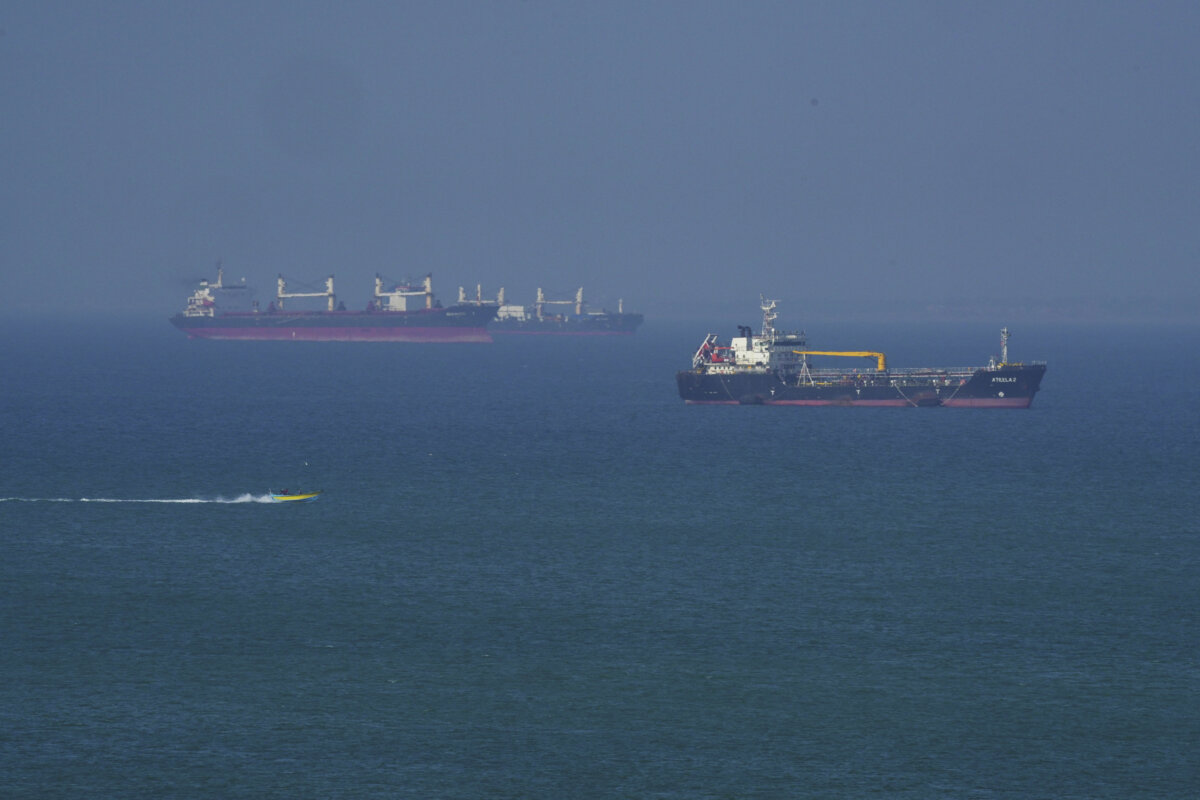
An F/A-18 Super Hornet fighter jet fired a precision munition into the Palau-flagged M/T Marivex’s engineering and steering areas as it was transiting toward Iran, according to the U.S. Central Command (CENTCOM). The vessel’s crew didn’t comply with directions from the U.S. military, it said.
The Marivex, it said on X on June 8, “is no longer sailing to Iran” after it was disabled. The tanker is roughly 442 feet in length and 72 feet in length.
CENTCOM added that it has disabled seven non-compliant vessels, redirected 134 other ships, and allowed 42 vessels with humanitarian aid to pass through as part of the U.S. naval blockade that started on April 13.
The U.S. military has prevented any ships from entering and exiting Iranian ports as part of the blockade, which came after Tehran effectively shut down commercial traffic in the Strait of Hormuz since hostilities between the United States and Iran started on Feb. 28.
Last week, a U.S. fighter plane fired a Hellfire missile at the Botswana-flagged M/T Lexie oil tanker that was sailing toward Kharg Island, an Iranian oil port, said CENTCOM. In that incident, the Lexie’s crew did not heed warnings from the U.S. military command and did not comply with directions over a 24-hour period.
Iranian officials, meanwhile, have said they want to set up a toll system in the strait, which, before the conflict, carried roughly a fifth of the world’s traded oil and gas on a regular day. But U.S. and European Union officials have said that such a plan is illegal and a violation of international law.
As a tentative ceasefire continues between the United States and Iran, officials have not been able to turn the cessation in fighting into a deal to end the conflict. Israel and Lebanese terrorist group Hezbollah have also engaged in periodic fighting, while Iran and Israel also launched strikes at each other this week.
The new Israel–Iran strikes prompted U.S. President Donald Trump to call for an immediate end to fighting between the two.
The president on Monday told reporters that negotiations on an agreement with Tehran are in the final stage, with a deal coming in “two or three days.” He added that Israel and Iran “were going back and forth and now they both agreed through me to stop, and we’re in the final throes of what will be a very, very good deal.”
Tehran has said any peace deal with the United States depends in part on an end to fighting in Lebanon as Israel send troops to the southern part of the country in March in pursuit of Hezbollah members who had fired across the border into Israel.
Trump has said any peace deal must ensure Iran cannot develop a nuclear weapon, that it hands over its highly enriched uranium, and that the Strait of Hormuz is reopened. Iran’s other demands include the lifting of international sanctions, the release of billions of dollars in frozen assets, and recognition that it controls the strait.
Reuters contributed to this report.
 Friends Read Free
Copy
Facebook
Tweet
Friends Read Free
Copy
Facebook
Tweet