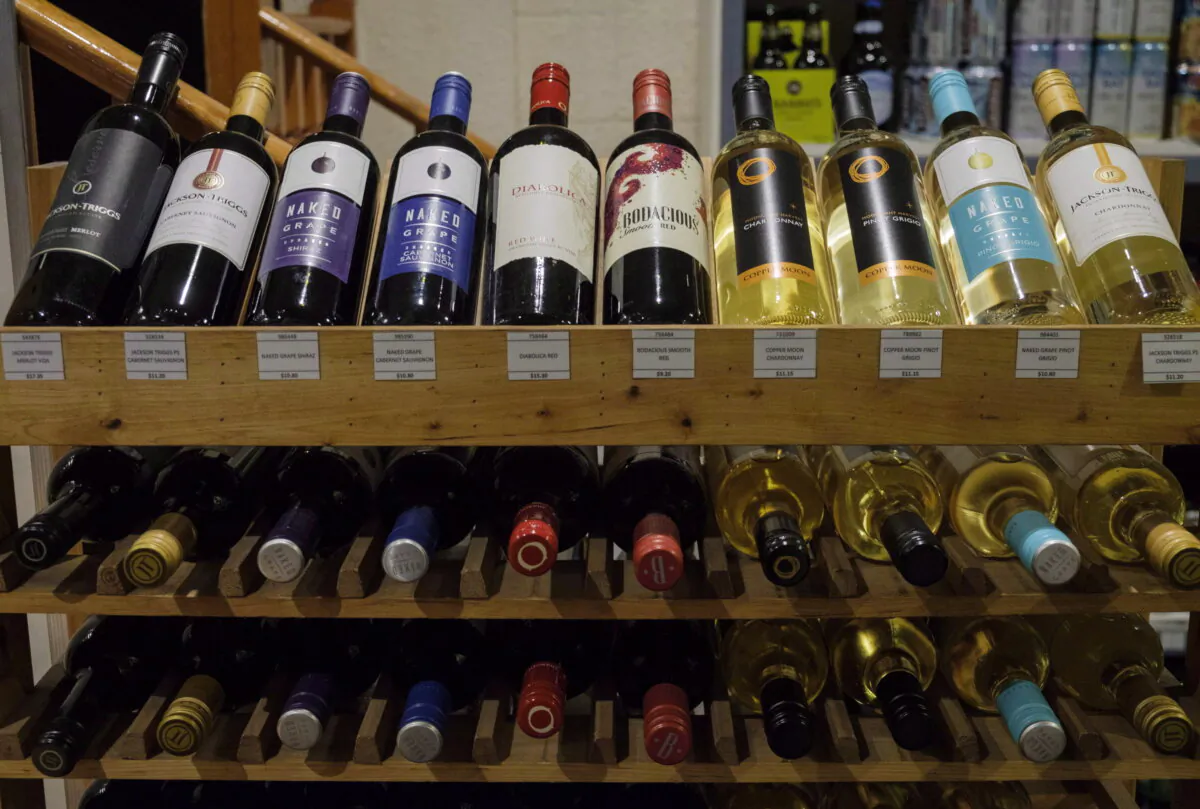

Canada’s wine sector is already valued in excess of $10 billion annually, but the industry says some simple modifications, including the removal of domestic trade restrictions, could inject billions more into the national economy.
A recent report by Deloitte, commissioned by Wine Growers Canada, indicates that domestic support of the country’s wine sector could use a boost. Wines produced or blended in Canada in 2023-2024 accounted for just 28.8 percent of all wine sales in the country.
Encouraging Canadians to buy their wine from domestic producers would bolster the industry while contributing billions to the country’s economy, the report said.
Achieving this goal would elevate the value of the wine industry from the current $10.1 billion to $13.7 billion.
Wine Growers Canada President Dan Paszkowski said in a recent press release that the benefits would be felt outside the wine industry as well.
“Wine is more than an agricultural product, it underpins a broad, place-based value chain that supports manufacturing, tourism, transportation, and cultural industries,” Paszkowski said. “The Canadian wine sector also generates significant strategic spillovers, driving tourism, innovation, domestic and export sales, and sustained growth in rural communities across the country.”
Each bottle of 100 percent Canadian wine generates $89.99 for the economy on average, compared to $15.73 for each imported bottle, according to the report. As a result of that, the wine sector currently contributes $3.2 billion directly to Canada’s gross domestic product (GDP), with an estimated additional $6.9 billion produced through related industries, the report estimates.
But if Canadians are encouraged within the next 15 years to buy at least 51 percent of their wine from domestic producers, this contribution would increase, the report notes.
The key to driving this change is not asking Canadians to buy or drink more wine, but to replace foreign purchases with domestic ones, similar to the French, the report authors wrote. Wine drinkers in France, for example, buy domestic 83 percent of the time rather than support foreign wineries.
Market Issues
The report warns change may not be easy. The industry has remained stagnant at about 40 percent domestic market penetration for nearly 20 years despite the healthy supply of Canadian wineries.
Canada boasted more than 31,000 grape-producing acres and more than 600 wineries in 2025, establishing it as one of the most varied agricultural and economic sectors in the country, the report said. Wine is produced in every province across Canada, but the bulk of commercial wine production is in Ontario, British Columbia, Quebec, and Nova Scotia. These four provinces account for more than 90 percent of national wine production.
In spite of consistent growth over the past decade, the report indicates that Canada still falls behind prominent wine-producing nations that benefit from coordinated government-industry strategies, long-term market development initiatives, and reduced internal trade obstacles.
Direct-to-consumer shipping in the United States is allowed in 48 states, giving producers a near-national market that helped grow the value of the California wine sector to about US$67.5 billion in 2024, the report says.
The federal government has lifted most of its limitations on the trade of alcohol between provinces, but provincial limitations persist, the report said. Only British Columbia, Manitoba, and Nova Scotia allow unrestricted direct-to-consumer wine shipments from other regions.
Some provinces have established one-time agreements or have started to ease restrictions since U.S. trade disputes began last year. Alberta has a pact with B.C. that permits direct-to-consumer sales across the border, while Ontario signed a memorandum of understanding with Nova Scotia earlier this spring with similar aims, the report noted. New Brunswick and P.E.I. have both proposed legislation that is awaiting approval, while Saskatchewan permits direct sales from outside the province but mandates a permit.
Ten provinces and territories signed a memorandum of understanding last year committing to explore a direct-to-consumer system. Paszkowski said he expects an announcement soon on creating a fully integrated market that will tackle the harmonization of matters such as shipping, compliance, and tax collection.
Wine producers are also seeking to address what they describe as an uncompetitive federal excise tax system, which often makes foreign wine less expensive than domestic.
The excise tax for Canadian wine containing more than 7 percent alcohol is 74.5 cents per litre. In the United States, the excise tax works out to about 39 cents per litre, says the report, while France’s tax is about six cents per litre. Paszkowski said a Canadian winery in Ontario’s Niagara region can pay hundreds of thousands of dollars more in tax than its American counterparts.
Ottawa launched the $166 million Wine Sector Support Program in 2022 to help the industry respond to challenges. The program was renewed in 2024 with an extra $177 million but is set to end on March 31, 2027.
The sector is advocating for another renewal, emphasizing the necessity for greater long-term investment certainty.
Wine Growers Canada Chair Del Rollo said there is a lot governments can do to better support the industry.
“Canada’s wine industry is uniquely positioned to grow as a nationally connected supercluster,” Rollo said in the press release. “By strengthening internal trade, supporting investment, and improving market access, governments can help unlock the full economic potential of Canadian wine from coast to coast.”
The Canadian Press contributed to this report.
 Friends Read Free
Copy
Facebook
Tweet
Friends Read Free
Copy
Facebook
Tweet