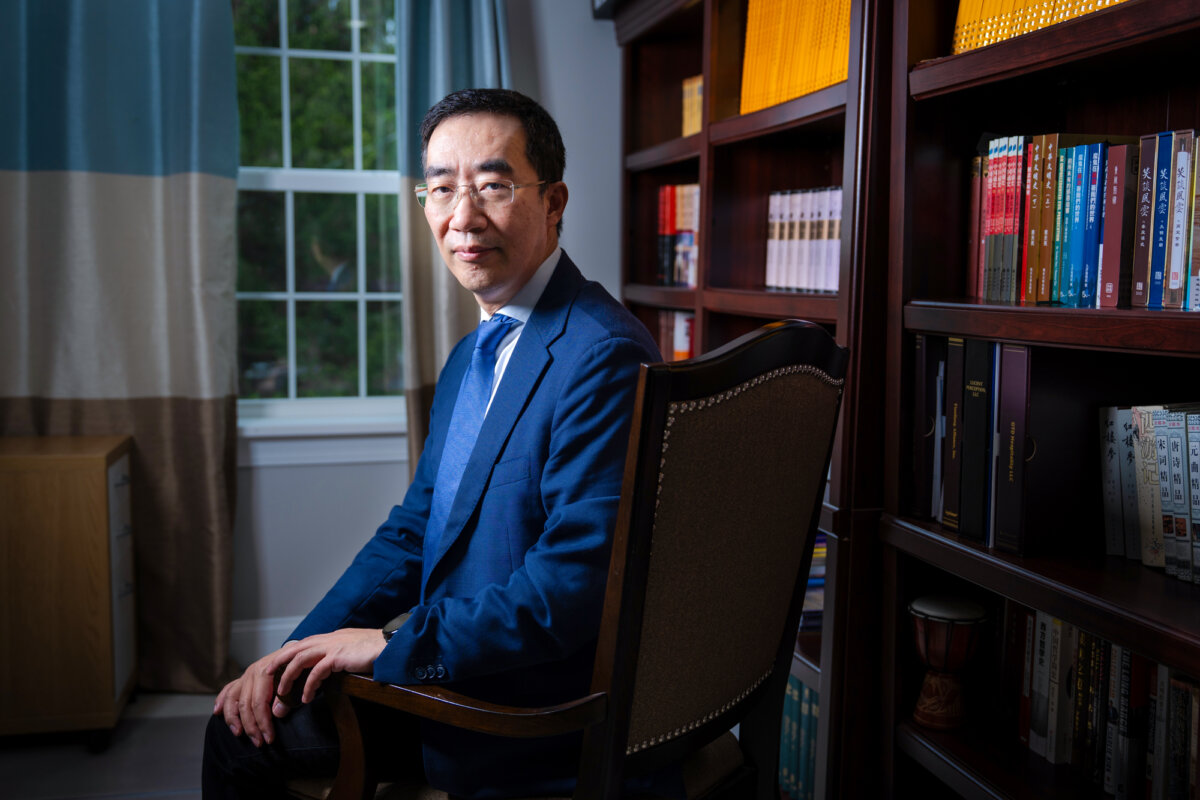

All Zhang Tianliang’s faith in the Communist Party crumbled right there, in a large state auditorium in Beijing.
They had all been waiting there, hundreds of them, shut inside since that sweltering morning in July 1999, bewildered.
It was the start of a bloody persecution, the likes of which had not been seen since the Cultural Revolution, although no one knew it at the time.
“Wait until 3 p.m. You will see it on TV,” the officers told them.
At 3 p.m. sharp came the revelation: Falun Gong, the spiritual practice they and millions of others had taken up, had been banned by Chinese leadership. As the crowd processed their shock, a state-run documentary began to play on the many television screens mounted to the ceiling, attacking the founder of Falun Gong, Mr. Li Hongzhi.
Of all the claims that set Zhang reeling, one was enough to undo his Party loyalty in one fell swoop: a short clip from a talk Li had given months prior that Zhang had watched in full. The snippet cut out a phrase midsentence, reversing Li’s meaning.
If the regime could alter a speech to fabricate incriminating evidence, what else was it capable of?
It hit Zhang that the Party might have been lying to him his whole life.
A year later, in 2000, Zhang escaped China for the United States. Twenty-six years later, he’s a Chinese history professor, political commentator, and co-author of several books on communism that have been translated into more than 20 languages. A talk show he appeared on, “Discussions on Chinese Communist Party Culture,” circulated around China via video copies and broadcasts and reached tens of millions of people, by his estimates.
His most recent endeavor is the English-language documentary “China’s Stealth Invasion,” which lays out all the infiltration tactics in Beijing’s tool chest. The film is described as “a high-stakes investigative documentary examining how the Chinese Communist Party may be exploiting America’s openness, institutions, and dependencies to expand influence from within.”
Zhang said America took him in when he was at his most vulnerable, and now that the freedoms of his second home are at stake, he sees an obligation to speak out.
“The Chinese Communist Party considers America as its biggest enemy,” he told The Epoch Times. “I can’t just watch it manipulate this country and erode its way of life.”
America Weaponized
From Mao Zedong’s famous dismissal of the United States as a “paper tiger” to Xi Jinping’s ambition for a global “community with a shared future,” successive Party leaders have vied for world domination.
Regardless of the packaging, the aim is the same: to export communist ideology around the world, Zhang said.
In 2024, Zhang saw that playing out right in front of his eyes—but this time on U.S. soil.
The pattern echoed the propaganda campaign he witnessed in China a quarter century ago. A negative media blitz, including a barrage of baseless claims of wrongdoing and extreme behavior, was launched against entities that Falun Gong practitioners started in the United States. Zhang struggled to wrap his mind around what he was seeing.
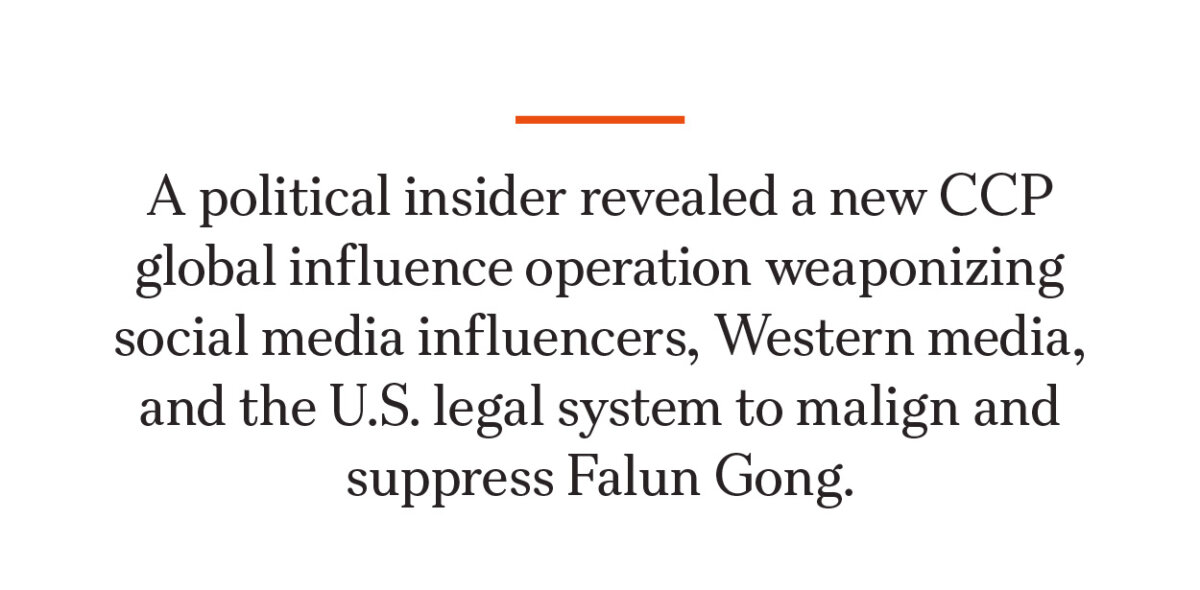
Then, in December 2024, an insider with access to the top Chinese political circle revealed the regime was running a new global influence operation. The strategy was to weaponize social media influencers, Western media outlets, and the U.S. legal system to malign and suppress Falun Gong in the United States.
Everything clicked in Zhang’s mind when he remembered a book written in 1991, “America Against America,” by Chinese political theorist and current Politburo member Wang Huning. The work, widely read in China, describes fragmentation and polarization dividing China’s greatest rival for world power, reinforcing the Chinese elites’ belief that the United States would inevitably decline.
That idea was pushed further by two Chinese military colonels in their 1999 book “Unrestricted Warfare.” The two laid out various nontraditional means that China could exploit to take down the much more powerful United States.
That’s it, Zhang thought—the Falun Gong community, numbering tens of millions in China and globally, had been a testing ground for the regime to sharpen its persecutory tools.
And what was taking place was just like what the Chinese elites envisioned, “American Institutions being weaponized against an American enterprise,” Zhang said.
That belief grew as new information surfaced.
Two Chinese agents had been sentenced weeks prior for trying to bribe an IRS agent into opening an investigation on Shen Yun Performing Arts, a nonprofit dance company founded by Falun Gong practitioners in the United States. One of the men took rolls of cash from Chinese officials during trips to China.
These same individuals traveled to Shen Yun’s headquarters in Orange County, New York, to surveil Falun Gong practitioners and collect materials for “the basis for a potential environmental lawsuit meant to inhibit the growth of the Falun Gong community in Orange County,” court filings state.
On X, thousands of Chinese accounts sprang up, amplifying articles targeting Shen Yun. The platform took down a swath of them after an Epoch Times investigation.
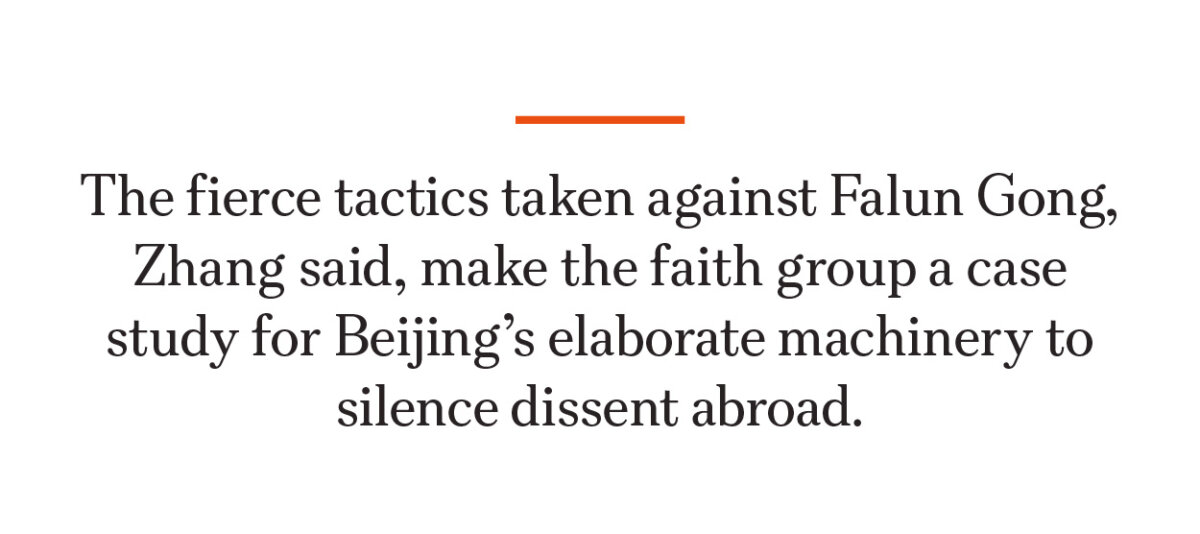
Falun Gong is a case study for how Beijing’s overseas influence operation works, because through its practitioners’ decades of peaceful civil disobedience, it has become the biggest thorn in the regime’s side, Zhang said. The Party once thought it would wipe out Falun Gong in a matter of months. Decades later, Falun Gong is still standing.
And the fierce tactics taken against Falun Gong make the faith group a textbook example for Beijing’s elaborate machinery to silence dissent abroad, he said.
‘Battle of the Soul’
The first half of Zhang’s life was one of believing in the Party and its stated goal of “serving the people.”
That changed that day in 1999, when a 26-year-old Zhang went to appeal against the suppression of his faith and was instead bused to the stadium for a hate propaganda session.
After a week of soul-searching, he knew that China was no longer his home.
In 2000, a few months after his mother was sentenced to one year in prison over Falun Gong, he boarded a plane for the United States.
In the United States, unshackled from China’s internet censorship, Zhang reexamined everything anew. He devoured historical memoirs, documentaries, and all the literature he could lay his hands on about the modern Chinese century.
The first topic he had to confront was the Tiananmen Square massacre.
In September 1989, three months after the bloodshed in Tiananmen, Zhang arrived in Beijing as a college freshman. For much of the first two weeks, the new cohort had only one task: read and watch materials about the incident. All of them instilled the same message: The young pro-democracy protesters were rioters sowing chaos in China.
Zhang was too young to participate in the demonstrations but had considered himself a supporter. After those sessions at the start of college, he said, he was “completely brainwashed.”
“I thought the Communist Party did the right thing. Otherwise, how would it have cleaned up this mess?” he said. “This is how powerful brainwashing is.”
The Chinese revolution history class taught him “how the Communist Party led China to independence and prosperity.” He had believed it and thought the Party was wonderful. Even on the rare occasion when he encountered contrary views, Zhang believed that the regime was doing the right thing; it was making China rich.
Learning about the sheer scale of killing in the communist record shook him.
Millions died in the land reform during the early 1950s, which pitted peasants against the better-off landowners. Tens of millions more lives perished in the Great Famine and the Cultural Revolution over the next two decades. Guns and tanks at Tiananmen Square likely wiped out thousands in 1989.
Then, at the turn of the century, the Party came after his belief, the spiritual practice that tens of millions had embraced, decimating the community with forced disappearances, an extensive range of torture, and forced organ harvesting.
Zhang called it “a history of murder.”
“It’s simply horrifying,” he said.
And he believes that’s by design. The communist regime rules through coercion, he said; every few years, it has to create a campaign of terror enough to “chill one to the marrow.”
Every step of the way, he said, the regime has been attacking the foundation of China: culture, thought, and beliefs.
The atheist communist party builds its legitimacy off a systematic “Party culture,” and any other ideology that’s different—Western democracy or Chinese tradition—constitutes a threat, Zhang said.
“It’s a battle of the soul.”
‘Know Your Enemy’
Zhang has thrown himself into the battle.
He puts the bulk of his energy into now warning about what he describes as communist infiltration of the United States.
As a YouTube influencer, he has reached a sizable portion of the Chinese community in the West; now, he said, he wants to get the message across to more Americans.
The fight is also personal. One of Zhang’s former students at the Shen Yun-affiliated Fei Tian College had said that she appreciated her years there and had even invited him to her wedding after graduation, screenshots of chat messages shared with The Epoch Times show.
However, after a trip to China and collaboration with a Chinese state-run dance academy, she turned around and launched a lawsuit against both him and the school.
Zhang explored the dimension of what he describes as lawfare in the new documentary.
Sarah Cook, a longtime China researcher, explains in the film that she has come across meritless lawsuits used across multiple countries to silence Beijing’s critics. Most of them have ended up getting tossed out or dropped, but even just this process achieves two objectives for the regime: It hurts the targets in the pocketbook, and it tarnishes their reputation, according to Cook.
Zhang said he’s focusing on the bigger picture. He quoted U.S. civil rights leader Martin Luther King Jr.: “Injustice anywhere is a threat to justice everywhere.”
“This is how it is with the Communist Party,” Zhang said. “You don’t have to actively oppose it, but as long as you are different and you are good, you will become a contrast to its evil.”
To tackle the growing threat of infiltration, the West needs to remain clear-eyed, Zhang said.
In the classic Chinese military treatise “The Art of War,” strategist Sun Tzu wrote, “Know yourself, know your enemy; a hundred battles, a hundred victories.”
Beijing knows the enemy; the question in Zhang’s mind is whether America does, too.
 Friends Read Free
Copy
Facebook
Tweet
Friends Read Free
Copy
Facebook
Tweet