The next cloudless night that rolls by, head out to where houses are few and the lights are dim, and look up. Stars wash across the sky, far off worlds glimmer, and even the most jaded of stargazers may spend a moment in thought. There’s a primordial connection between the stars and a sense of wonder—between that grand scene, and inspiration for all from the philosopher to the inventor.
Yet just as dreams end with the blaring of an alarm clock, so too is that night sky being lost to light pollution. And it’s because of this that Doug Reilly, an amateur astronomer based in Geneva, New York, believes that astronomy can be one of the greatest tools of social awareness. He hopes to bring this about by inspiring a sense of wonder, and is bringing this about by creating Bicycle Astronomy and building a new type of bicycle and a new type of telescope to make it possible.
Reilly describes stargazing as “prehistoric television.” He said stargazing was likely an activity that was not only common in most communities, but also important. “Really most of what we would call civilization, including agriculture, relied on astronomy,” he said via email, “Over two millennia ago you have Plato saying, ‘Astronomy compels the soul to look upward and leads us from this world to another.'” And it is this want to compel other souls to look upward that drives him.
Grand discoveries are being made about the structure and expanse of the universe, he said, “And yet at this very same time we’re losing our access to this source of inspiration. Light pollution is erasing the stars from our night sky. I’m afraid of what will happen if people stop looking up and wondering. Afraid of what it will do to our minds, and what that in turn will lead us to do to our planet.”
The Seeds of Inspiration
Reilly regularly hosts star parties—usually free gatherings in parks where he points a large telescope at Saturn’s rings, Jupiter’s moons, or into distant galaxies. He hopes fellow stargazers bring home a greater appreciation for the rare planet that is Earth, and, with that, a deeper respect for its delicate environment.
This is also the seed for the next project on his agenda. Reilly is starting a new movement through Bicycle Astronomy—abandoning his car for the monthly star parties, and taking to a bicycle capable of hauling a telescope around town, with a billboard calling all to the park to gaze at the stars.
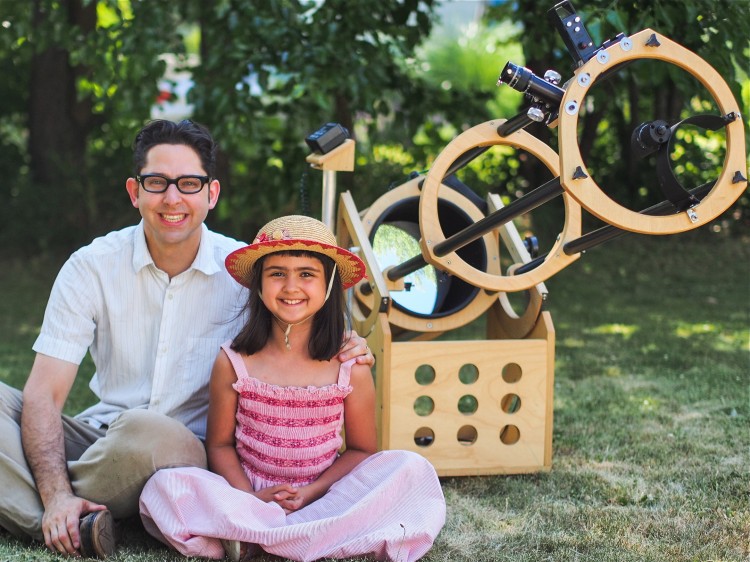
The project has a couple of reasons behind it. Reilly’s star parties were growing in popularity in Geneva, yet he saw two problems. The first was difficulty in telling the community about each star party ahead of time. The other was his general unhappiness with having to use a car to haul the telescope around the city. “I began to wonder if the bicycle might address both of those issues, as well as open an important new dialogue in my astronomy outreach efforts—getting people to think about how they might live on this precious earth in a more sustainable way,” he said.
Yet this isn’t as easy as it sounds. Creating a bicycle capable of hauling a telescope—not to mention a telescope light and small enough to be hauled—is another issue entirely. And so Reilly is turning those wheels of innovation, and has set out to build these himself, with help from donations through crowd-funding website, Kickstarter.
He is looking over some of the current designs capable of meeting this goal. For the bike, he’s looking at some uncommon designs for a cargo bicycle. For the telescope, he’s turning to designs from small companies and DIY telescope builders, which he says are making strides in light, powerful scopes that can be broken down for transport.
“In part this is a reaction to light pollution. … People need to travel farther to actually see a night sky, and so telescopes need to get easier to haul around,” Reilly said, “This matches my own skill set: I’ve made telescopes before but not bicycles!”
It may be difficult work, but Reilly believes it’s worth it—and his inspiration for this project pulls from a broad set of sources. “For my day job in international education, I’ve recently traveled to Denmark, Vietnam, and Japan, and in all of them I saw how integral the bicycle is in the fabric of daily life,” he said.
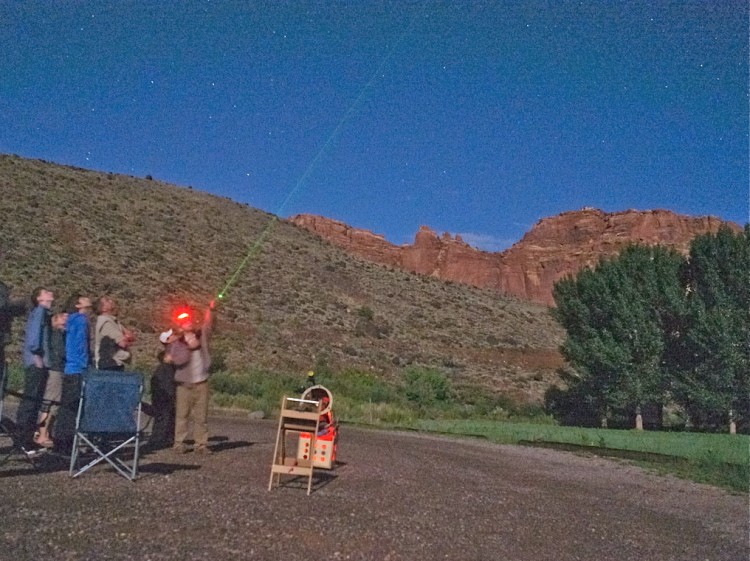
“So I had been thinking about how I might integrate the bicycle into my life more fully,” he said, “It just seems to be such an obvious choice for a world choking on fossil fuels, as well as a world in a deep multilevel crisis.”
Inspiration also came locally. Reilly states on his Kickstarter page that the light bulb came on after the owner of his local bike shop “described the bicycle as the perfect tool for social transformation. I remember thinking: That’s the way I feel about the telescope! What if we got those two together? Can the night sky inspire thoughts about sustainability?”
And sustainability is what this is all about, after all.
He said, “At the most basic level, I want people to see that a bicycle can be made to haul cargo, and that it’s a valid, healthy and fun alternative to the automobile, and that I think the very unique experience of seeing the grandeur of the universe through a telescope has the effect of opening people’s minds to new ideas and new ways of thinking and being.”
The Epoch Times publishes in 35 countries and in 19 languages. Subscribe to our e-newsletter.
 Friends Read Free
Copy
Facebook
Tweet
Friends Read Free
Copy
Facebook
Tweet