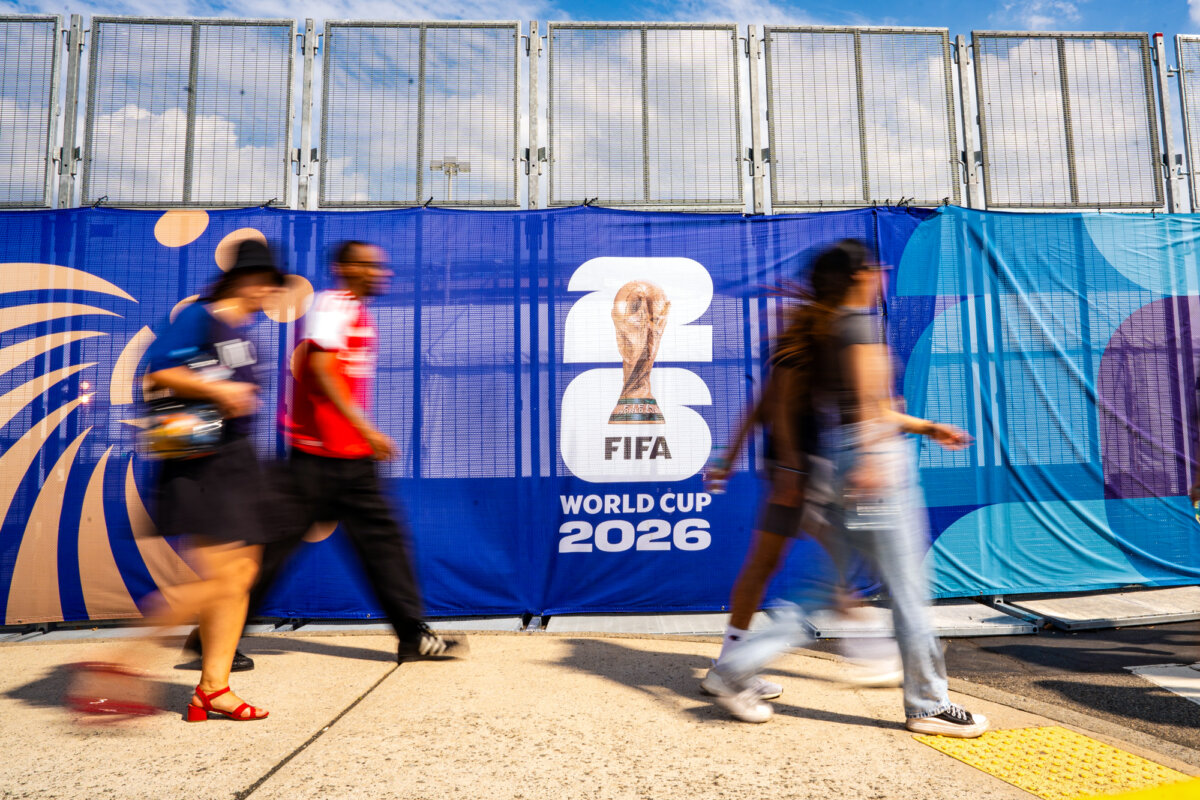
PHILADELPHIA—In the City of Brotherly Love, fans representing the fiercest rivalries in world soccer converged on a FIFA fanzone to enjoy a beer together and a friendly kickabout.
Rory Prenter, of Belfast, Northern Ireland, rocked a U.S. jersey as he played in a mini match with his father, Paul; his brothers, Patrick and Oliver; and several new international friends.
“It has been amazing,” said Rory, who, with Oliver, competes for his national team at the academy level. “I love it here.”
Even though their nation didn’t qualify for this World Cup, the Prenters said they are thrilled to be part of the American experience for the globe’s most popular sporting event.
“Clare and I promised the kids years ago that we’d travel somewhere someday for a World Cup,” he told The Epoch Times. “I’m glad we chose this one.”
The Prenters are among the estimated 1.24 million international visitors traveling to the United States for World Cup matches and celebrations, according to travel data analyst Tourism Economics.
Theirs is just one of innumerable stories international travelers have been sharing about their discoveries of America and their appreciation—and outright adoption—of whole cities.
As the nation celebrates its 250th birthday, social media posts of foreign fans being wowed by American experiences—Texas barbecue, Buc-ee’s massive travel centers, hypermarkets, large meal portions, huge stadiums—have gone viral.
Solidifying an American Bond
Halvor Francke and three of his sons were decked out in their Team Norway jerseys as they hopped aboard a Philadelphia tourist bus, where riders paid $5 for unlimited day passes. The family had already visited New York City and Boston, where they attended the Norway–France match. Their final stop was Washington for Fourth of July festivities.
“Boston is so walkable and does have more of a European feel,” he told The Epoch Times. “Really nice people there, too.”
Boston also became a favorite American city of another group of fans: Scotland’s Tartan Army. The Scots failed to advance from the group stage, but their fans occupied “Beantown” with their bagpipes and kilts.
Pubs such as the Sam Adams Taproom were filled with song and drained dry. Every accessible statue was topped with a traffic cone, and streets turned into makeshift parade routes. The city ultimately fell in love with its visitors, and Boston Mayor Michelle Wu named Glasgow its new sister city.
Back in Philadelphia, Francke said he’s enjoyed the sunshine and warm temperatures and didn’t mind getting rained on at the match. American stadiums are so much larger than what he’s familiar with in Norway and England, and the fanfare takes some getting used to, he said.
“In Europe, fans initiate the entertainment—no help needed,” he said, adding that fans chant and sing songs about their clubs dating back more than a century. “Here it’s a bit more staged. You’ll see a message to ‘make some noise’ on the big scoreboard.”
And their fellow Norwegians did not hesitate to make their own entertainment. The traveling Nordic tribe went viral, taking over random locations in various cities, including New York City’s Times Square, to demonstrate their now-famous “Ro!” rowing chant.
“It’s different here, but it’s really nice,” he said. “America has been great.”
In New York City and Miami, visitor Alejandro Barrantes enjoyed a fantastic experience. He’ll also visit the host cities of Philadelphia and Dallas.
Barrantes, a Colombian native who lives in Mexico, said he aspires to live and work in the United States someday. Latin American people, he said, regard the United States as a country of opportunities.
“You can do whatever you want, and you feel that energy that you are capable of doing whatever you want,” he told The Epoch Times during his stop in New York City. “So this is the most magic that this city has.”
An American Feast
The opportunity to visit America and attend the global tournament also attracted visitors who were not following their national teams.
David Ozga, a professional coach and former player with the club Gornik Zabrze, and his wife, Patricia Ozga, traveled from Poland to the Philadelphia area to join American relatives for World Cup celebrations. They cheered for France because Sweden beat their nation in qualifying for the tournament.
The family got a great taste of the first capital city in the United States, running up the 72 stone “Rocky steps” at the Philadelphia Museum of Art and trying a Philly cheesesteak.
“Greasy,” Patricia Ozga told The Epoch Times, “but good.”
Francke, meanwhile, said Boston has been his favorite U.S. city so far and that lobster rolls might be the “best thing” he’s tasted.
Cheesesteaks and lobster rolls exemplify yet another major discovery for European visitors to America: the food.
Whether they’d visited a Waffle House, a Chick-fil-A, or any semi-outdoor place serving American barbecue, tourists filled social media with praise for American foods that many Americans take for granted. The tourists expressed shock at the portion sizes, flavors, and overall quality of the food served.
As the group stage came to an end, fans began heading home, eager to take some of the culinary treasures back with them. The Transportation Security Administration issued a statement guiding foreigners on how to travel through airport security with ranch dressing, and videos on social media showed British people grilling in their backyards with seasoning they bought in Texas.
David Ozga was elated with the breaking news that Robert Lewandowski, heralded as the greatest Polish player of all time, is joining the Chicago Fire of Major League Soccer. That solidifies the bond that so many of his countrymen have with the United States, especially in a city with such a strong Polish community, he said.
“I’ve loved it here,” he said. “Everything about it.”
Making the Most of It
France’s 3–0 drubbing of Sweden on June 30 didn’t dampen Axel Insulander’s enthusiasm. The only drawback for him was public transportation to the venues, which was far more expensive and involved longer walking distances than in Europe.
The Swede attended that match at MetLife Stadium in New Jersey, as well as other games, including Norway’s match against Iraq in Boston. He also visited Philadelphia.
Despite a bargain bus price, Francke was also surprised that accommodations in the large U.S. cities he’s visited so far, mainly hotels, food, and transportation, cost so much.
Still, he said, it’s great to witness so much enthusiasm, fanfare, and culture with people from so many different nations in restaurants and out in public.
In fact, people in all three cities have been very friendly, Insulander said, but Boston and Philadelphia proved to be “a really nice surprise.”
“Boston, it was another feeling. It was more calm, I would say, in comparison to New York at least,” Insulander told The Epoch Times.
Tara, a Cambodian visitor who provided only his first name, was scammed by a fake online ticket vendor advertising tickets for the Portugal–Uzbekistan match. Still, he and his family made the most of their U.S. vacation, visiting Texas, Washington, and New York City.
They said they especially appreciate the security and preparation that often go unnoticed, and that they’ve felt very safe, comfortable, and accommodated throughout their entire trip.
“I love the food here,” Tara’s son, Drago, told The Epoch Times in New York City.
With 16 venues spread out across the lower 48, the tournament’s sprawl has prompted many attendees to rent cars for multiweek stays. Between matches, they’ve sought out state and national parks, beaches, historical sites, Walmart, and Buc-ee’s. One Australian visitor remarked on social media that a Florida beach he visited was just as good as anything his home nation had to offer.
When it was time to leave their beloved Boston to face Brazil in Miami, members of the Tartan Army chronicled their road trip down the East Coast, making note of when they crossed the Mason–Dixon Line and visited landmarks such as Fort Sumter, before ultimately taking over South Beach and Little Havana in the same fashion they did up north.
Appreciating Those Behind the Scenes
Even though the United States doesn’t have the same sense of history and pageantry as other nations, it’s been able to carve out a niche for a unique and comfortable World Cup experience based on how vastly it differs from European and Latin American cities, said Maurice Smith, an Atlanta-based travel and hospitality strategist. He used his city as an example.
Mercedes-Benz Stadium, for example, has design, technology, and food options unlike anything else in the world, he told The Epoch Times.
“The stadium can feel like part of the attraction, not just the venue,” he said.
City transportation planners in Atlanta and the other host cities are aware that fans from other nations depend on reliable and easy-to-navigate bus and rail lines, so the call for all hands on deck was received loud and clear, and the abundance of American ride-sharing services has helped fill in the gaps.
Police and security services have done a great job being present, not threatening, and have provided the same sense of city ambassadorship as transportation workers and hospitality professionals, Smith said.
“For someone visiting from another country, especially during a major event, visible support can make the city feel easier to understand. It’s not just about security. It’s also about orientation,” he said.
“My main takeaway is that World Cup visitors are judging the full city experience, not only the match. Stadiums create the wow factor, but food, transportation safety, service, and local culture are what determine whether people leave with a positive impression of the host city.”
 Friends Read Free
Copy
Facebook
Tweet
Friends Read Free
Copy
Facebook
Tweet