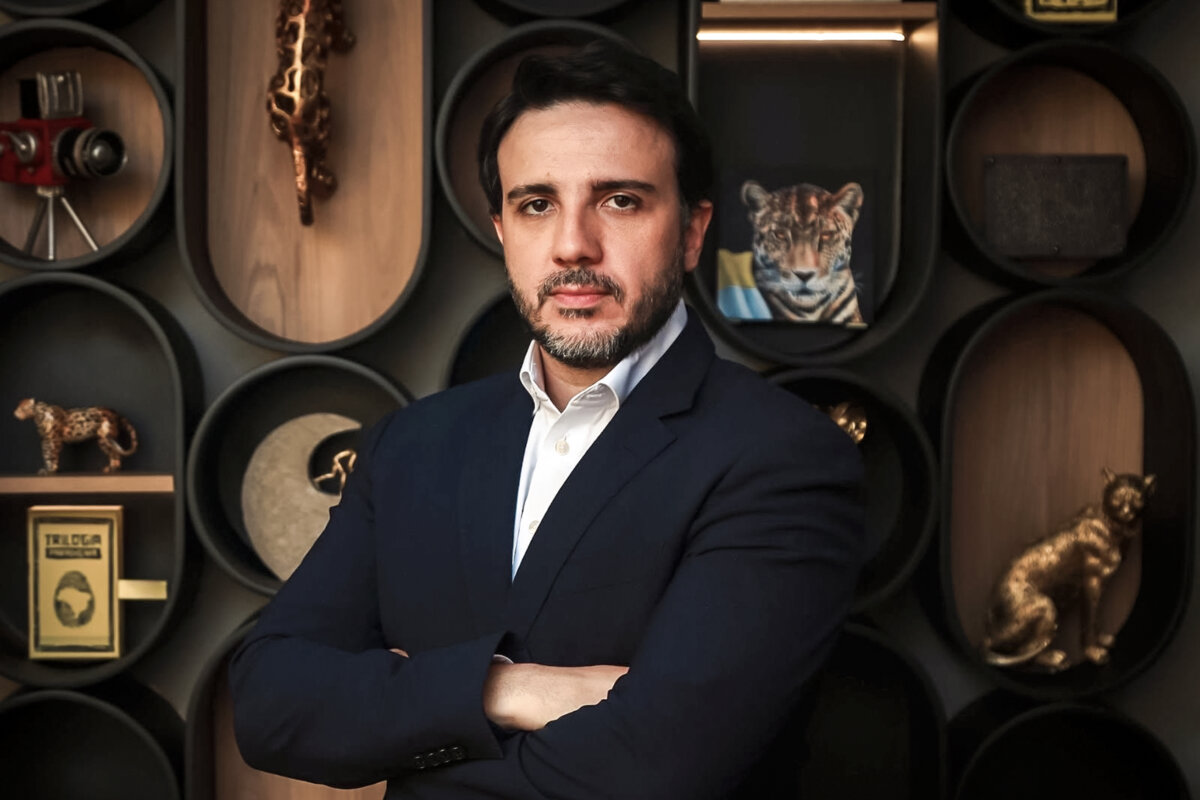

WASHINGTON—Renan Santos was blunt: The truth, as he sees it, is politically incorrect.
“Many people in the first-world countries, they’re like, ‘Oh my God, we don’t want to become like Brazil,’” the Brazilian presidential hopeful told The Epoch Times. “I want to show those guys, ‘OK, we can de-Brazil-ify Brazil. We can save Brazil.’”
The activist shot into the headlines on Aug. 31 when Brazilian supreme court justice José Antonio Dias Toffoli effectively ended his campaign, citing the delayed registration of affiliated social media accounts. One day later, amid public outcry over the decision, Toffoli reversed it, stating that his initial order was merely a precautionary measure and enabling Santos to once again take in campaign donations and participate in debates.
Who is Renan Santos—and how would he go about “de-Brazilifying” Brazil?
Santos, who got his start leading anti-government protests over a decade ago, has an ambitious vision and a political vehicle—the Mission Party, or Missão. Inspired by Argentina’s Javier Milei and El Salvador’s Nayib Bukele, Santos and his allies say they want to fight organized crime, reform the bureaucracy, and align Brazilian politicians’ incentives with the public interest, all while steering an independent course for Brazil on the world stage.
While some polling shows that his support is rising, particularly among younger Brazilians, Santos still faces daunting odds in the Oct. 4 presidential election. He’s up against established leaders on the Brazilian right who have touted somewhat similar agendas—most notably Brazilian Sen. Flávio Bolsonaro, the son of the country’s former president, Jair Bolsonaro, who is currently serving a 27-year term under house arrest.
“Renan Santos and Missão are not authentically anti-system,” Ernesto Araújo, Brazil’s foreign affairs minister under Bolsonaro, told The Epoch Times.
Santos said he could never see himself supporting the younger Bolsonaro, whom he frequently targets on social media.
Despite that charged history, Flávio Bolsonaro spoke out against Toffoli’s initial decision against Santos.
Although Santos may not be on a path to a short-term victory, his expansive and original vision—including a disciplined party and approach to messaging—is making waves across South America. The politician and psychedelic rock musician, a man who started as an anti-corruption activist, could wield influence as an also-ran if the contest goes to an Oct. 25 runoff between Bolsonaro and the left-wing incumbent, President Luiz Inácio Lula da Silva.
A prominent South American journalist who asked to remain anonymous described Santos as “very smart.”
“He stands no chance against Lula and Bolsonaro, but he wants to play the role of kingmaker in the runoff,” the journalist added, predicting that Santos could use his votes in the election’s first round as a bargaining chip to advance his agenda or even gain power in the eventual government.
Santos’s Cause
Before the Mission Party and the presidential run, there was the Free Brazil Movement—a free-market political organization that Santos co-founded in 2014.
At the time, dissatisfaction with then-President Dilma Rousseff—like Lula, a member of the left-wing Workers’ Party—was fueling mass unrest.
Santos recalled feeling upset when he saw friends lead left-wing protests against Rousseff in 2013. He wanted to challenge her from a different ideological position.
During that same period, the Operation Car Wash probe was uncovering the widespread extortion of contractors by the state-owned oil giant, Petrobras, as part of a scheme of bribery, kickbacks, and other corruption involving a cartel of massive Brazilian construction firms.
Santos’s pro-market group was a leading force in anti-Rousseff demonstrations during 2015 and 2016. Growing anger at Rousseff culminated in her impeachment and removal from office, though she was never convicted of a crime.
Lula, too, was caught up in the corruption scandal.
The politician, who served as president before Rousseff, was arrested in 2018 in connection with Operation Car Wash. He was released in 2019 after Brazil’s supreme court ruled that defendants cannot be imprisoned if they have not exhausted all appeals. Lula was then reelected to the presidency in 2022.
The same climate that fueled the Free Brazil Movement also propelled Jair Bolsonaro to the presidency. Like Lula, he was jailed after leaving office—in his case, over charges that he planned to overthrow the government following Lula’s reelection.
Santos said the early Free Brazil Movement had “some sort of libertarian vibe,” though with a socially conservative streak.
He added that he was never a full-blown libertarian. But in his view, the scope of state interference in Brazil’s private sector has required at least some libertarian remedies.
Today, at the helm of the Mission Party, Santos radiates a more heterodox energy.
“We don’t care that much about categories,” he said, lauding a rather non-libertarian model in the region—Bukele, whose crackdowns on gang activity, though popular in El Salvador, have been criticized by human rights groups.
Bukele, Santos said, “started with law and order, and now he’s reforming the state.”
The Free Brazil Movement gave rise to the Mission Party in 2023. In late 2025, after the party met Brazil’s signature-gathering requirements, the Superior Electoral Court formally registered it.
Big Ideas
Santos and the Mission Party are known for big ideas and eye-catching gestures.
His party’s platform document was named “The Yellow Book,” parodying Moammar Gadhafi’s Green Book and Mao Zedong’s Little Red Book. It’s part of a wider media ecosystem around the party that also includes a physical magazine, Revista Valete, and a mobile application.
The same year the Mission Party was registered, he and others linked to the party formed a psychedelic rock band, Limão Rosa—Portuguese for “pink lime” and named for the reddish, almost pinkish Rangpur lime. Santos is the lead singer and lead guitarist.
“We have our own scene,” he said.
Santos, the mass mobilizer, has also learned from an influential, and controversial, critic of mass politics, Curtis Yarvin. The American political theorist and software developer sees liberal democracy as a failure, advocating the restoration of monarchy under a CEO-like sovereign.
“What we look for in America is the critics they have of democracy,” Santos said of his interest in Yarvin.
He thinks an ongoing American and European dialogue about what some view as the West’s ongoing political and cultural degeneration—a discussion in which Yarvin has participated—can help Brazil discover its “position in the big scheme of things.”
Santos, for his part, believes Brazil is “something new,” meaningfully distinct from a West that has mulled its own supposed decline for over a century.
In thinking through what could be, he has drawn inspiration from a thinker of the past, Stefan Zweig.
The Austrian Jewish intellectual fled to South America amid the rise of fascism and militarism in Europe. There he wrote “Brazil, Land of the Future.”
Zweig argued that his adopted country could provide a model for a harmonious multiracial society, one dedicated to peaceful development.
Poverty, violent crime, occasional military coups, and political maladministration—not to mention ethnic tensions that strain its multiracial self-image—mean Brazil has often failed to live up to Zweig’s idealized representation of it.
Santos believes Brazil can forge a successful future on its own terms, as a tropical civilization capable of leading the Global South.
His roadmap includes “defavelization,” a plan to eliminate the favelas—informal settlements that harbor much of the country’s organized crime.
“We can do it in 10 years,” he said, outlining a plan to create new housing and streets, normalize residents’ property ownership, plant trees, and “arrest and kill all the leaders of the cartels.”
“It’s not a big deal,” he added.
Santos also wants to slash public spending by merging municipalities and cutting red tape.
Most interesting of all, he sees a path to bureaucratic reform that runs through a seemingly immovable feature of Brazil’s political landscape: its patrimonialism.
“We tried for at least 100 years to defeat this patrimonialistic spirit,” he said of Brazilian politicians’ penchant for nepotism, favoritism, and the cultivation of personal power and wealth at the hazy boundary between the public and private domains.
His Managerial Responsibility Act would seek to yoke that spirit to merit and efficiency, rewarding officials who meet well-defined goals with more money and power and penalizing those who fall short.
“The patrimonialistic leader, that was a problem, can become a solution when you have technology,” he said.
Santos and the Bolsonaros
Santos’s message appears to be resonating with some Brazilians, particularly the youth.
A July survey from AtlasIntel found that 7.8 percent of Brazilians intended to support him in the first round. That share rose to 37.9 percent among respondents between 16 and 24—a larger chunk than either Lula or Bolsonaro claimed in that age group.
Santos described Bolsonaro’s electorate as “a boomer vote,” one not all that different from the bloc that supports Lula.
One Mission Party insider, who wished to remain anonymous, said Bolsonaro has lost youth backing in part because of a vote in March for a controversial anti-misogyny hate speech law that many others on the Brazilian right opposed.
While the AtlasIntel survey looked good for Santos, many others suggest he is in a somewhat weaker position. None have shown Santos rising to anything like the overall support claimed by the two favorites—and Lula has generally led Bolsonaro in the polls, although some recent surveys show him starting to pull ahead.
Both of the leading candidates are tainted by associations with real or alleged malfeasance.
The younger Bolsonaro’s links to the Banco Master scandal, including a meeting with the banker at the center of the scandal to request financing for a film about his father, have also jeopardized his reputation as an alternative to the corruption Brazilians see in their political establishment.
Toffoli, the judge whose order briefly restricted Santos’s campaign, has been linked to the same banker, Daniel Vorcaro. Toffoli recused himself from the investigation of Banco Master earlier this year after a report from Brazilian police drew attention to his connections to the former president and controlling shareholder of Banco Master.
In a post on X after Toffoli’s initial decision, Santos noted he had organized street protests against the judge.
Toffoli did not respond to a request for comment from The Epoch Times.
While Santos has accused both Bolsonaro and Lula of corruption, his conservative critics have faulted his past ties to former President Michel Temer, a figure closely aligned with the Centrão, or big center—a loose coalition of parties at the heart of Brazil’s patronage-driven political status quo.
Santos worked with Temer, who was Rousseff’s successor, to defend reforms advanced by Temer’s government.
Santos and the younger Bolsonaro, though broadly similar in many areas, part ways on foreign policy.
Santos, who has been critical of U.S. President Donald Trump’s tariffs on Brazil, said Brazil must not defer to either of the two global superpowers.
“Lula put Brazil in a position where Brazil is submissive to China, and the Bolsonaros put us in a position where we’re submissive to Trump,” he said.
Araújo, the elder Bolsonaro’s former foreign minister, stressed what he sees as the benefits of working with the United States.
“I think the only chance for Brazil to get rid of organized crime is strong American cooperation to identify the money schemes that connect organized crime to politics,” he said.
Santos, for this part, said Brazil could be a good partner to the United States. Yet that friendship would have to be reconciled with the country’s pursuit of its own destiny.
“Trump’s taking care of America, and Brazil must take care of Brazil,” he said.
The realities on the ground suggest Santos and his allies may be hard-pressed to approach the dreams of Zweig, at least in the short term.
In the view of the Mission Party insider, Santos “is playing the long (really long) game.”
As the political right gains strength across Latin America, time will tell if Santos makes his mark or keeps dreaming.
 Friends Read Free
Copy
Facebook
Tweet
Friends Read Free
Copy
Facebook
Tweet