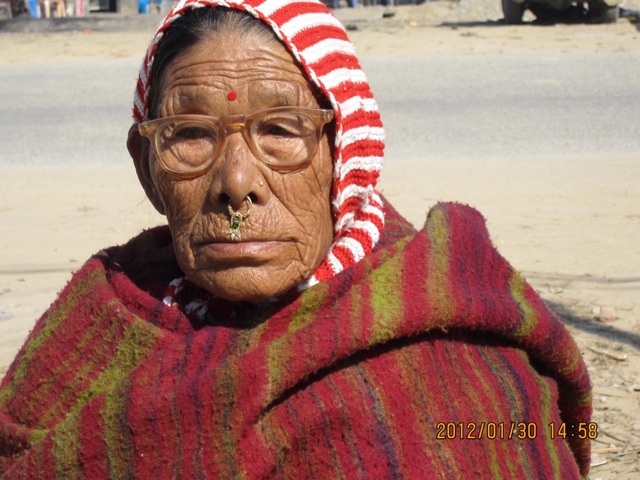
As the ancient Kusunda culture slowly disappears, linguists from all over the world are working to document the language of Nepal’s smallest ethnic group.
The Kusunda, or Ban Rajas (Kings of the Forest), were formerly a nomadic jungle tribe from central and southwestern Nepal. Widespread deforestation forced the tribal population to fragment into various bands. A lack of potential marriage partners necessitated extensive intermarriage with various ethnic groups.
Now the Kusunda culture, traditions, and language are on the verge of disappearing.
To document the language, linguists are sketching out its grammar and vocabulary, or lexicon, with the help of the endangered language’s only remaining fluent speaker, 75-year-old Gyani Maiya Sen.
Sen left her forest home when she was only 10 years old.
“Since that time she has rarely got an opportunity to speak her mother tongue, but we were surprised to find her speaking the language fluently at the age of 67 when we first met her in 2004,” wrote Madhav Prasad Pokharel in his article “Patterns of Language Endangerment in Nepal.”
Pokharel is a linguist professor at Nepal’s Tribhuvan University and one of the linguists heading up the Kusunda research team.
That first meeting in 2004 included two other Kusunda speakers, though they were not nearly as fluent as Sen. Over the three months of that initial contact, researchers noted that she was in fact the last fully speaking resident of the Kusunda language and possibly the torchbearer for the entire culture.
Since 2004, researchers have been working tirelessly as they endeavor to detail the language.
In January, Pokharel appointed his student Bhojraj Gautam to work with Sen. For six months he recorded her speech, returning on June 22 to analyze the language.
“Bhojraj, who can speak the Kusunda language now, reported to me that most of the interactions were done in the Kusunda language toward the end of his departure. Bhojraj may become the last Kusunda speaker,” wrote Pokharel via email.
Linguists studying the language today have their work cut out for them.
Besides not having an alphabet, Kusunda possesses some unique yet problematic characteristics that make it difficult for the researchers who are studying its linguistic properties.
One issue is that Kusunda is not morphologically similar to any other language, which is called a “language isolate.”
Pokharel says some researchers believe the Kusunda language is related to Indo-Pacific languages, such languages of Papua. Others have claimed it is a natural derivative of the south Asian Tibeto-Burman family.
Regardless of its potential origins, however, Kusunda is on the verge of extinction. With one native speaker left, it’s not extinct yet, but it is what linguists refer to as a dead language.
“Kusunda is a moribund language, because Gyani Maiya’s children are not speaking the language,” says Pokharel.
Pokharel says the elder recognizes the importance of the research. He says she has been “very excited” to help with the research, and he also notes that her fluency has improved significantly.
Documenting the language affords coming Kusunda generations the opportunity to become fluent themselves while rediscovering the unique civilization.
As Pokharel emphasizes the importance of saving the language, he notes that it is a survival that coexists with the preservation of the culture. “If the language disappears, it is an irreparable loss of the human heritage, because language dies with culture,” he says.
“Our documentation saves the language from dying. With our data we can revitalize the language if the Kusunda community is willing to learn it.”
The Epoch Times publishes in 35 countries and in 19 languages. Subscribe to our e-newsletter.
 Friends Read Free
Copy
Facebook
Tweet
Friends Read Free
Copy
Facebook
Tweet