
NATO allies declined to join the United States’ blockade of the Strait of Hormuz, which began on April 13, targeting only vessels traveling to or from Iranian ports.
Iran has largely restricted access to the strait since the Iran war started on Feb. 28, allowing only its own vessels through.
President Donald Trump announced that the United States would work with partner nations to block maritime traffic in the strategic waterway after weekend negotiations failed to resolve the six-week conflict.
NATO members have so far refused to participate in any current military action.
Trump warned that NATO could face a “very serious examining” due to its lack of support during this conflict.
As U.S.–NATO friction grows, The Epoch Times turned to readers for their perspective.
US–NATO Tension
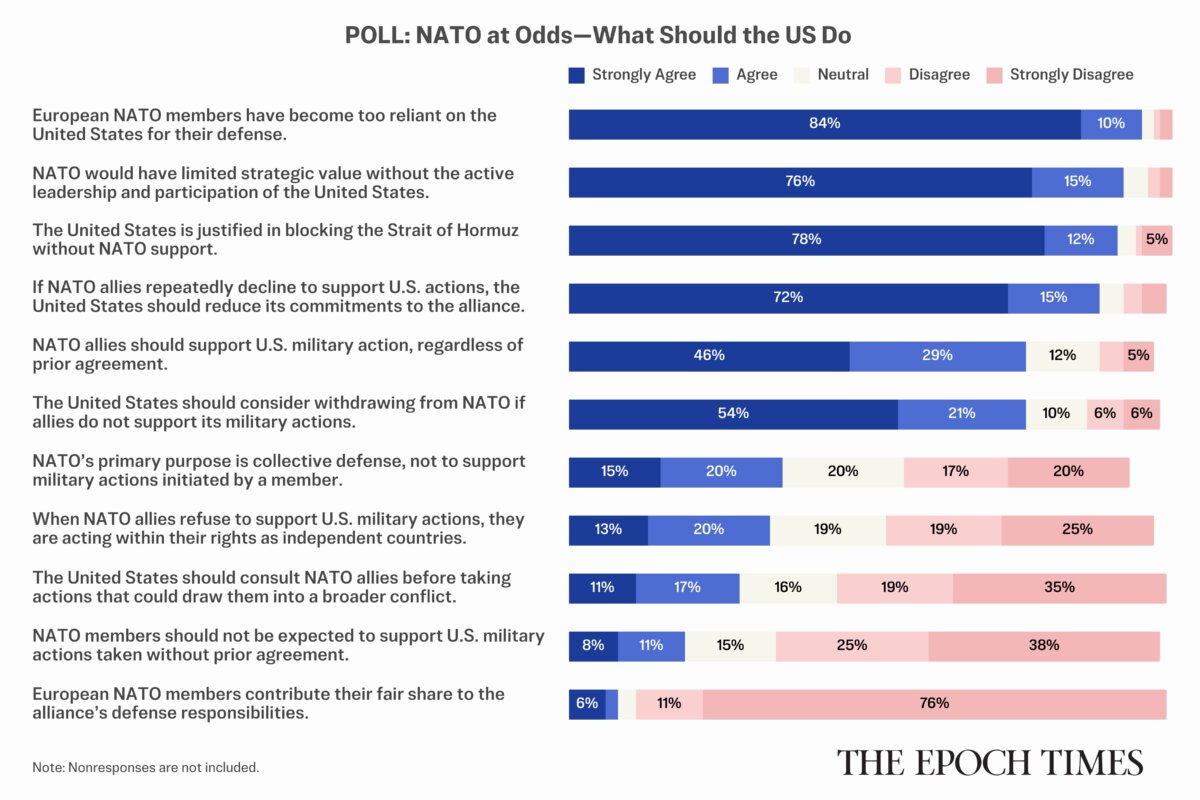
Survey respondents overwhelmingly (90 percent) agreed that the United States is justified in blocking the Strait of Hormuz without NATO support. Nearly 80 percent strongly agreed.
A majority of respondents—87 percent—agreed that if NATO allies repeatedly decline to support U.S. actions, the United States should reduce its commitments to the alliance. More than 70 percent expressed strong support.
Three-quarters of survey respondents agreed that the United States should consider withdrawing from NATO if allies do not support its military actions. More than 50 percent strongly agreed.
Most survey respondents think NATO is heavily dependent on the United States, with more than 90 percent agreeing that European members have become too reliant on the United States for their defense.
Forty years ago, the United States provided 80 percent of the funding for NATO infrastructure. That proportion was based on the state of European economies in the early 1960s. Since then, Europe’s economic power has nearly doubled.
These European nations have a combined annual gross domestic product of more than $22 trillion—10 times the size of the Russian economy.
“The U.S. should continue its participation as a NATO member, but only paying its 1/32 proportional share,” a reader commented. “The U.S. is not obligated to carry NATO. NATO nations should be expected to fund, arm, and collectively act in their own interests.”
NATO includes 32 member countries that agree “to guarantee the freedom and security of its members through political and military means.”
However, more than 90 percent of respondents agreed NATO would have limited strategic value without the active leadership and participation of the United States.
Prior Agreement
Readers showed mixed opinions on the necessity of prior agreement with NATO allies before military actions.
Roughly 75 percent of respondents agreed that NATO allies should support U.S. military action regardless of prior agreement. Slightly fewer than half showed strong agreement.
More than 60 percent of respondents disagreed that NATO members should be exempt from supporting U.S. military action taken without prior agreement. However, nearly 20 percent agreed with the exemption.
More than 50 percent of respondents disagreed that the United States should have to consult NATO allies before taking actions that could draw them into a broader conflict. However, nearly 30 percent agreed with that statement.
“Yes, the United States should rely more on its own power,” a reader commented. “If it requires withdrawing from prior agreements to protect our own national values and interests, so be it.”
The Role of NATO
Respondents were split on NATO’s role. Roughly 35 percent agreed its primary purpose is collective defense, not to support military actions initiated by a member, while nearly 40 percent disagreed. An additional 20 percent reported mixed feelings.
More than 30 percent agreed that when NATO allies refuse to support U.S. military actions, they are acting within their rights as independent countries. However, 44 percent disagreed.
Nearly 90 percent of respondents disagreed that European NATO members contribute their fair share to the alliance’s defense responsibilities.
One reader commented that U.S. allies should support efforts to topple foreign governments that are widely considered a “serious problem to the entire world.”
“Our allies fully benefit from the decisive actions of the U.S., but don’t want to support the efforts in any form,” the reader said.
The Epoch Times conducted this reader survey on April. 15–16, 2026, by email and social media, generating 3,114 responses.
Lawrence Wilson, Jackson Richman, Jack Phillips, Carl Schuster, and Victor Davis Hanson contributed to this report.
 Friends Read Free
Copy
Facebook
Tweet
Friends Read Free
Copy
Facebook
Tweet