
The question of the declining birth rate in the United States has been weighing on many, including economists and those in the religious sector.
As more Americans reach the age of qualification for Social Security, the question of how to meet that demand alone has caused some to question what the future holds if American birthrates continue their current downward trajectory.
The current American fertility rate is roughly 1.6 children per woman.
A poll of Epoch Times readers found most believe that children are important, and also that the nation should look for ways to support family growth.
Importance of Family
With a national average of less than two children per woman, readers were asked how they feel about family size.
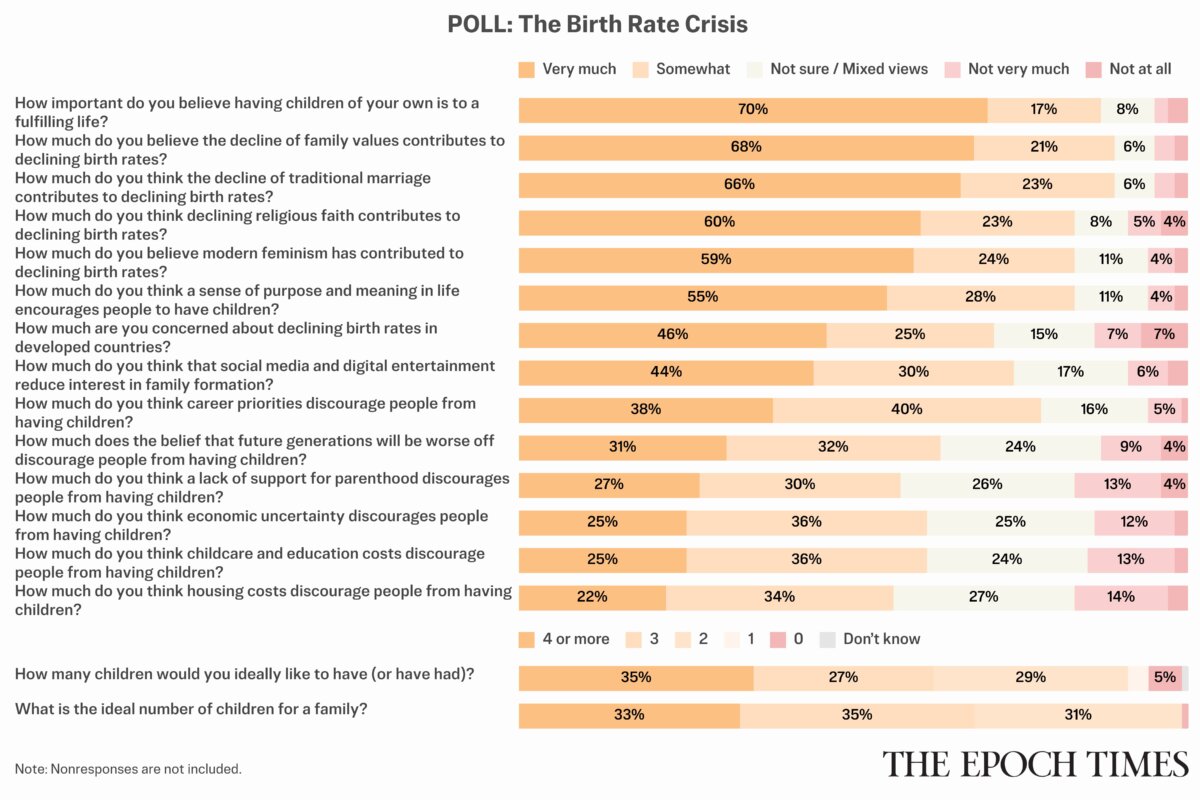
A large majority of those polled (87 percent) believe that having children is important to having a fulfilling life.
To add to that, 71 percent are concerned about the declining birth rates in developed countries across the world, but 63 percent agree that the belief that future generations will be worse off discourages people from having children.
When asked about the ideal number of children for a family, 35 percent of respondents said three children, 33 percent said four or more children, and 31 percent said two children.
When readers were asked how many children they either have, or ideally would like to have, 35 percent of respondents said four or more children.
Another 29 percent selected two children, and 27 percent selected three. Five percent said they would ideally have no children, while 3 percent preferred one child.
Religion and Values
According to Epoch Times readers, religion and values play a huge role in the decision to grow a family.
A whopping 83 percent of readers believe that declining religious faith contributes to declining birth rates. Even more (89 percent) think that the decline of traditional marriage contributes to declining birth rates.
However, outside factors are also thought to be a major consideration. Fifty-seven percent of those polled think that the lack of support for parenthood discourages people from having children.
When asked, 83 percent of readers agree that a sense of purpose and meaning in life encourages people to have children.
The same percentage believes that modern feminism has contributed to declining birth rates, and even more (89 percent) think that a national decline in family values contributes to a corresponding decline in birth rates.
One reader said, “A return to traditional values in the home and in the educational system is what I believe we need.”
Other Influences
Practical struggles are also a factor contributing to adults’ unwillingness to grow their families.
Sixty-one percent of those polled believe that economic uncertainty discourages people from having children.
Currently, 56 percent of readers agree that housing costs discourage people from having children, and 61 percent believe that costs associated with childcare and education discourage people from having children.
In a related question, 78 percent of readers believe that career priorities play a role in discouraging people from having children.
However, almost three-quarters of those asked (74 percent) also think that social media and digital entertainment reduce interest in the formation of families.
A reader commented that “Economic relief from the massive fraud, which has caused the tax rate to explode,” could be one solution to the issue of the declining birth rates. “This allows people to take less money home.”
Addressing the Challenge
Those who believe there is a problem with how many children Americans are having also offered suggestions on what would be the most effective way to encourage family growth.
The largest group of respondents (46 percent), said they believe renewed religious and spiritual values would have the most impact on Americans’ likelihood of having more children.
Another 16 percent think that a stronger sense of purpose and meaning in life would encourage family growth, and 13 percent think that economic security would move the needle.
A combined 13 percent of readers credited either greater support for parenthood, lower costs in raising children, and more affordable housing would be the most effective way to change people’s minds.
When asked to write in what they believed is most important, many made comments supporting things like “safety for the future,” “strong marriages,” and more “value and support of motherhood” as possible cures for the issue.
One respondent pointed to a possible systemic problem, saying, “A society that is not wrapped up in itself [becomes] less me-oriented.”
The Epoch Times conducted this reader survey on June 3–4, 2026, by email and social media, generating 1,277 responses.
 Friends Read Free
Copy
Facebook
Tweet
Friends Read Free
Copy
Facebook
Tweet