
President Donald Trump signed legislation on April 30 that ended the Department of Homeland Security’s (DHS) partial shutdown after 11 weeks.
But Immigration and Customs Enforcement (ICE) and Customs and Border Protection are not covered in the funding bill.
The legislation provided funding only to agencies such as the Transportation Security Administration (TSA), the U.S. Coast Guard, the Federal Emergency Management Agency, and the Secret Service.
Before the bill was sent to Trump’s desk on Thursday, The Epoch Times asked readers to weigh in on how they thought lawmakers in Washington handled the DHS shutdown, and 1,964 responded.
Immigration Enforcement
Funding for Immigration and Customs Enforcement (ICE) and Customs and Border Protection was not in the newly signed legislation, and Republicans plan to pass immigration funding via the reconciliation process.
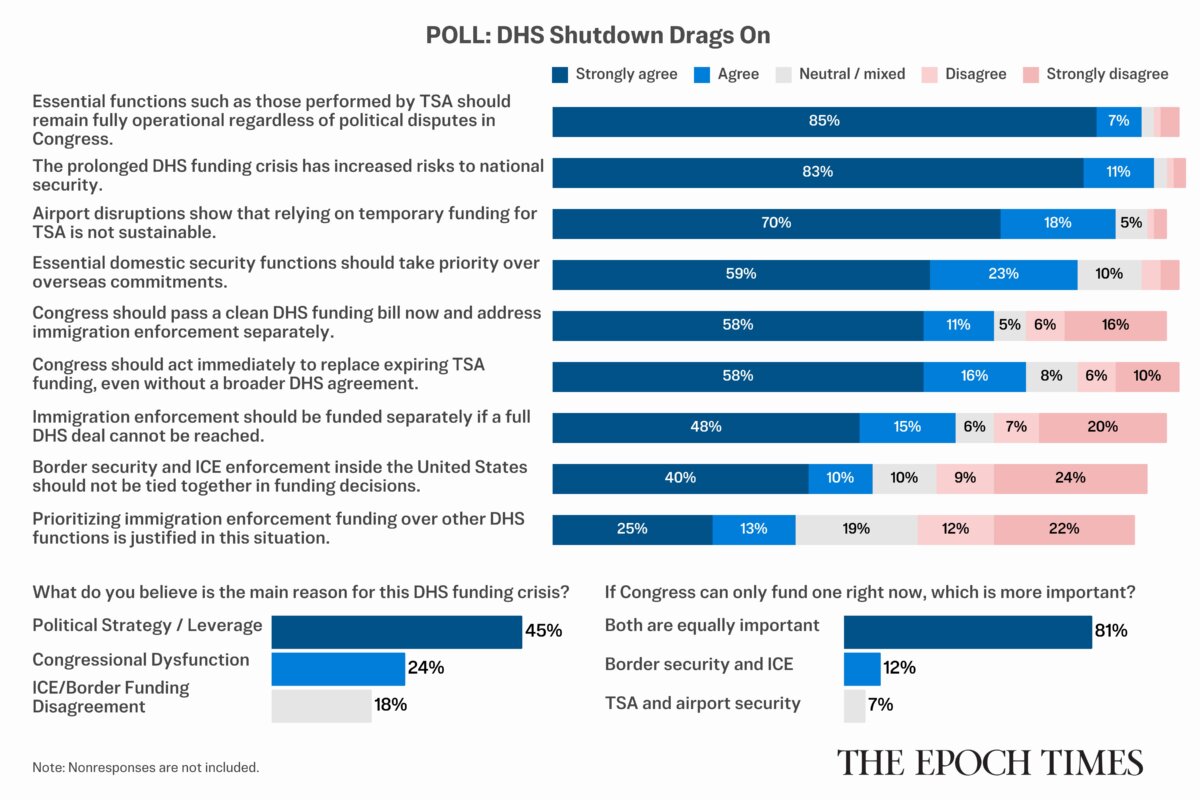
When asked if Congress should have passed a clean DHS funding bill and addressed immigration enforcement separately, 69 percent of survey respondents agreed, 22 percent disagreed, and the rest were neutral or unsure.
Readers had mixed reactions when polled on whether immigration enforcement should be funded separately if a full DHS deal cannot be reached, with 63 percent of respondents agreeing, 27 percent disagreeing, and the rest answering neutral or unsure.
Reactions were mixed when asked if border security and ICE enforcement inside the United States should be tied to funding decisions. Half of those polled agreed it should not be tied together, a third disagreed, and the rest answered neutral or unsure.
Those surveyed were divided when asked if prioritizing immigration enforcement funding over other DHS functions is justified in this situation, with 38 percent agreeing, 34 percent disagreeing, and 28 percent undecided.
Airport Disruptions
The 76-day shutdown, which started on Feb. 14, caused hours-long TSA lines at airports nationwide as many staffers called in sick because they weren’t being paid.
The majority of polled readers (88 percent) agreed that the airport disruptions caused by the funding lapse showed that relying on temporary funding for TSA is not sustainable.
Ninety-two percent of the sample group agreed that the essential functions, such as those performed by TSA, should remain fully operational regardless of political disputes in Congress.
Before the legislation was signed by Trump, 74 percent of readers agreed that Congress needed to act immediately to replace expiring TSA funding, even without a broader DHS agreement.
Security
The sample group had different opinions on what caused the DHS funding crisis.
Nearly half of readers (45 percent) suggested that it was a political strategy or leverage, 24 percent blamed congressional dysfunction, 18 percent thought it was due to disagreements over ICE and Border Funding, and 5 percent said that Democrats were to blame.
Eighty-two percent of people polled agreed that essential domestic security functions should take priority over overseas commitments, while 6 percent disagreed.
When survey respondents were asked if the prolonged DHS funding crisis had increased risks to national security, 94 percent agreed.
Jackson Richman and Joseph Lord contributed to this report.
 Friends Read Free
Copy
Facebook
Tweet
Friends Read Free
Copy
Facebook
Tweet