
The Trump administration will accelerate research and approval of psychedelic treatments to help Americans combat mental illness.
President Donald Trump signed an executive order on April 18 aimed at establishing a pathway to give people easier access to psychedelic drugs, including controversial ibogaine compounds.
The Epoch Times asked readers to weigh in on whether Trump’s order will help combat the mental health crisis in the United States, and 546 responded.
Mental Health Crisis
Nearly one in five adults in the United States are affected by a mental illness each year, according to data from the National Alliance on Mental Illness.
Americans have a plethora of options to treat mental health issues, such as therapy, exercise, and prescribed medicines, but some have dabbled with controversial—and illegal—fixes for their condition.
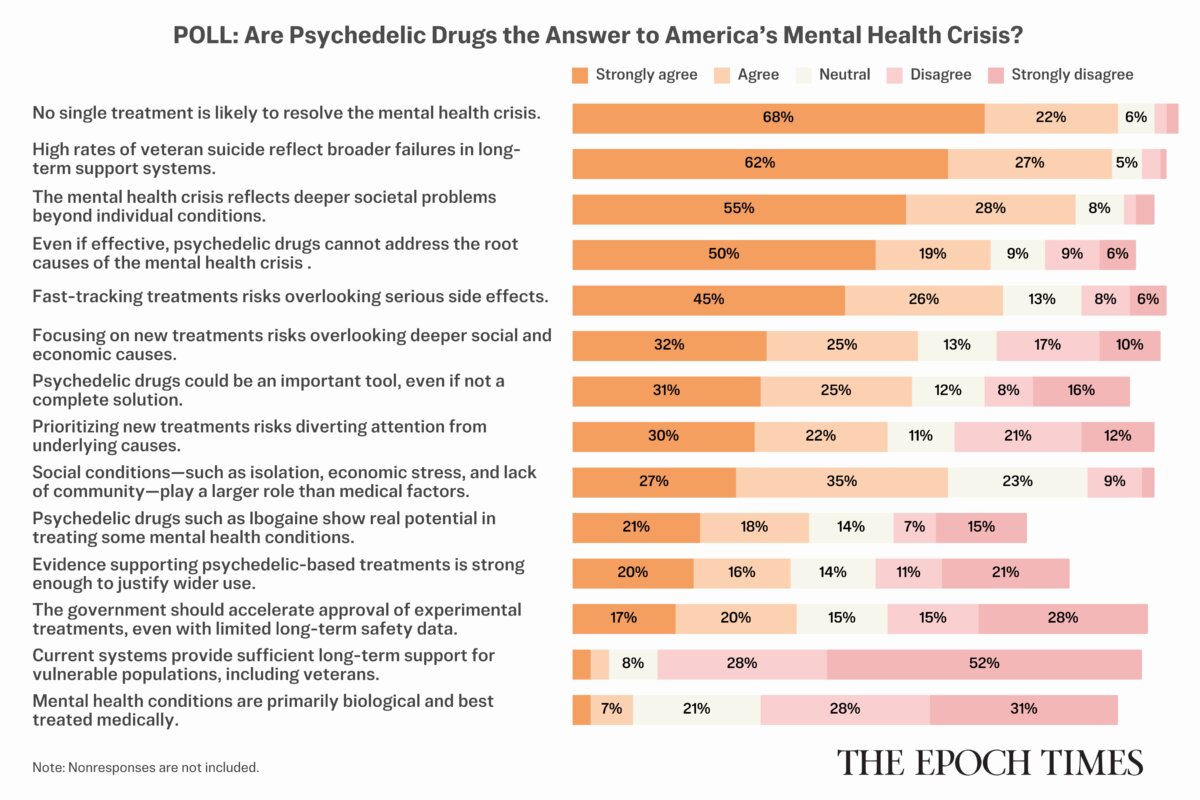
Ninety percent of the respondents agreed that there is no single treatment that is likely to resolve the mental health crisis in the United States.
Of those surveyed, 83 percent agreed the mental health crisis reflects deeper societal problems beyond individual conditions, while 5 percent disagreed and the rest remained neutral or unsure.
When survey takers were asked if the current systems provided sufficient long-term support for vulnerable populations, including veterans, 80 percent polled no, 6 percent polled yes, and 14 percent were neutral or unsure.
Psychedelic-Based Treatments
Only 10 percent of survey-takers agreed that mental health conditions are primarily biological and best treated medically, while 59 percent disagreed and the rest answered neutral or not sure.
The sample group was mixed on whether psychedelic drugs could be an important tool, even if not a complete solution, with 56 percent agreeing, nearly a quarter (24 percent) disagreeing and 20 percent remaining neutral or unsure.
Readers were also mixed when asked if prioritizing new treatments risked diverting attention from underlying causes.
Just over half of respondents (52 percent) agreed that new treatments could risk shifting attention away from underlying causes, 33 percent disagreed, and 15 percent remained neutral or unsure.
Ibogaine
Ibogaine is a plant-based psychoactive compound that safely led to improvements in depression, anxiety, and functioning for veterans who suffered from traumatic brain injuries, according to a 2024 study by Stanford Medicine researchers.
But ibogaine was prohibited in the United States, so people risked going to other parts of the world to try it.
Thirty-nine percent of those surveyed agreed that psychedelic drugs, such as ibogaine, show real potential in treating some mental health conditions.
Survey-takers were split when asked if evidence that supported psychedelic-based treatments was strong enough to justify wider use, with 36 percent agreeing, 32 percent disagreeing, and the remaining 32 percent remaining neutral or not sure.
Those surveyed were also divided when asked if the government should accelerate approval of experimental treatments, even with limited long-term safety data, with 37 percent agreeing, 43 percent disagreeing, and the rest not sure or neutral.
Risks
Seventy-one percent of poll participants agreed that fast-tracking treatments could risk overlooking serious side effects, while 14 percent disagreed, and 15 remained neutral or not sure.
But 69 percent of those polled said psychedelic drugs cannot address the root causes of the mental health crisis even if they are effective, and 57 percent of readers agreed that the focus on new treatments could risk overlooking deeper social and economic causes in the United States.
Support
When Trump signed the executive order on April 18 to speed up the approval of psychedelic drugs, he said that this decision was “for our military in particular.”
Suicide was the second leading cause of death for Veterans under the age of 45, according to the 2024 National Veteran Suicide Prevention Annual Report.
When asked if high rates of veteran suicide reflected broader failures in long-term support systems, 89 percent of respondents agreed, 4 percent disagreed, and the rest were neutral or not sure.
Polled readers had mixed opinions about what the most important cause of the mental health crisis in the United States.
When asked about the cause, 18 percent said it was family breakdown or lack of support systems, 17 percent said substance abuse or addiction, 15 percent suggested social isolation and lack of community, while others pointed toward limited access to mental health care and genetic factors.
Sixty-two percent of readers suggested social conditions—such as isolation, economic stress, and lack of community—play a larger role than medical factors, while 11 percent disagreed and a quarter of respondents were neutral or unsure.
 Friends Read Free
Copy
Facebook
Tweet
Friends Read Free
Copy
Facebook
Tweet