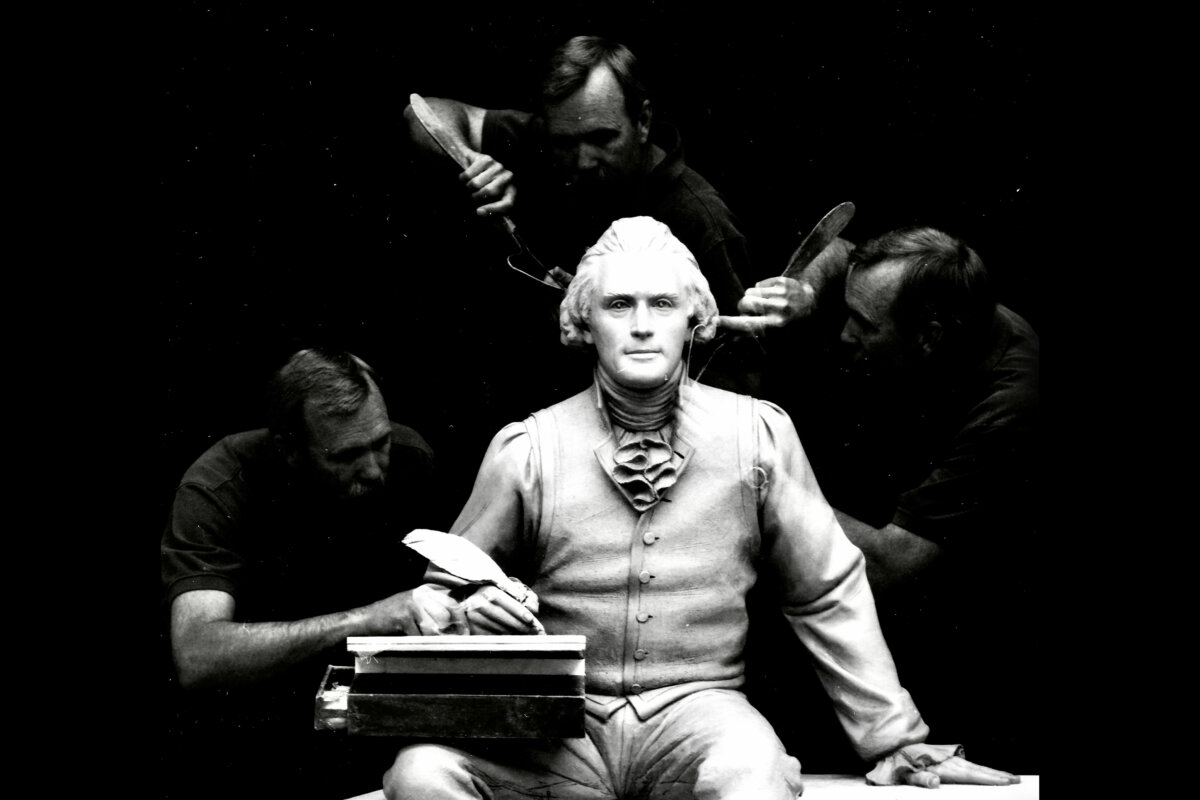

On July 4, Colorado sculptor George Lundeen received a surprise voicemail from President Donald Trump thanking him for his bronze statue of Founding Father Thomas Jefferson.
“Luckily, I was not in my studio when he called. And he left a message on my answering machine, so I was able to keep that,” the 77-year-old artist told The Epoch Times.
The president said in the message: “Hi, George. It’s your favorite president, Donald Trump, and I just wanted to thank you. … It looks really beautiful.
“I’ll see it very shortly, but just from the picture, I can see it’s really incredible. And we have a wonderful place [for it] right in the Rose Garden, and I appreciate it.”
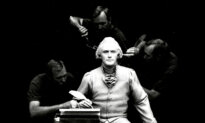
The life-size bronze statue depicting Jefferson seated on a bench with the Declaration of Independence and a feather quill had remained in Lundeen’s studio for nearly 25 years. It now stands in the White House Rose Garden as one of the new monuments Trump added to celebrate America’s 250th birthday.
The person behind the effort to deliver the statue to the president was Steve Barber, Lundeen’s longtime friend and business partner based in Los Angeles.
Barber helps raise funds, works with sculptors, and oversees the creation and installation of statues for the president and other major public projects.
When Barber saw the sculpture in Lundeen’s studio, he felt it belonged at the White House and wanted to donate it as a gift. But getting the attention of White House officials proved far more difficult than he expected.
Barber told The Epoch Times that he spent seven or eight months making nearly 100 phone calls and sending countless emails to the White House and other officials to get approval. After no response, he decided to give up the idea. Then something unexpected happened.
“As soon as I let go, like the second I let go, I got an email from the White House,” Barber said.
The message asked when he could send the sculpture.
“I couldn’t believe it,” Barber said, thrilled by the email he had received at 4 a.m.
The 585-pound sculpture was shipped to Washington a few weeks later, with hopes that it could be installed it in the Rose Garden before the Independence Day celebrations.
However, getting it to the White House was another challenge. A heat wave, road closures, and heightened security measures around the National Mall all delayed its arrival. The Secret Service also needed to complete a security screening.
Lundeen joked that officials had to make sure no one was “sending a Trojan horse in the shape of Thomas Jefferson.”
Nearly a week after Independence Day, Lundeen and Barber finally received a photo from the White House showing the statue installed in the Rose Garden.
The Portable Lap Desk
The new piece now stands alongside four others installed in the Rose Garden: statues of George Washington, Benjamin Franklin, and Alexander Hamilton, and a sculpture called “Freedom’s Charge” depicting two life-size Revolutionary War soldiers.
“It’s an honor to see where people put your sculpture when they put it in a very public place, no matter where it is,” Lundeen said.
Seeing the photo of his statue at the White House was the culmination of an idea that had been sparked nearly 25 years earlier.
The inspiration came when he discovered a mahogany lap desk designed by Jefferson.
Curious about its history, Lundeen did some research and learned that Jefferson had commissioned the portable writing desk from a craftsman in Philadelphia. In June 1776, he used this lap desk in a rented room on Market Street to draft the Declaration of Independence. Jefferson kept and used the desk for the next 50 years.
“I thought that was a pretty cool deal,” Lundeen said.
Inspired by the story, Lundeen collected photos and measurements of the lap desk and made it the centerpiece of his work.
He made 21 copies of the sculpture, which are now displayed in various places around the country. One of them stands next to Thomas Jefferson’s original gravestone at the University of Missouri.
The Statue of Trump
Lundeen has worked as a sculptor since the mid-1970s. He and his brother, Mark, own a sculpting studio in downtown Loveland, Colorado.
Barber, who has collaborated with the Lundeen brothers on several projects, said he considers them among the nation’s finest sculptors.
Among their recent collaborations was the “Defiance Monument,” a seven-foot bronze statue of Trump that was unveiled at Trump International Golf Club in West Palm Beach, Florida, in April 2025.
The sculpture shows Trump raising his fist and was created to commemorate his survival of the July 2024 assassination attempt in Butler, Pennsylvania.
Barber had thought about building Trump’s monument years earlier, but he realized no sitting president had ever had a monument dedicated to him while in office. Since that had never been done, he said, he put the idea aside.
When Trump, then a presidential candidate, was shot in Butler, Barber felt it was the right moment. He called a wealthy friend and said, “Hey, man, we got to build this monument. Let’s help get this guy back in office.”
That friend was Anthony Constantino, founder of the custom sticker company Sticker Mule. He pledged $300,000 that same day, and Barber started working right away.
From Filmmaking to Monument-Making
A filmmaker by profession, Barber produced 10 feature-length documentaries before moving into monument-making about 10 years ago.
Initially, he hadn’t expected the business to be so challenging. “Sometimes ignorance is bliss, you know,” he said.
It was nearly 10 years ago when he first came up with the idea of building the Apollo 11 monument at the Kennedy Space Center and raised $150,000 to fund the project.
“All of a sudden, I found myself in the monument business,” Barber said.
He later raised $750,000 to build an Apollo 13 monument at the Houston Space Flight Center. But when the COVID-19 pandemic hit, fundraising became much more difficult.
“That was the end of easy,” he said.
For a few years, Barber said he couldn’t sell anything. He eventually raised $300,000 each for two monuments of Sally Ride, the first American woman in space—one at the Cradle of Aviation Museum and the other at the Reagan Library. He said those two projects took about four years to fund.
On Oct. 1, Barber will unveil a statue of President Jimmy Carter at the Naval Academy, another project created by Lundeen.
Barber is also working on building three other monuments for Trump’s National Garden of American Heroes. The park, which will feature 250 statues, was planned for West Potomac Park but has been delayed due to legal challenges.
Trump’s notable projects in Washington include building a 250-foot-tall Triumphal Arch and turning the East Wing of the White House into a grand ballroom.
He also rolled out many renovation projects, including restoring the Lincoln Memorial reflecting pool, fixing and cleaning many fountains, and repairing statues throughout the city. He also added new statues, such as an equestrian statue of Founding Father Caesar Rodney to Freedom Plaza for the 250th anniversary.
Trump has repeatedly praised his renovation projects.
“Nobody’s seen anything like it,” Trump told reporters in the Oval Office on July 29. “Washington’s become a beautiful city. It’s become a hot city.”
 Friends Read Free
Copy
Facebook
Tweet
Friends Read Free
Copy
Facebook
Tweet